
Free construction calculators for quick, accurate estimates, measurements, and project planning
Aluminum Weight Calculator
Accurately estimate the weight of aluminum parts based on shape, dimensions, and alloy.
Select Shape
Plate
Round Bar
Tube
Square Tube
Hex Bar
L-Profile
U-Profile
Enter Dimensions
Material & Quantity
$
Your Estimate
Weight per Piece
0.00
lb
Total Weight
0.00
lb
Estimated Cost
$0.00How to Use the Aluminum Weight Calculator
Get a precise weight estimate for your aluminum stock in a few simple steps.
Select Your Shape
Start by choosing the shape of your aluminum piece from the visual selector. The required dimension fields will update automatically.
Enter Dimensions
Input the measurements for your aluminum piece. You can easily switch between inches, feet, millimeters, and other units.
Choose Alloy & Quantity
Select the correct aluminum alloy for an accurate density calculation, then enter the number of pieces you have.
Visual Guide to Weight Calculation
Our tool uses a simple but powerful formula: Weight = Volume × Density. Here's how it works.
Step 1: Calculating Volume
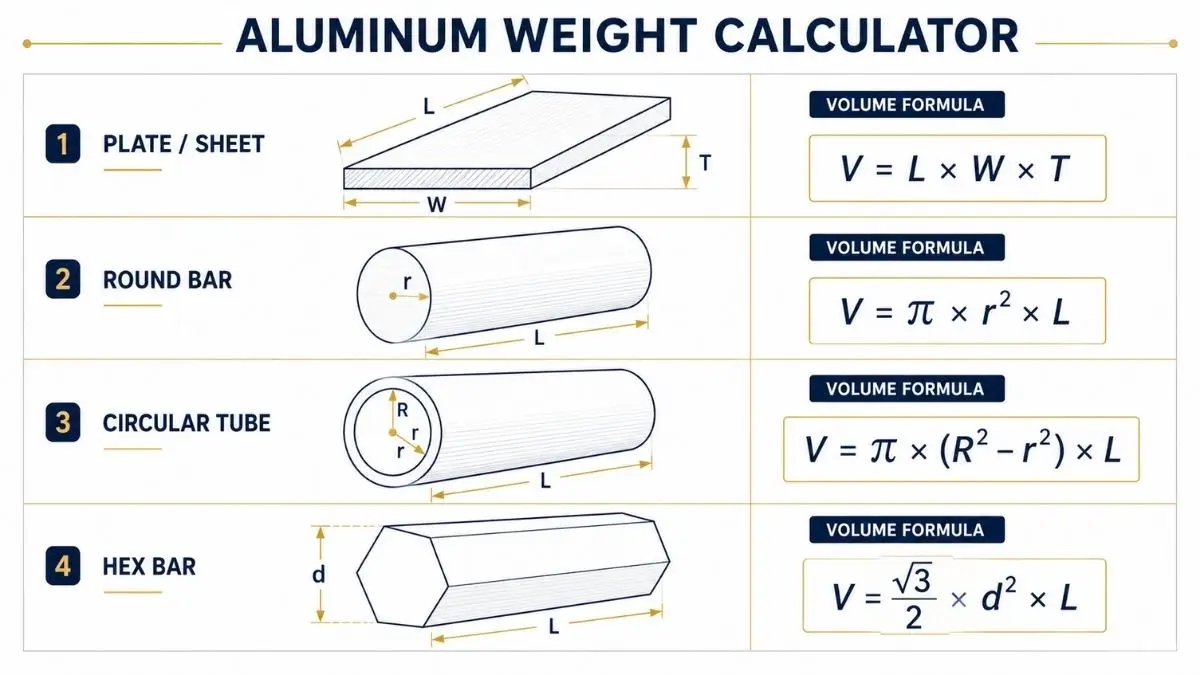
First, the tool calculates the total volume of the object. It uses standard geometric formulas based on the shape you select and the dimensions you provide. For example, for a plate, it's Length × Width × Thickness.
Step 2: Applying Material Density
Next, it uses the known density of the selected aluminum alloy. Different alloys have slightly different densities, which is why choosing the right one is key to an accurate calculation. For example, 7075 aluminum is denser and heavier than 6061 aluminum.
Final Calculation
The tool multiplies the calculated volume by the alloy's density to get the final weight. It then converts this weight to your chosen unit (e.g., pounds or kilograms).
The Formulas: Calculating Volume by Shape
Curious about the math behind the scenes? Here are the geometric formulas used to determine the volume of common shapes before applying material density.
Plate / Sheet
V = L × W × T
Round Bar
V = π × r² × L
Tube
V = π × (R² - r²) × L
Hex Bar
V = (√3 / 2) × d² × L
Which Aluminum Shape Do You Need?
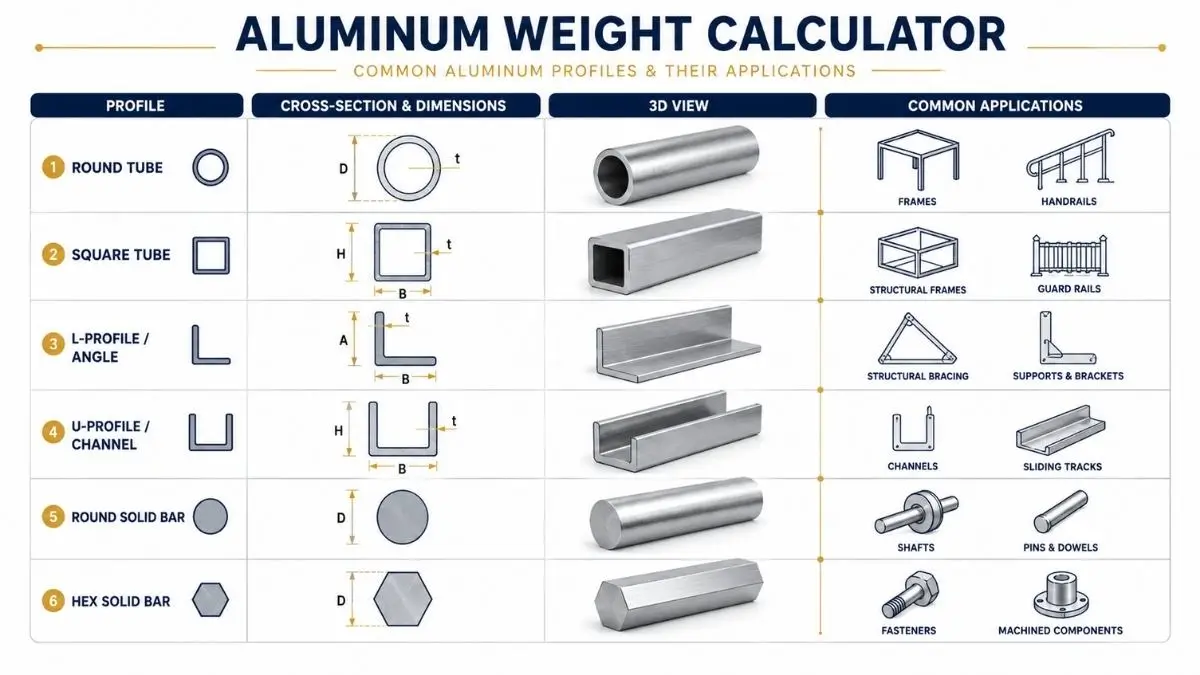
Selecting the right profile is just as important as the alloy. Here’s a quick guide to matching shapes to structural applications.
Tubes & Pipes
Round and square tubes offer the highest strength-to-weight ratio for multi-directional stress and torsional (twisting) loads. Ideal for frames, handrails, and roll cages.
L & U Profiles
Excellent for adding rigidity without the heavy weight of solid stock. L-profiles (angles) are perfect for corner bracing, while U-profiles (channels) excel at edge protection and linear framing.
Solid Bars
Round, square, and hex bars are used when maximum sheer strength is required, or for heavy CNC machining. Common applications include axles, pins, fasteners, and heavy-duty brackets.
A Guide to Common Aluminum Alloys
The type of alloy significantly impacts weight, strength, and corrosion resistance. Here’s a quick guide to the alloys in our calculator.
6061 Alloy (Most Common)
The all-purpose workhorse.
Strength: Good
Corrosion Resistance: Excellent
Common Uses: Structural components, machine parts, bike frames, and general fabrication.
7075 Alloy (High Strength)
Strong as many steels, but lighter.
Strength: Excellent
Corrosion Resistance: Fair
Common Uses: Aerospace components, high-stress applications, molds, and military equipment.
5052 Alloy (Marine Grade)
Excellent for bending and forming.
Strength: Medium
Corrosion Resistance: Excellent
Common Uses: Sheet metal work, boat hulls, fuel tanks, and hydraulic tubes.
1100 Alloy (Pure & Soft)
Commercially pure and highly formable.
Strength: Low
Corrosion Resistance: Excellent
Common Uses: Chemical equipment, food containers, fin stock, and decorative parts.
2024 Alloy (Aerospace)
High strength for demanding applications.
Strength: Very Good
Corrosion Resistance: Poor
Common Uses: Aircraft structures, fuselage components, high-performance auto parts.
3003 Alloy (General Purpose)
Most widely used of all alloys.
Strength: Low-to-Medium
Corrosion Resistance: Excellent
Common Uses: Cooking utensils, ductwork, storage tanks, and heat exchangers.
Pro Tips for Accurate Calculations
Avoid common pitfalls and ensure your weight estimate is as precise as possible.
| Tip / Common Mistake | Why It Matters & How to Do It Right |
|---|---|
| Wall Thickness on Tubes | Forgetting to subtract the hollow center is a common mistake. Our tool calculates the volume of the outer shape and subtracts the inner hollow volume to find the material's true volume and weight. |
| Nominal vs. Actual Size | Manufactured metal has a "tolerance," meaning its actual dimensions can vary slightly. For critical applications, always measure your stock with calipers instead of relying on the listed size. |
| Complex Shapes | For complex shapes not in our calculator, try to break them down into simpler forms (plates, bars, etc.). Calculate the weight of each part and add them together for a total estimate. |
Real-World Sizing & Freight
Crucial logistics to keep in mind when transitioning from an estimated weight to ordering your material.
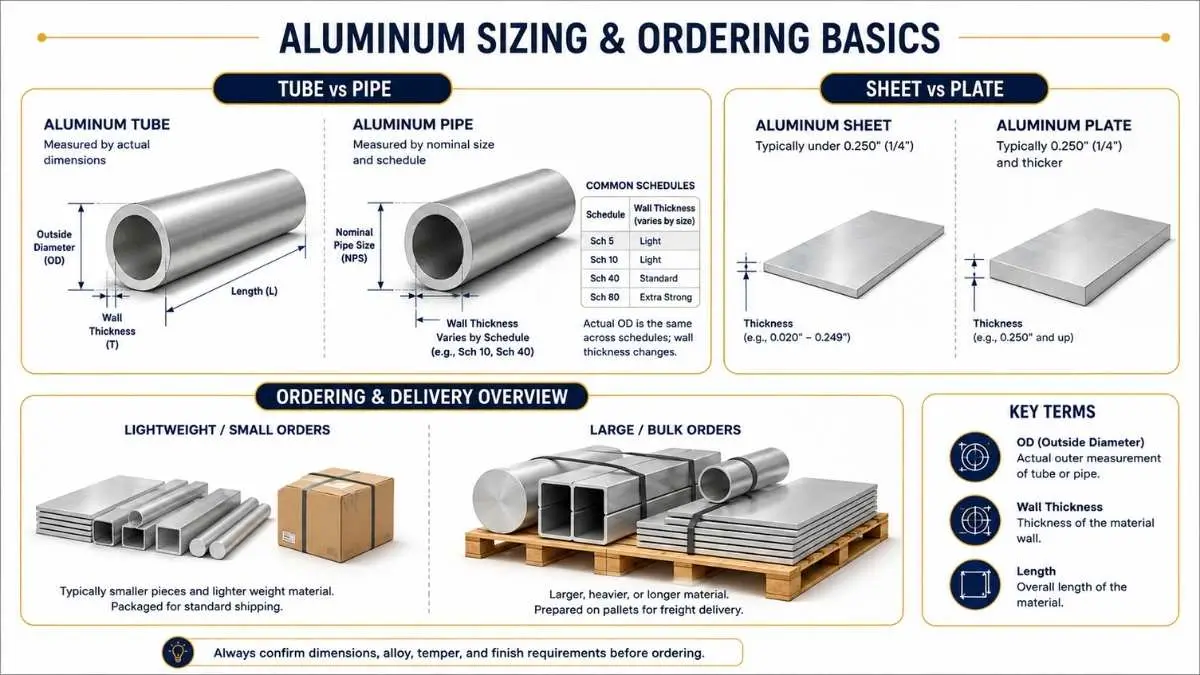
Sizing Terminology
- Tubes vs. Pipes: Tubing is measured by exact Outside Diameter (OD) and wall thickness. Pipes are measured by "Nominal" sizes and "Schedules" (wall thickness), which differ from their actual physical dimensions.
- Sheet vs. Plate: Aluminum under 0.250 inches (1/4") is generally classified as "Sheet" (often measured in gauges). Anything 0.250" and thicker is considered "Plate."
Shipping Thresholds
- Under 150 lbs: Generally qualifies for standard parcel shipping (UPS, FedEx Ground). Packages over 50 lbs usually require a "Team Lift" warning label.
- Over 150 lbs (or long lengths): Will almost certainly require LTL (Less-Than-Truckload) Freight shipping. Material will arrive on a pallet and requires a forklift, loading dock, or liftgate service for delivery.
Frequently Asked Questions (FAQ)
The weight depends on its thickness and alloy. For example, a common 1/8" (0.125 inch) thick 4x8 sheet of 6061 aluminum weighs approximately 59.8 pounds. You can use our calculator to find the exact weight for any thickness.
Steel is significantly heavier. On average, steel is about 2.5 to 3 times denser than aluminum. This is why aluminum is a popular choice in industries like aerospace and automotive where high strength-to-weight ratio is critical.
This is usually due to manufacturing tolerances. A bar listed as 1" in diameter might actually be 1.005". While small, these differences can add up over a long piece. The densities used are also averages for a given alloy. For most purposes, the calculated weight is a very reliable estimate for shipping and project planning.
The calculator simplifies this. It calculates the area of the two "legs" of the L-shape, making sure not to double-count the corner where they overlap. It then multiplies this cross-sectional area by the length to get the volume, and finally multiplies by the alloy's density to find the weight.
What Our Users Say
Sarah Lauren
Metal Fabricator
"I use this tool daily to quote jobs. The new shapes like L-profile and hex bar make it indispensable. It's fast, accurate, and saves me from doing tedious math by hand."
Alex Johnson
Weekend Warrior
"Perfect for my DIY garage projects. The feet & inches input is a huge plus. Made figuring out the weight for my aluminum workbench frame a breeze."
Brenda Kelly
Architect
"Good for quick estimates on structural elements. The L-Profile and U-Profile shapes are very helpful for preliminary designs. Would love to see T-beams added in the future!"
Mike Reynolds
Logistics Manager
"Calculating freight costs for metal shipments is a huge part of my job. This tool is a lifesaver for getting quick, reliable weight estimates so I can accurately book shipping."
Tom Wallace
Art Student
"Helpful for my sculpture projects to estimate material costs and check if I can lift the final piece! The interface is easy but sometimes it's a bit slow to update on my old laptop."
David Chen
Engineering Student
"Perfect for my materials science class. The alloy guide is a great touch. The 'share with results' feature is awesome for including calculations in my project reports."