
Free construction calculators for quick, accurate estimates, measurements, and project planning
Baluster Calculator
Calculate balusters (spindles) and spacing for your level deck or porch railing.
Railing Measurements
Total end-to-end length of the railing system.
Total posts, including start and end posts.
The thickness of a single post (e.g., 4x4 post is 3.5 in).
The thickness of a single baluster or spindle.
Spacing Requirements
Typically 4 inches (or 10 cm) to meet building codes.
Your Baluster Calculation
Total Balusters
0Spindles needed
Actual Spacing
0 inSpace between balusters
Detailed Breakdown
Total Railing Length:0 in
Number of Posts:0
Post Width:0 in
Number of Sections:0
Total Open Span:0 in
Length per Section:0 in
Baluster Width:0 in
Balusters per Section:0
Total Balusters Needed:0
Spaces per Section:0
Actual Spacing:
0 in
Do you like this calculator?
How to Use the Baluster Calculator
Get your exact baluster count and spacing for your deck or porch in six simple steps.
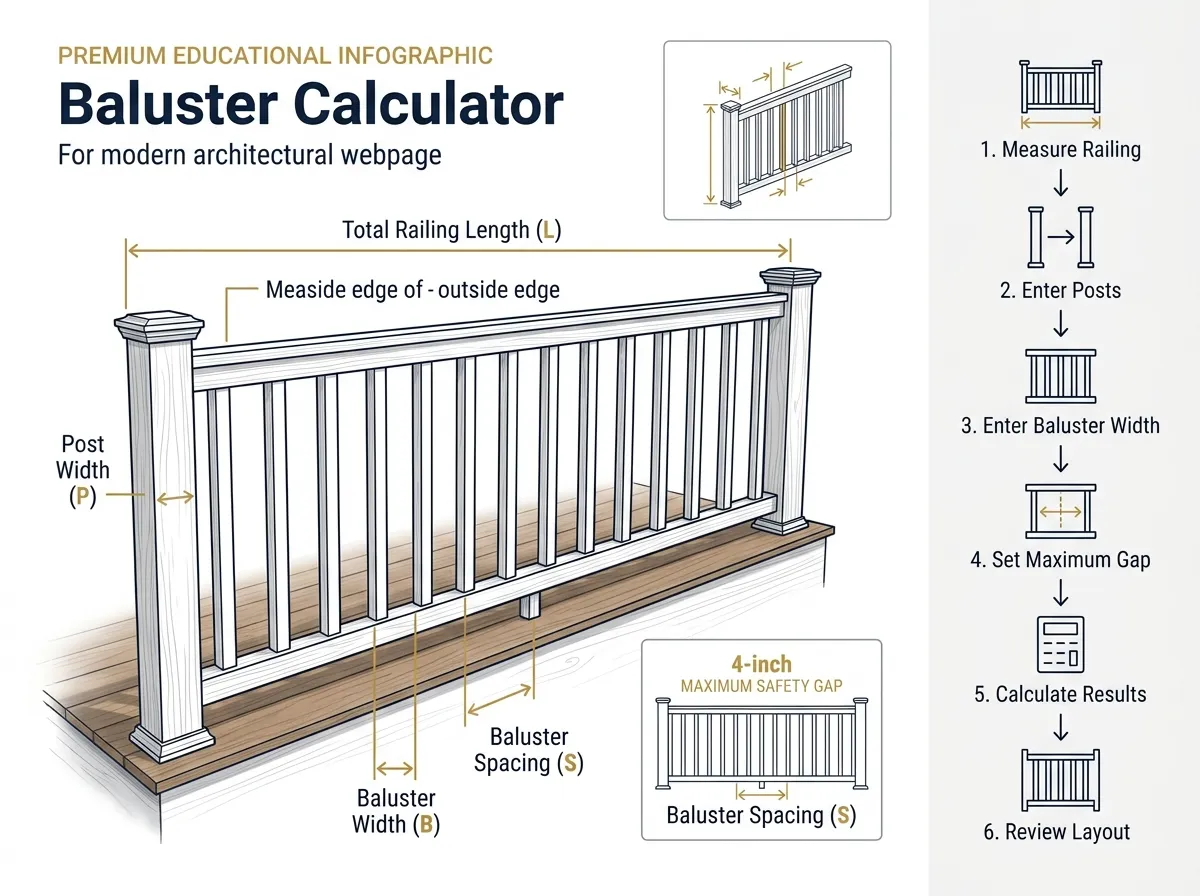
Measure Total Length
Measure the total, end-to-end length of your deck railing system, from the outside of the first post to the outside of the last post.
Enter Post Details
Enter the total number of posts in the railing run (e.g., 2 for one section) and the width of a single post (e.g., 3.5 in for a 4x4).
Enter Baluster Width
Measure and enter the width (thickness) of a single spindle or baluster you plan to install (e.g., 1.5 in).
Set Max Spacing
Enter your local building code's maximum allowed gap. This is typically 4 inches (10 cm) to ensure safety.
Review Your Results
Instantly see the 'Total Balusters Needed' and the 'Actual Spacing' for your project, ensuring it's code-compliant.
Check the Breakdown
View the detailed breakdown to understand balusters per section, open span measurements, and other key details.
Why Use Our Deck Baluster Calculator?
Our tool provides safe, accurate, and fast calculations for any level deck or porch railing project.
Ensure Building Code Compliance
Our logic guarantees your "Actual Spacing" will be safe and less than or equal to your maximum allowed gap, ensuring you pass inspection.
Handles Multi-Section Railings
Unlike simple calculators, this tool correctly accounts for multiple posts in your deck railing, calculating the open span between each post.
Instant & Error-Free
Stop doing complex math by hand. Get the exact baluster count and spacing measurement you need for installation in seconds.
Key Factors in Your Baluster Calculation
Understanding these variables is the key to a successful deck railing installation.
The "4-Inch Rule" (Building Code)
Nearly all building codes mandate that the space between balusters must be small enough to prevent a 4-inch (10 cm) sphere from passing through.
This is the #1 safety priority, and our calculator ensures you meet it.
Open Span (Length Per Section)
The most common mistake is to measure the total railing length. The actual measurement needed is the "open span"—the distance between posts.
Our deck baluster calculator finds this for you automatically.
Baluster Width
The thickness of your balusters directly affects the calculation. Thicker balusters (e.g., 2.5 in) take up more space.
This means you'll need fewer of them per section compared to thinner balusters (e.g., 0.75 in metal spindles).
Number of Spaces vs. Balusters
This simple concept trips up many DIY deck builders. There is always one more space than there are balusters in a section (e.g., 10 spindles create 11 spaces).
Our algorithm handles this logic perfectly.
Pro-Tips for a Perfect Installation
Use these tips to make your installation smooth, professional, and code-compliant.
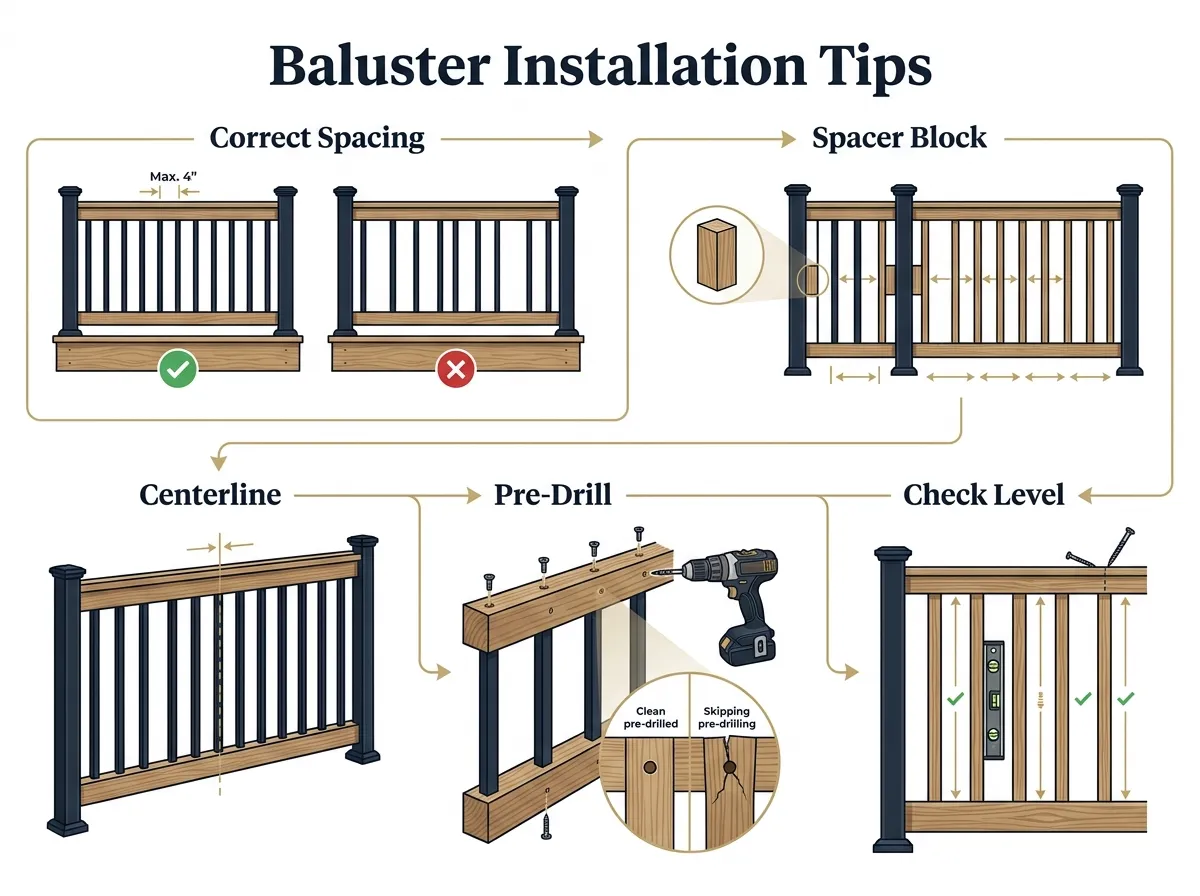
A visual comparison of correct, code-compliant spacing vs. incorrect, unsafe spacing.
Make a Spacer Block
This is the #1 pro tip. Once you have your "Actual Spacing" from our baluster spacing calculator, cut a scrap piece of 2x4 to that exact width. Use this block as a template between each spindle for perfect, consistent spacing.
Mark Centerlines
For a visually balanced look, find the exact center of each railing section. Mark the centerline for your first baluster there, and then work your way out towards the posts using your spacer block.
Pre-Drill Your Holes
Always pre-drill holes for your baluster connectors or screws. This prevents the wood on your deck rails from splitting and ensures a stronger, cleaner connection.
Use a Level (Twice!)
Use a small level on every single baluster to ensure it's perfectly plumb (vertical). Check it once, fasten the bottom, then check it again before fastening the top.
Common Baluster Materials
The material you choose affects your project's look, maintenance, and cost.
Wood Balusters
Classic, affordable, and easy to paint or stain. Pressure-treated pine is common, while cedar offers natural rot resistance.
Requires regular maintenance (sealing/staining) to prevent rot.
Metal Balusters
Typically made from powder-coated aluminum or steel. Very durable, low-maintenance, and offers a modern look.
Aluminum is lightweight and won't rust. Steel is heavier and stronger.
Composite Balusters
Designed to match composite decking. Made from a blend of wood fibers and plastic. Extremely low-maintenance and won't rot, warp, or splinter.
A higher upfront cost but lasts for decades.
Frequently Asked Questions (FAQ)
This is the most common building code requirement for deck and porch railings. It states that the open space between any two balusters (or between a baluster and a post) must be small enough that a 4-inch-diameter sphere cannot pass through it.
This is a safety measure, primarily for children. Our calculator ensures your "Actual Spacing" will always be at or below this maximum limit.
This calculator is designed specifically for horizontal (level) railings, such as for decks, porches, and landings. Calculating baluster spacing on stairs is more complex and this tool should not be used for it.
Why is stair baluster calculation different?
- Angles: The railing runs at an angle (e.g., 30-37 degrees), not level.
- Measurement: The 4-inch spacing rule is measured differently. You must ensure a 4-inch sphere cannot pass through the gap at any point, especially at the "V" where the baluster meets the bottom rail.
- Connectors: Stair balusters require angled connectors or holes drilled at an angle.
While we don't have a specific stair baluster spacing calculator at this time, you must always follow the 4-inch rule and your baluster manufacturer's specific instructions for angled stair installation.
This is normal and correct! To fit a whole number of balusters into your deck railing section, the spacing must be divided perfectly. For example, to be safe, the tool rounds up to the nearest whole baluster (e.g., from 9.2 to 10 balusters).
Adding that 10th baluster reduces the "Actual Spacing" to be slightly less than 4 inches (e.g., 3.85 inches). This ensures your railing is both safe and visually even.
These terms are used interchangeably. "Baluster" is the more formal, architectural term. "Spindle" is a very common, informal term used by homeowners and contractors, especially for wood balusters.
They mean the same thing: the vertical supports in a railing system. Our calculator works for both.
"Actual Spacing" (what our tool provides) is the physical, open-air gap between balusters. This is the measurement an inspector will check with the 4-inch rule.
"Center-to-Center" is the distance from the middle of one baluster to the middle of the next. Pro installers sometimes use center-to-center for marking, but "Actual Spacing" is what you need to verify code compliance.
If your deck railing turns a corner, you should treat each straight section as a separate project. Calculate each straight run (e.g., from the house to the corner post, then from the corner post to the end post) one at a time using the calculator.
What Our Users Are Building
Alex Johnson
DIY Builder
This calculator was a lifesaver for my 24-foot deck railing. It correctly calculated my 3 sections and told me I needed 11 spindles per section. My spacing was perfect and it passed inspection!
Sarah Chen
Landscaper
This is the best deck baluster calculator online. The fact that it accounts for post width and multiple sections makes it the only one I trust to give my clients a quick, accurate materials estimate. 5 stars.
Mike Rivera
Handyman
I was so confused about whether to include post width in my measurements. This simple baluster calculator made it clear. Entered my length, posts, and spindle size, and got the exact spacing. My porch railing looks amazing!
David Kim
Home Renovator
I was skeptical about another online calculator, but this one is legit. The multi-section feature is a game-changer. It saved me from buying way too many metal spindles for a client's 40-foot porch. Definitely bookmarking this.
Emily Tran
First-time DIYer
Honestly, I was so intimidated by the 4-inch rule! This calculator made it foolproof. I just plugged in my numbers, and it told me exactly what spacing to use. My deck railing looks professional, and I built it myself!
Greg Cooper
Retired Carpenter
Been doing this for 30 years, and I usually just do the math in my head. Tried this tool for a small job, and I'll be damned, it's spot on. The spacer block tip is exactly what I tell apprentices. Good, solid tool.