
Free construction calculators for quick, accurate estimates, measurements, and project planning
Gallons Per Square Foot Calculator
Determine material coverage and volume for any project.
Calculate Area
Calculation Results
Total Volume
0.00
Coverage Rate
0.000
/ sq ft
What Is Gallons Per Square Foot?
"Gallons per square foot" is a measurement of liquid volume (gallons) distributed over a specific surface area (square feet). It is primarily used to determine the application or coverage rate of materials like epoxy coatings, concrete sealants, paints, and self-leveling compounds.
Understanding this rate allows you to figure out exactly how much material you need to purchase to achieve your desired depth across your entire project, ensuring you have enough coverage without over-ordering.
How to Calculate Gallons Per Square Foot
Get precise material estimates for your project in a few simple steps.
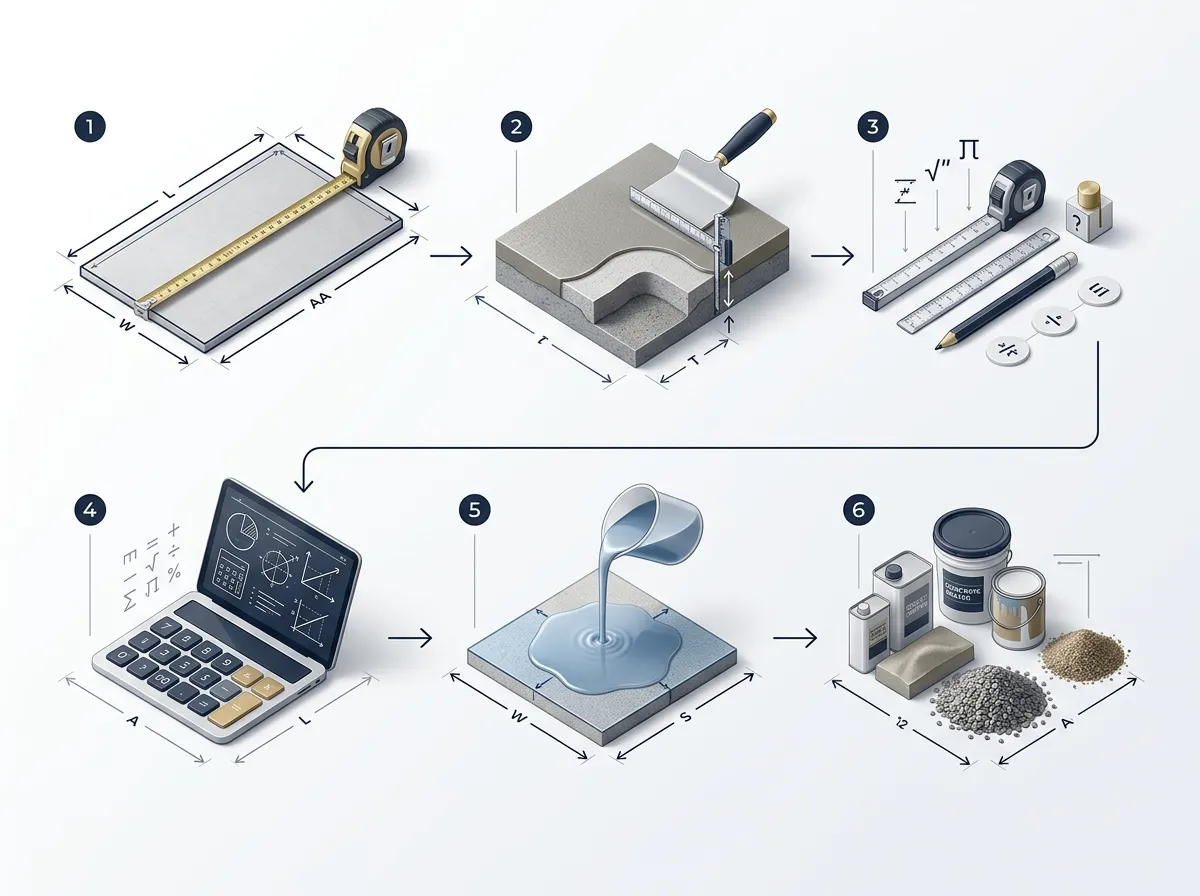
Measure Your Space
Begin by measuring the length and width of the area you intend to cover. For non-rectangular areas, calculate the total square footage first and enter it directly into the "Area" field.
Define the Thickness
Input the desired height (or depth) of the material. This could be the thickness of an epoxy coat, the depth of a new garden bed, or a layer of gravel for a pathway.
Check Your Units
Double-check that you've selected the correct measurement units (e.g., feet, inches, meters) for each input to ensure your final calculation is perfectly accurate.
Get Instant Volume
The calculator instantly computes the total volume of material required. You can easily switch between gallons, liters, cubic feet, and other units to match your needs.
Understand Coverage Rate
The final field shows the volume of material used per square foot. This is vital for comparing your plan against the recommended coverage rate on your product's label.
Plan and Purchase
With your precise volume calculation, you can now confidently purchase the right amount of material. Remember to add a little extra (5-10%) to account for waste!
Visual Guide to Volume & Coverage
Understanding the relationship between area, depth, and volume is key to accurate material estimation.
The calculator uses a simple, powerful formula: Area × Height = Volume. This tells you the total amount of material needed to fill your space to the desired depth.
Understanding the Formulas
Our tool simplifies complex conversions, but here’s the logic behind the calculations:
- Area: Length × Width
- Volume: Area × Height
- Coverage Rate: Total Volume / Total Area
The "Gallons per square foot" result is your application rate. For example, if the result is 0.1 gal/sq ft, it means that for every square foot of your area, you will be applying 0.1 gallons of material. This is the number you should compare to your product's technical data sheet.
Project Tip
Always purchase slightly more material than calculated (5-10% extra) to account for spills, uneven surfaces, or measurement errors. It's better to have a little leftover than to run out mid-project.
Gallons Per Square Foot by Thickness
See how material coverage changes as your application depth increases. Use these common industry benchmarks for quick reference.
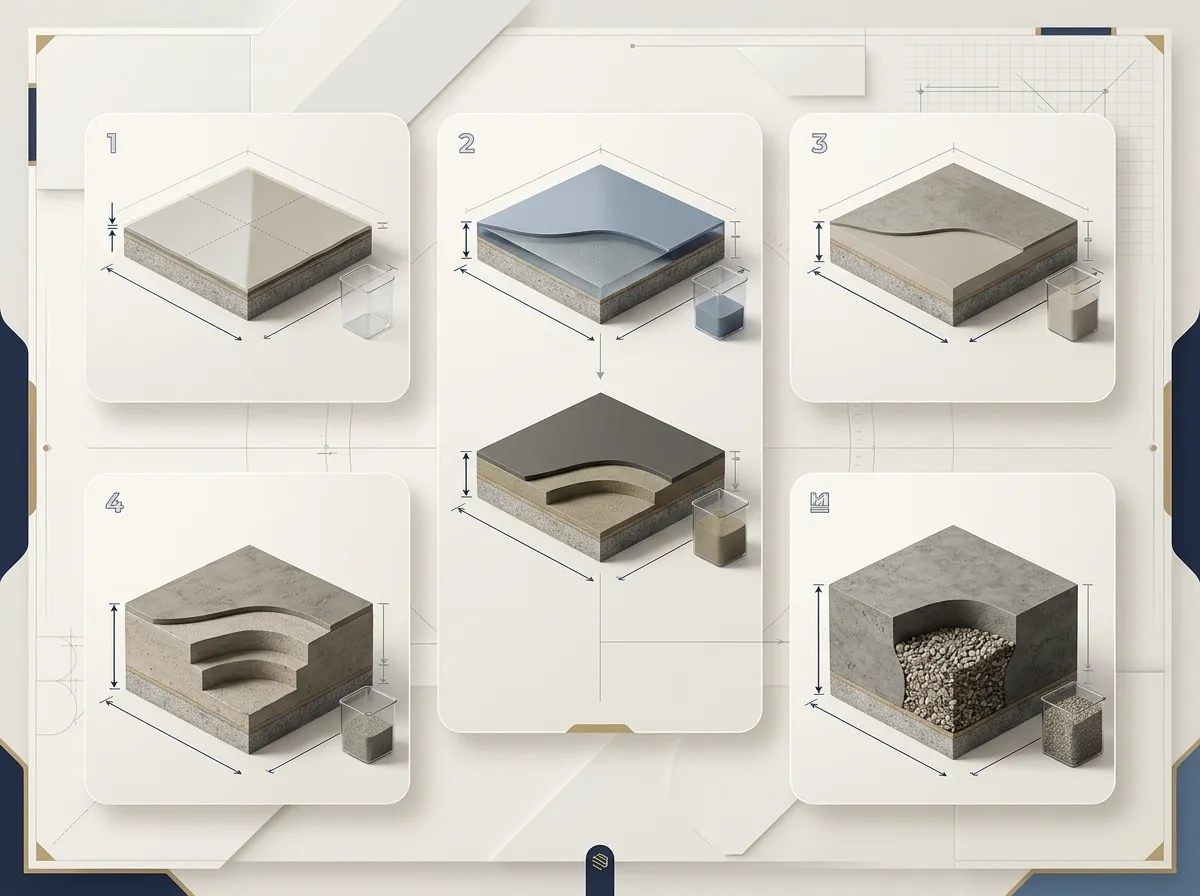
Thin Coat
1/16"
Thin Floor Coatings
Ideal for sealers, clear topcoats, and light protective layers.
Coverage Rate:
0.039 gal/sq ft
Standard
1/8"
Epoxy Self-Leveling
Standard thickness for durable epoxy floors and high-build paints.
Coverage Rate:
0.078 gal/sq ft
Medium
1/4"
Overlayments & Mortar
Great for thin overlayments and heavy-duty resurfacing beds.
Coverage Rate:
0.156 gal/sq ft
Heavy Duty
1/2"
Concrete Resurfacing
Used for deep patching, resurfacing, and thick self-levelers.
Coverage Rate:
0.312 gal/sq ft
Maximum Depth
1"
Deep Pours & Landscaping
Designed for deep structural repairs, slab pouring, ponds, or landscaping materials.
Coverage Rate:
0.623 gal/sq ft
How Much Material Do I Need?
Follow these 4 simple steps to estimate your total volume and determine exact purchasing needs.
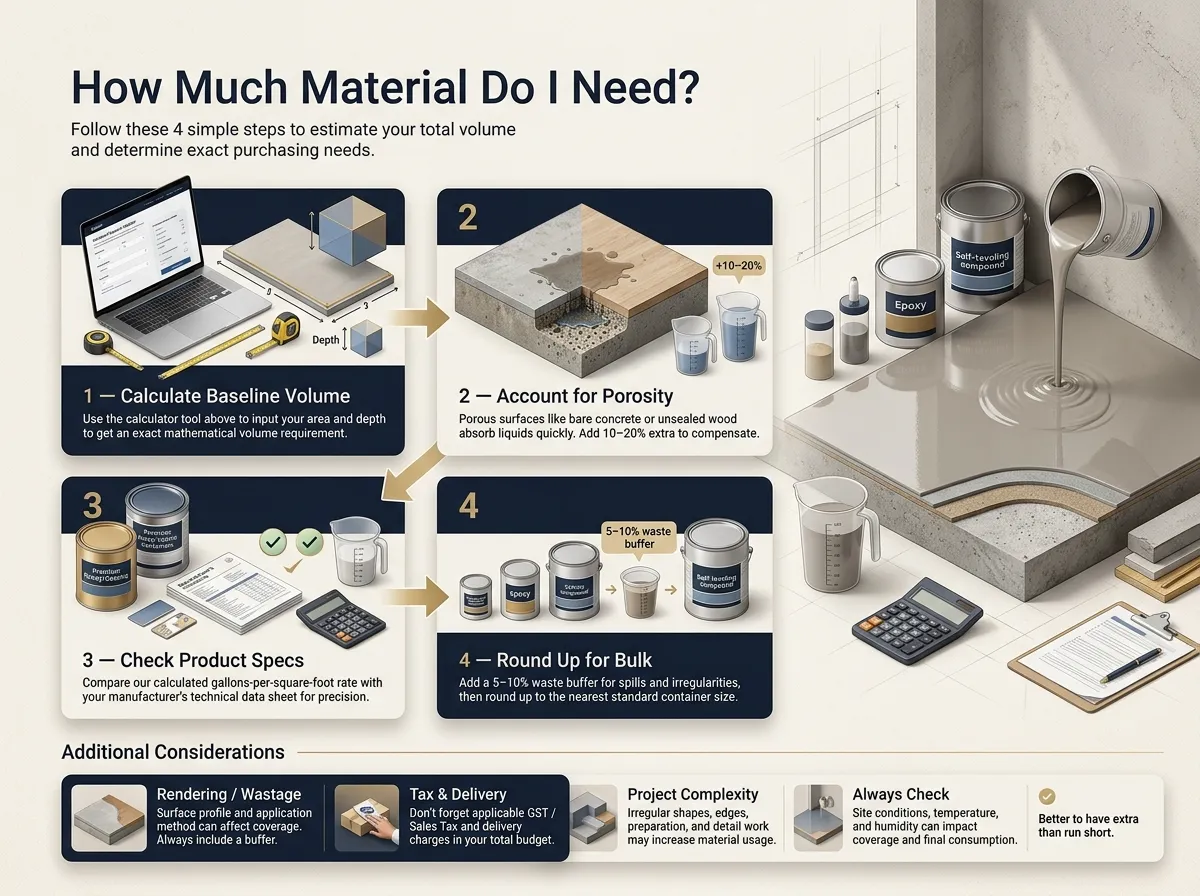
1
Calculate Baseline Volume
Use the calculator tool above to input your area and depth to get an exact mathematical volume requirement.
2
Account for Porosity
Porous surfaces like bare concrete or unsealed wood absorb liquids quickly. Add 10-20% extra to compensate.
3
Check Product Specs
Compare our calculated gallons-per-square-foot rate with your manufacturer's technical data sheet for precision.
4
Round Up for Bulk
Add a 5-10% waste buffer for spills and irregularities, then round up to the nearest standard container size.
Pro Tips for Accurate Material Estimation
Avoid common pitfalls and ensure your project is a success with these expert tips.
| Tip / Common Mistake | Why It Matters & How to Do It Right |
|---|---|
| Accounting for Waste | Always add 5-10% to your final volume. This "waste factor" covers spills, surface irregularities, and material left in the container. It’s much cheaper than running out and making a second purchase. |
| Measuring Irregular Areas | Don't just guess. Break down L-shapes, circles, or other complex areas into simple rectangles and triangles. Calculate the area of each, add them together, and enter the total in the "Area" field. |
| Forgetting Obstructions | Forgetting to subtract the area of large obstructions (like a kitchen island on a floor or a large boulder in a garden bed) is a common mistake that leads to over-buying material. Calculate their area and subtract it from your total. |
| Ignoring Product Specs | Your material's Technical Data Sheet (TDS) is your best friend. It will list a recommended coverage rate (e.g., "100 sq ft per gallon"). Compare this to the calculator's "Gallons per square foot" result to ensure they align. |
Frequently Asked Questions (FAQ)
This calculator is incredibly versatile! It works for liquids like epoxy resin, concrete sealers, paint, and self-leveling compounds. It's also perfect for calculating volumes of loose materials like garden soil, mulch, sand, or gravel for pathways and flower beds.
For a simple, uniform slope, the most effective method is to find the average height. Measure the height at the highest point and the height at the lowest point of the slope. Add those two numbers together and divide by two. Use this average height in the calculator for an accurate volume estimate.
This is an important distinction! A UK (or Imperial) gallon is about 20% larger than a US gallon. One UK gallon is equal to about 1.2 US gallons. Be sure to check which unit your material is sold in, especially if you're buying from an international supplier. Our calculator can convert between them for you.
The definition of a gallon has changed over time and by region. The two most common today are the US gallon (approximately 3.79 liters) and the larger UK Imperial gallon (approximately 4.55 liters). While a "dry" gallon also exists for measuring things like grain, our calculator focuses on the liquid US and UK gallons used for project materials.
Our calculator works by converting every input you provide into a consistent internal standard (cubic feet). It performs the core calculation (Area in ft² × Height in ft = Volume in ft³) and then converts the final result back into whichever output unit you've selected (like gallons, liters, etc.). This ensures accuracy no matter how you mix and match your input units.
What Our Users Say
Sarah Lee
Pool Contractor
"Used this to calculate the sealant needed for a concrete pool deck. The unit conversions are a lifesaver when dealing with different supplier specs. Saved me from over-ordering."
Tom Wilson
DIY YouTuber
"My go-to for project planning videos! Whether it's a garage floor epoxy or a gravel path, this calculator gives my viewers (and me!) an accurate estimate every time. The share-with-results feature is killer."
Brenda Carter
Facility Manager
"Needed to figure out cleaning solution volume for stripping and waxing our office floors. This tool made it incredibly simple. Bookmarked."
David Chen
Urban Gardener
"This gallons calculator is a game-changer for planning my raised garden beds. I can figure out the exact amount of soil I need in seconds. No more guesswork or wasted bags from the store!"
Maria Garcia
General Contractor
"I have this page bookmarked on my work tablet. It's essential for quoting jobs that involve self-leveling compounds or epoxy coatings over large warehouse floors. Fast, accurate, and professional."
Kevin Robinson
Pond Hobbyist
"I used this gallons calculator to figure out the water volume for my new koi pond. It was surprisingly accurate and helped me buy the right size pump and filter. Highly recommended."
Emily White
Industrial Painter
"Estimating thick, high-solid floor coatings is tricky. This calculator lets me input thickness in mils (by converting to inches first) and get a perfect volume. Invaluable for my line of work."