
Free construction calculators for quick, accurate estimates, measurements, and project planning
Square Feet to Cubic Yards Calculator
Easily calculate exact material volume for concrete, soil, gravel, sand, and mulch projects.
Enter Your Measurements
Total Volume Needed
-
Cubic Yards (yd³)
Equivalent To
-
Cubic Feet (ft³)
Did this calculator solve your problem?
How Square Feet Converts to Cubic Yards
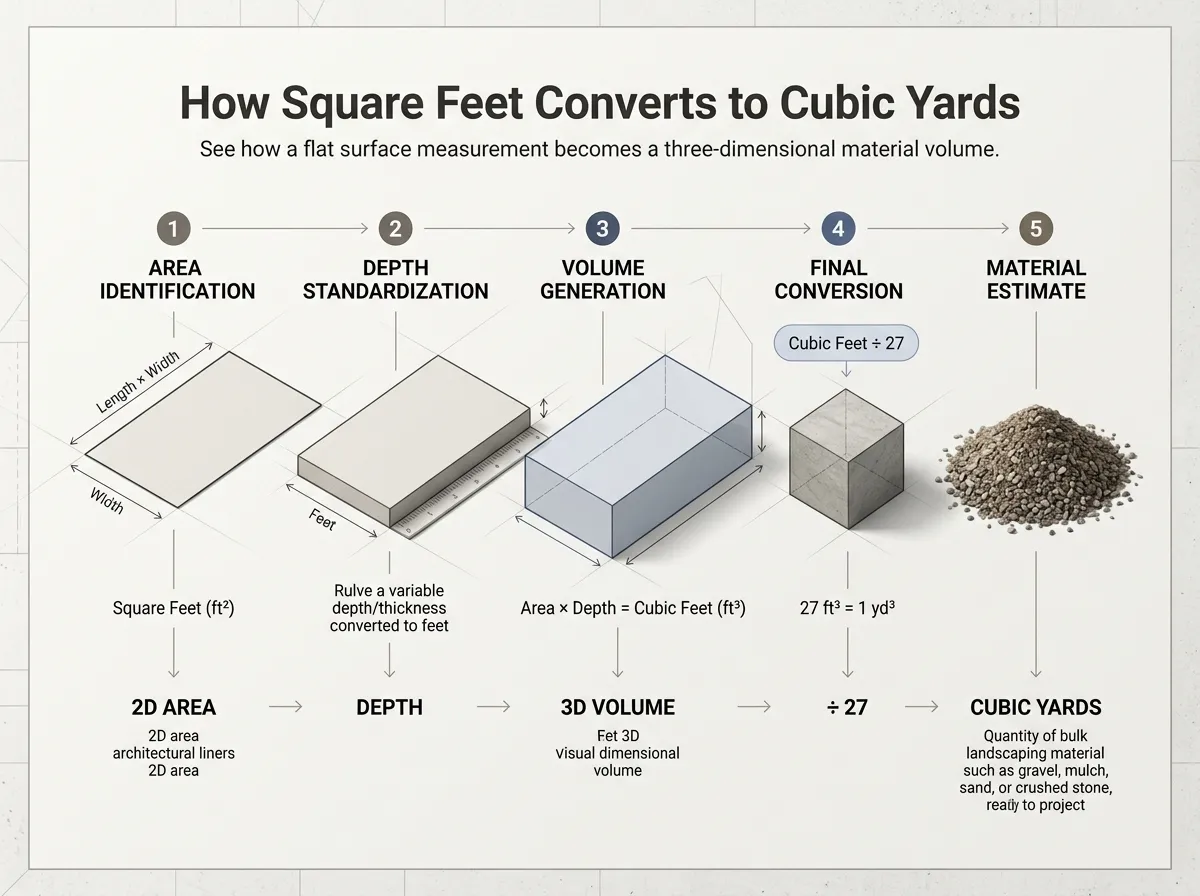
Our calculator simplifies 3D volume geometry into a few easy steps. Here is the process it follows to give you an accurate material estimate.
1. Area Identification
The tool takes your flat, two-dimensional area measurement and seamlessly standardizes it into square feet, regardless of the starting unit.
2. Depth Standardization
It converts any depth or thickness measurements (like inches or centimeters) into standard feet to ensure dimensional consistency.
3. Volume Generation
By multiplying the square footage by the standardized depth, the calculator mathematically expands the 2D plane into a 3D volume (cubic feet).
4. Final Conversion
Finally, the tool divides the total cubic feet by 27 (since there are 27 cubic feet in one cubic yard) to provide your final bulk material estimate.
Common Uses for Cubic Yard Calculations
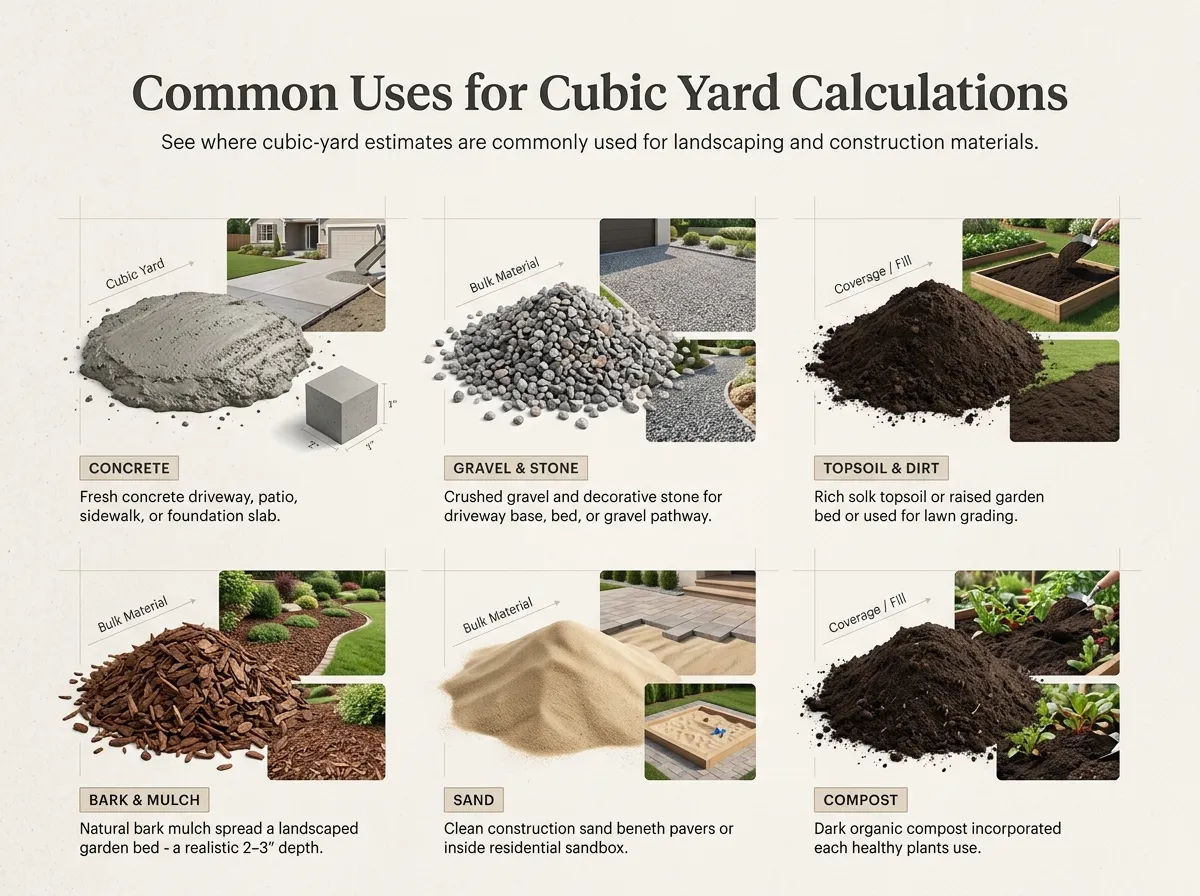
Volume calculations are critical for ordering bulk landscaping and construction materials. Here is what this tool is commonly used for.
Concrete Slabs
Calculate precise cubic yards required for pouring driveways, patios, foundation slabs, and sidewalks. Ordering the right amount prevents cold joints.
Gravel & Stone
Estimate gravel for drainage beds, decorative pathways, or driveway bases. Remember that gravel may settle and require slight over-ordering.
Topsoil & Dirt
Perfect for determining volume needed to fill raised garden beds, grade a lawn, or replace excavated earth. Fluffed soil will compact over time.
Bark & Mulch
Find out exactly how many yards of mulch you need to cover garden beds to a standard 2 to 3-inch depth for optimal weed suppression.
Sand
Calculate the volume of sand required for masonry work, paver leveling bases, children's sandboxes, or improving heavy clay soils.
Compost
Accurately determine the cubic yards of compost required to amend large agricultural spaces, lawns, or new planting beds.
Understanding Volume and Area Units
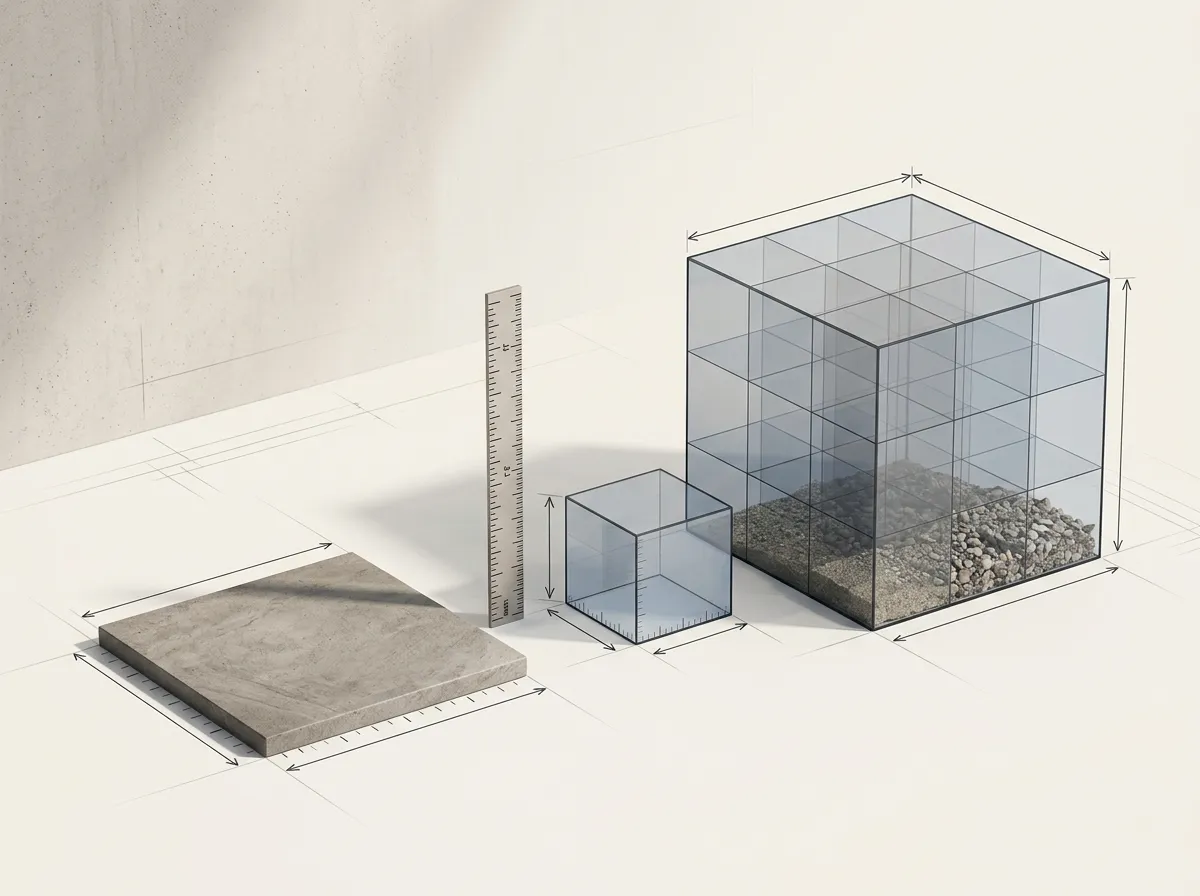
Get to know the relationship between 2D area and 3D volume to make your project planning seamless.
Square Foot (ft²)
A 2D measurement representing an area 1 foot long by 1 foot wide. It does not possess depth.
Inch (in)
The most common unit for material depth. There are 12 inches in a standard foot.
Cubic Foot (ft³)
A 3D measurement of volume. It represents a block that is 1 foot wide, 1 foot long, and 1 foot deep.
Cubic Yard (yd³)
The standard bulk material unit. It equals 27 cubic feet (a block 3 ft × 3 ft × 3 ft).
Pro Tips for Accurate Material Estimation
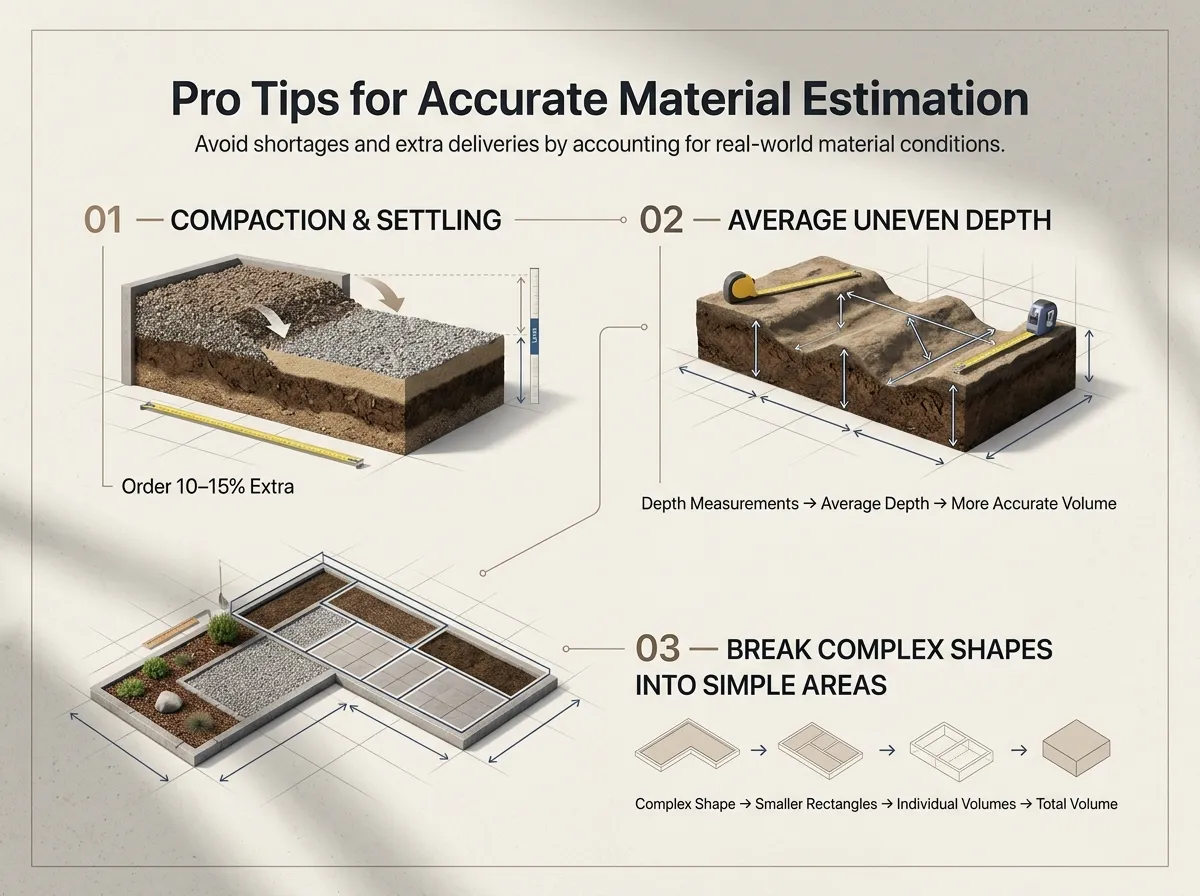
Avoid material shortages and costly extra deliveries with these expert volume estimation tips.
Account for Compaction and Settling
Materials like dirt, gravel, and sand settle after delivery and installation. Always order 10% to 15% more material than your raw mathematical volume to account for this shrinkage.
Average Uneven Depths
If you are filling a trench or a yard with uneven terrain, measure the depth in several different spots. Add those measurements together and divide by the number of spots to find an accurate average depth.
Break Complex Shapes into Rectangles
For L-shaped patios or curved garden beds, break the total area down into smaller, simpler squares or rectangles. Calculate the volume for each piece separately, then add the cubic yards together.
How to Calculate Cubic Yards from Square Feet
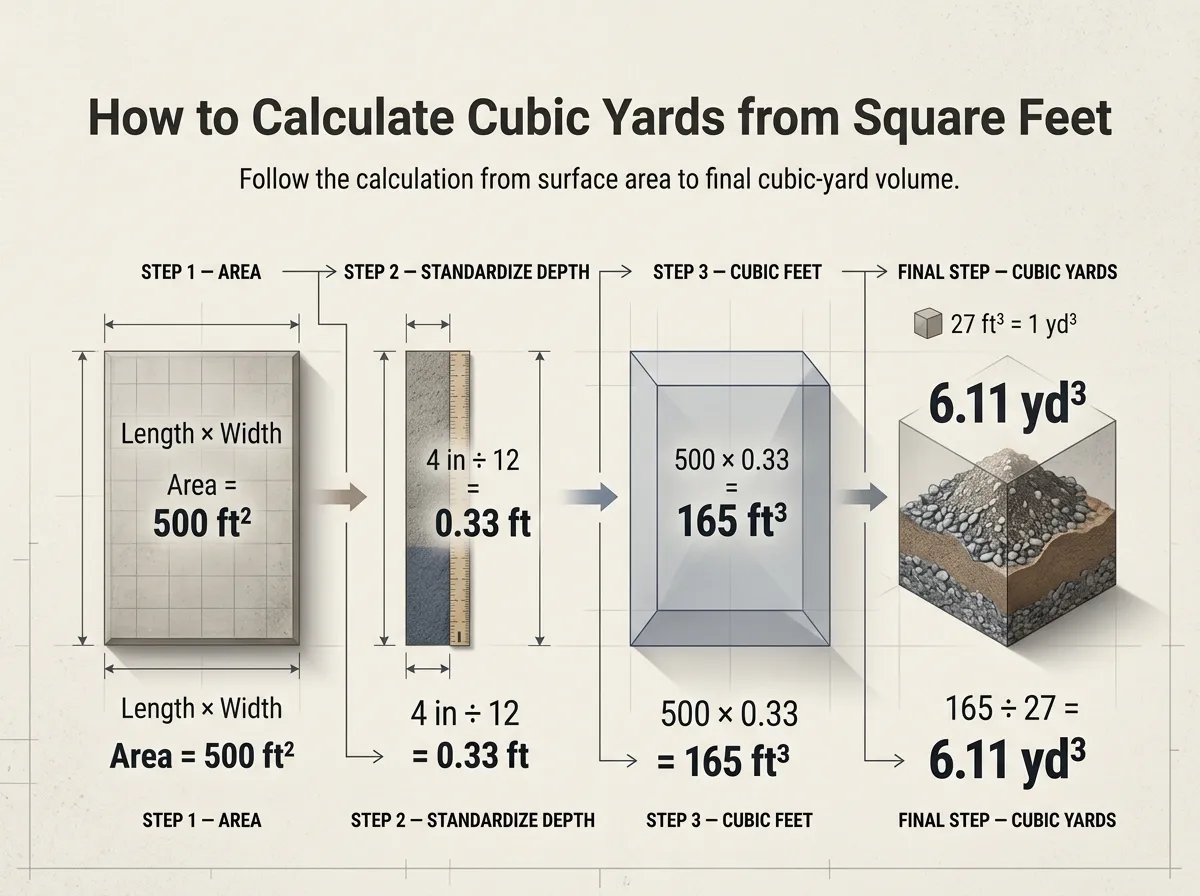
Understanding the math behind the conversion helps ensure accurate ordering. Here is the step-by-step flow our calculator uses to convert a 2D area into a 3D bulk volume.
Step 1
Area (Square Feet)
Determine your 2D area footprint (Length × Width).
Area = 500 ft²
Step 2
Standardize Depth
Convert depth into standard feet (Inches ÷ 12).
4 in ÷ 12 = 0.33 ft
Step 3
Cubic Feet
Multiply the Area by the standardized Depth.
500 × 0.33 = 165 ft³
Final Step
Cubic Yards
Divide the total Cubic Feet by 27.
165 ÷ 27 = 6.11 yd³
How Much Material Do I Need in Cubic Yards?
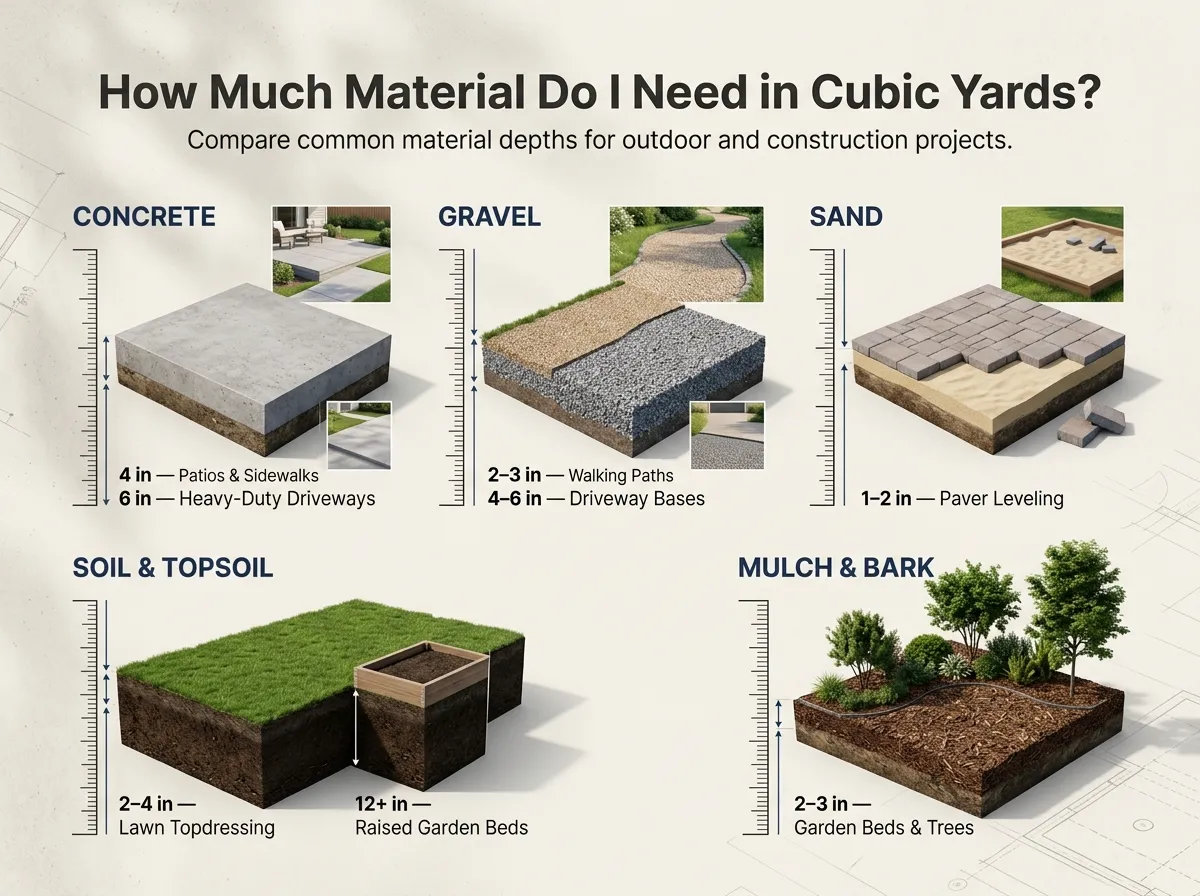
Different outdoor and construction projects require specific material depths. Here is a quick reference guide to help you estimate the volume for common applications.
Concrete
Typically poured at a depth of 4 inches for standard patios and sidewalks, or 6 inches for driveways carrying heavy vehicles.
Gravel
Requires 2 to 3 inches for general walking paths, or 4 to 6 inches for strong driveway bases to ensure proper drainage.
Sand
Usually applied at a 1 to 2 inch depth for leveling under pavers and stones, or ordered in larger bulk depths for play sandboxes.
Soil & Topsoil
Depths vary widely. 2 to 4 inches is standard for topdressing lawns, while filling new raised garden beds often requires 12+ inches.
Mulch & Bark
Best applied at a standard 2 to 3 inch depth around garden beds and trees to effectively suppress weeds and retain moisture.
Frequently Asked Questions
To convert square feet to cubic yards, you must add a third dimension (depth). First, convert your depth measurement into feet (for example, 6 inches becomes 0.5 feet). Multiply the square footage by the depth in feet to get total cubic feet. Finally, divide the total cubic feet by 27 to find the cubic yards.
The standard mathematical formula is: Cubic Yards = (Square Feet × Depth in Feet) ÷ 27. Our calculator handles this formula and all necessary unit conversions for you automatically.
Yes. Inches are the most common measurement for pouring concrete or laying mulch. Our calculator natively accepts inches and automatically divides them by 12 to properly formulate the volume equation.
Yes! Simply select "Feet & Inches" in the depth unit dropdown. A secondary input field will appear allowing you to enter whole feet alongside remaining inches (e.g., 2 feet and 6 inches).
Square footage only measures the flat surface area (length × width). Depth gives that flat surface its third dimension, turning it into volume. The deeper the material required, the more total volume (cubic yards) you will need for the exact same square footage.
Absolutely. Concrete, topsoil, mulch, sand, and gravel are all universally sold and delivered by the cubic yard. By entering your project's area and desired thickness, you will get the exact cubic yardage required to place your order.
The calculator provides exact mathematical volume based on your inputs. However, in real-world scenarios, materials settle, concrete spills, and soil compacts. It is highly recommended to add an extra 10% to 15% to your final calculated cubic yardage to account for this natural waste factor.
Customer Reviews
See what our users are saying about this tool.
SC
Sarah Chen
Interior Designer
"This tool is indispensable for my work. It gives me quick, accurate area calculations for flooring estimates. The cost estimator is a fantastic bonus."
MR
Michael Rodriguez
DIY Homeowner
"Used this for a major painting project. It was super simple to figure out wall areas. My only wish is for a feature to subtract window/door areas automatically."
EC
Emily Carter
Real Estate Agent
"I recommend this calculator to all my clients. It's perfect for verifying listing information. Very user-friendly on mobile devices."
DL
David Lee
Landscaper
"Great for planning out garden beds or new lawn installations. The different shape options are very useful. It handles most of my needs."
TJ
Tom Johnson
Flooring Installer
"The basic calculations are solid. It struggles a bit with very complex, irregular rooms. Still, it's a good starting point for most jobs."
JW
Jessica Williams
General Contractor
"A lifesaver on site. Fast, reliable, helps me create quotes for clients instantly. The clean interface is a huge plus."
BA
Ben Adams
Art Teacher
"I use this with my students for large-scale art projects. It helps them plan canvas sizes or mural spaces. They find it very intuitive."
OG
Olivia Garcia
Property Manager
"Managing multiple properties means constant small projects. This calculator is my go-to for everything from carpet replacement to ordering tiling. Highly recommend."
KH
Kevin Harris
Carpenter
"Helpful for estimating materials for custom decks or built-ins. I double-check with my own math, but it's always spot on. A reliable tool."
CM
Chloe Martinez
Event Planner
"Fantastic for mapping out venue layouts. Calculating floor space for seating or dance floors is now so much faster. The share feature is great for team collaboration."
Share Your Ideas
We are constantly working to improve our free tools. If you have a suggestion for a new feature or have noticed an issue, we would love to hear from you.