
Free construction calculators for quick, accurate estimates, measurements, and project planning
Squaring Calculator
Calculate the exact diagonal measurement needed to square a building, foundation, room, slab, deck, or rectangular layout.
Expected Diagonal
-
ft
Calculation Breakdown
-
Diagonal = √(Length² + Width²)
How the Squaring Calculator Works
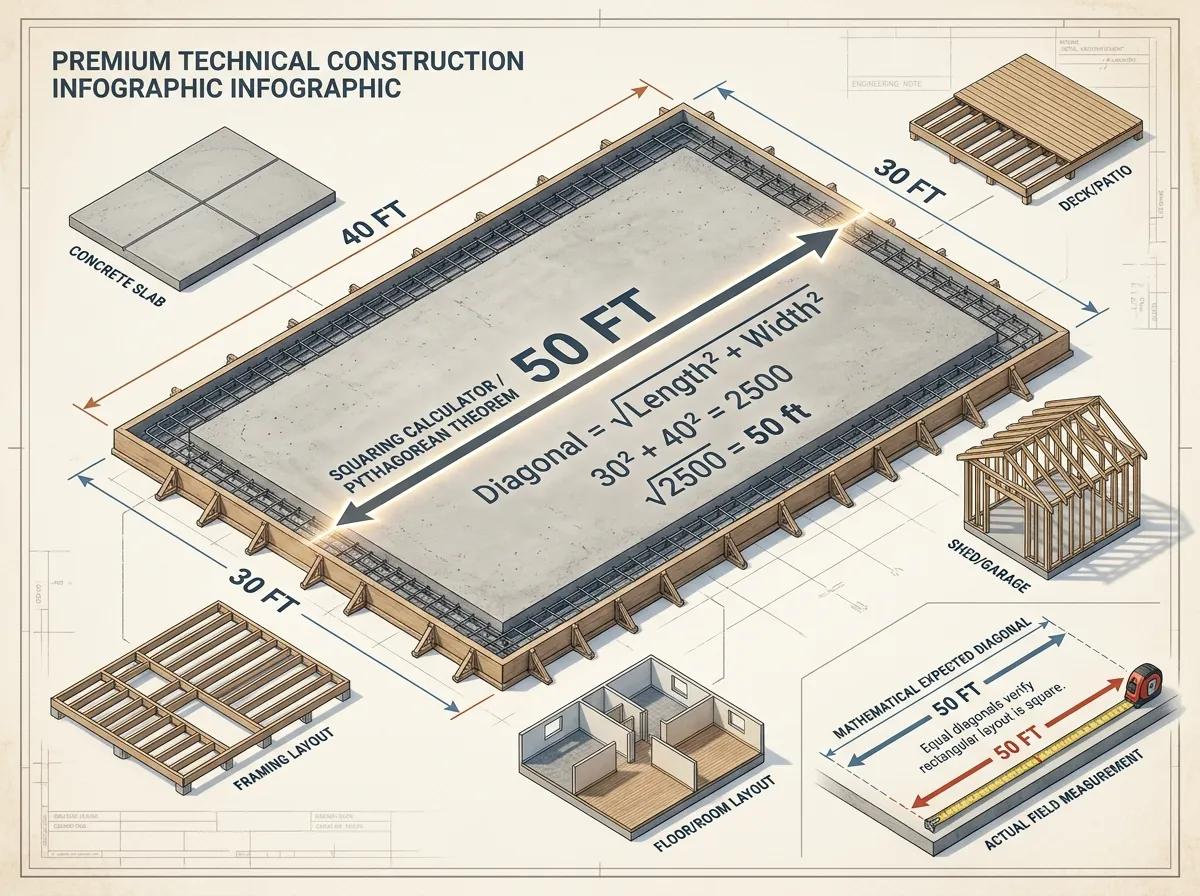
This construction square calculator uses the Pythagorean theorem to determine the expected diagonal of a rectangular layout based on your specific length and width measurements.
The Formula
To find the diagonal, you square the length, square the width, add those two numbers together, and then find the square root of the total.
Diagonal = √(Length² + Width²)
Practical Example
Imagine you are establishing a foundation layout that is 30 ft by 40 ft.
- 1. Square the sides: 30² + 40² = 2500
- 2. Find Square Root: √2500 = 50 ft
Your expected diagonal corner-to-corner is 50 ft.
Where to Use a Squaring Calculator
This tool is highly versatile and serves as a reliable square-up calculator for any project requiring a 90-degree corner. You can use it for:
- Building foundations
- Concrete slabs
- Decks and patios
- Sheds and garages
- Concrete forms
- Framing layouts
- Floor layouts
- Rooms
- Rectangular construction layouts
By providing the expected corner-to-corner diagonal, this calculator allows you to compare the mathematical ideal with your actual field measurement to verify that the rectangular construction layout is square.
How to Check if a Foundation Is Square
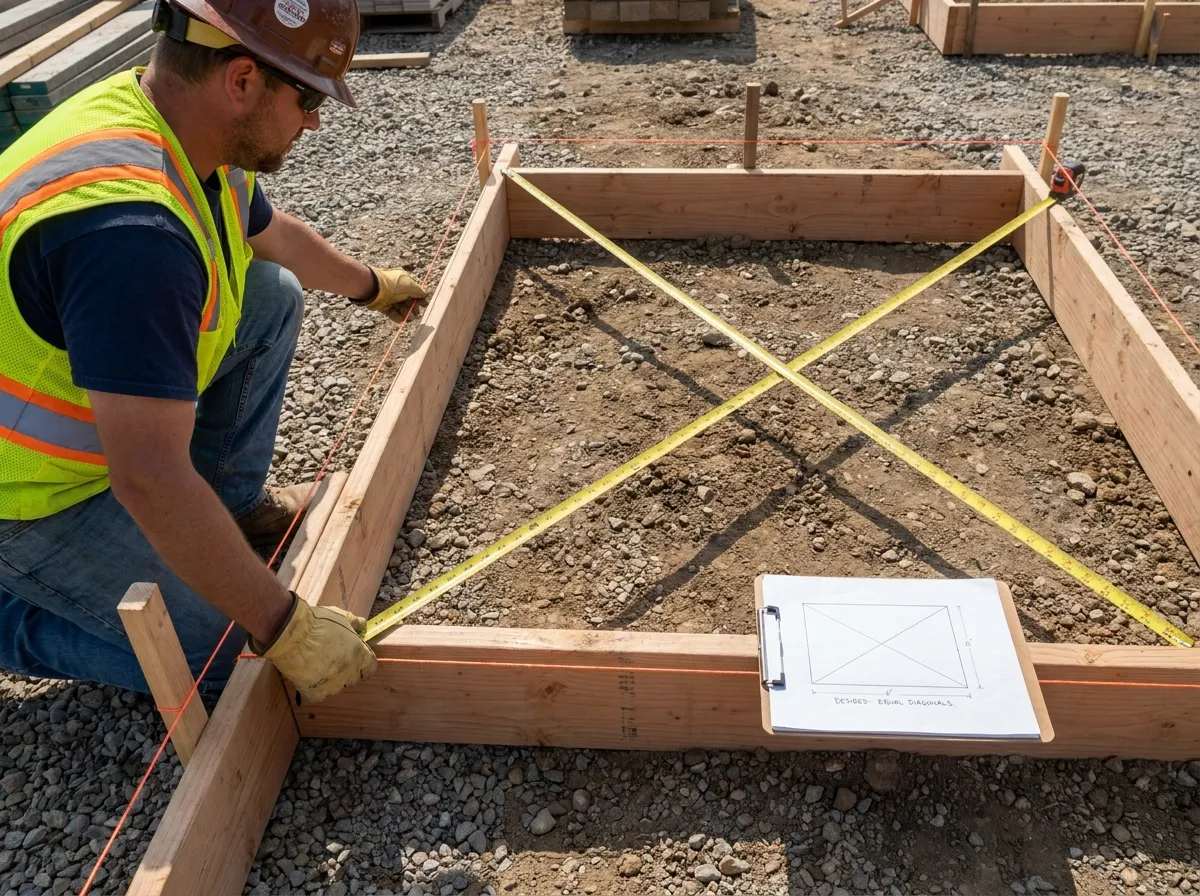
Knowing your expected diagonal is crucial in construction. If a layout is perfectly rectangular, the distance between the opposite diagonal corners will be exactly the same.
Step-by-Step Foundation Squaring
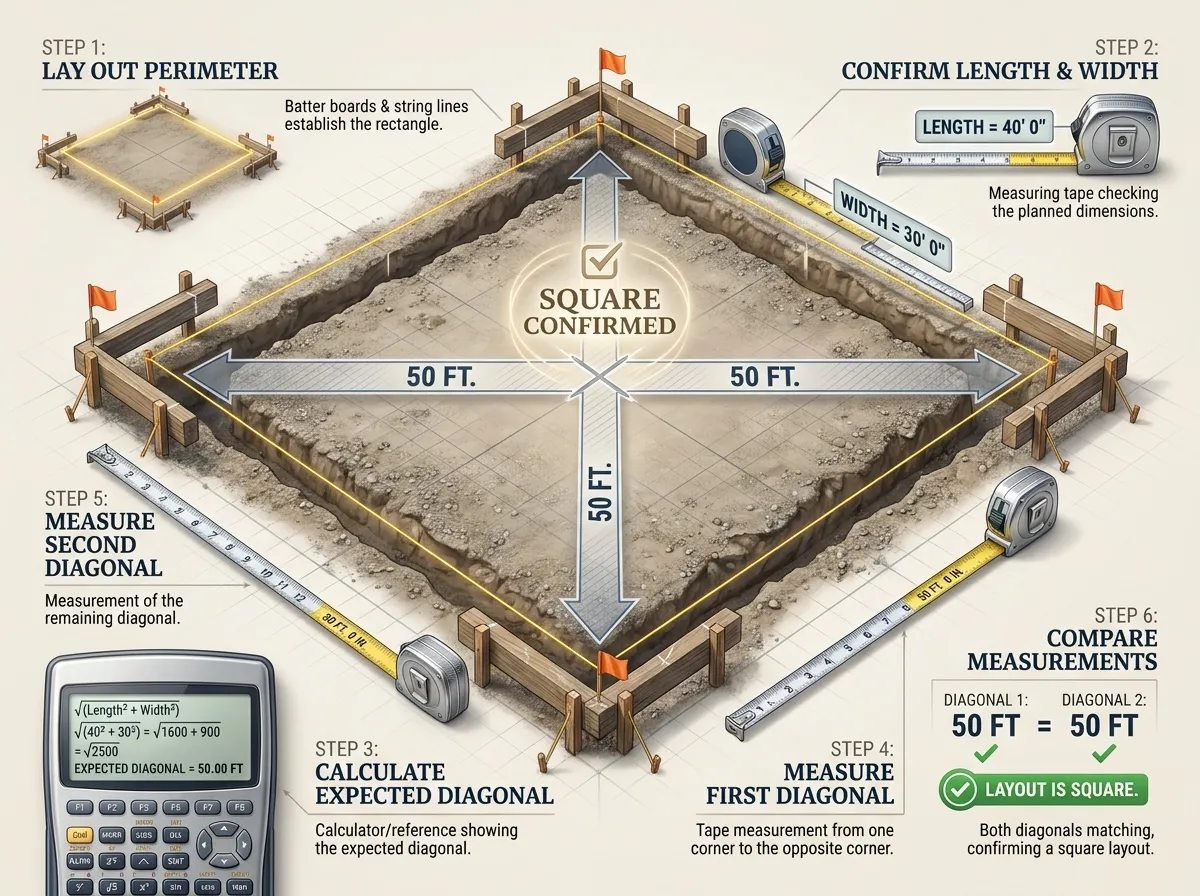
The process involves establishing the perimeter, confirming dimensions, calculating the expected diagonal, measuring both physical diagonals, and comparing the measurements.
1. Lay Out the Perimeter
Set your batter boards and string lines to establish the exact length and width of your planned structure.
2. Confirm the Length and Width
Measure the planned length and width carefully to make sure your layout dimensions are accurate.
3. Calculate Expected Diagonal
Enter the length and width into the Squaring Calculator to determine the expected diagonal measurement.
4. Measure the First Diagonal
Measure from one corner to the opposite corner across the layout.
5. Measure the Second Diagonal
Measure the remaining pair of opposite corners and record the measurement.
6. Compare the Measurements
If both measured diagonals match the calculated expected diagonal, your foundation layout is square.
How to Accurately Measure Diagonals
Best Practices for Accurate Diagonal Measurements
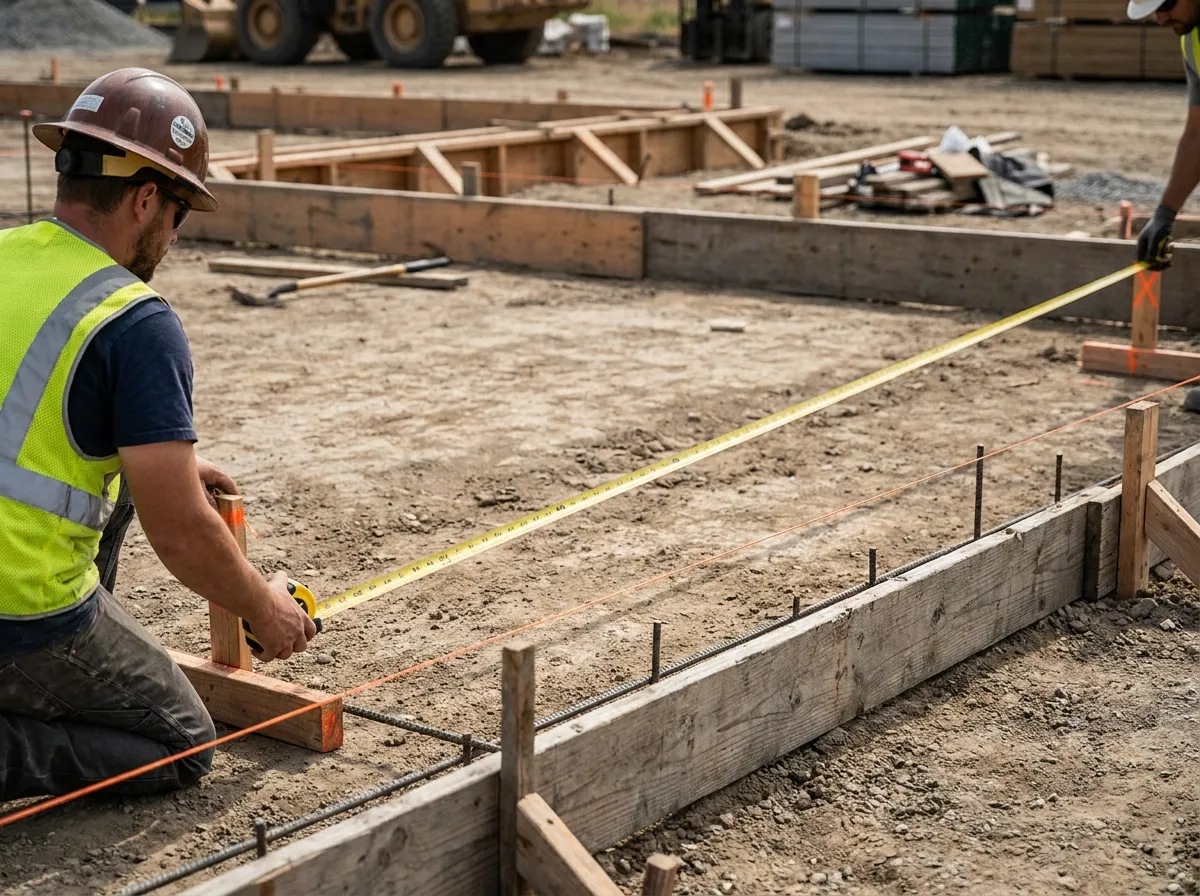
Even with the perfect mathematical calculation, a poor measurement in the field can ruin your layout. Follow these standard construction practices for measuring long diagonals:
- Use the same tape measure: Different tape measures can have slight variations. Use the exact same tape to measure both the length, width, and both diagonals.
- Pull it tight: A sagging tape measure will give an artificially long reading. Pull the tape as tightly and straightly as possible without snapping it.
- Measure from identical points: Whether you hook on the outside of a string line, the inside of a form board, or the center of a stake, ensure you are measuring from the exact corresponding point on the opposite corner.
The 3-4-5 Method for Squaring Construction Layouts
Before the convenience of a digital squaring calculator, builders relied heavily on the 3-4-5 method to establish a 90-degree corner (a perfect right angle). This method works because a triangle with sides measuring 3, 4, and 5 units will always form a perfect right triangle.
This ratio can be scaled up to suit the size of your project—for example, measuring 6-8-10, 9-12-15, or 12-16-20 feet. While the 3-4-5 rule is excellent for setting an individual corner, a diagonal calculator is often more practical for squaring large foundations, slabs, framing, or decks because it calculates the expected full corner-to-corner diagonal based on your exact overall length and width.
What to Do If the Diagonals Do Not Match
If the two measured diagonals are different, the layout is not square. Adjust the corners, string lines, or formwork gradually and remeasure both diagonals until they match the expected diagonal as closely as practical.
How to Use the Squaring Calculator
A quick guide to finding your expected diagonal.

1. Measure the Length
Determine the exact total length of one side of your rectangular layout.
2. Measure the Width
Determine the exact total width of the adjacent side.
3. Enter Measurements
Input both dimensions into the calculator above.
4. Select Units
Ensure your selected units match your measurements (e.g., feet, inches, meters). The tool handles mixed units automatically.
5. View the Calculated Diagonal
The calculator automatically displays the expected diagonal as soon as you enter or change the measurements.
6. Compare in Field
Pull your tape across both diagonals in the field. Adjust your layout until both measure exactly what the calculator provided.
Frequently Asked Questions (FAQ)
A square calculator for construction can calculate the expected diagonal of a rectangular layout from its length and width. This diagonal can then be compared with field measurements to help determine whether the layout is square.
First, calculate the expected diagonal based on your foundation's length and width. Next, measure the physical distance from corner to opposite corner. Then measure the other two opposing corners. If the layout is square, both physical measurements will be identical to each other, and identical to the calculated expected diagonal.
If your opposite diagonal measurements do not match, your layout is out of square (it is likely a parallelogram or trapezoid rather than a true rectangle). You will need to shift or rack the corners of your formwork or layout lines until the diagonal measurements are exactly equal.
Yes. The squaring calculator is designed to automatically convert mixed units. For example, if you enter a length in feet and a width in inches, the tool will standardize the measurements behind the scenes to give you a perfectly accurate diagonal.
The formula is based on the Pythagorean theorem: Diagonal = √(Length² + Width²). This means you square the length, square the width, add them together, and find the square root of the sum.
The 3-4-5 method uses the principles of a right triangle to create a 90-degree corner. By measuring 3 units down one side, 4 units down the adjacent side, and adjusting the corner until the diagonal between those points is exactly 5 units, you ensure a perfectly square corner.
Yes, the same diagonal squaring method applies universally. Whether you are laying out a deck, pouring a concrete slab, setting forms for a patio, or building a shed, measuring the cross-diagonals and comparing them to the calculator's expected result is the standard way to ensure a rectangular layout is square.
Both field diagonals should match each other as closely as practical, and they should closely match the calculated expected diagonal. While exact millimeter precision is the mathematical ideal, construction tolerances depend on the materials used. Pull your tape measure tight from consistent anchor points, and adjust the layout until the measurements are as identical as possible.