
Free construction calculators for quick, accurate estimates, measurements, and project planning
Concrete Calculator
Calculate Concrete Volume, Waste & Cost for Your Project
What are you calculating?
How to Use the Concrete Calculator
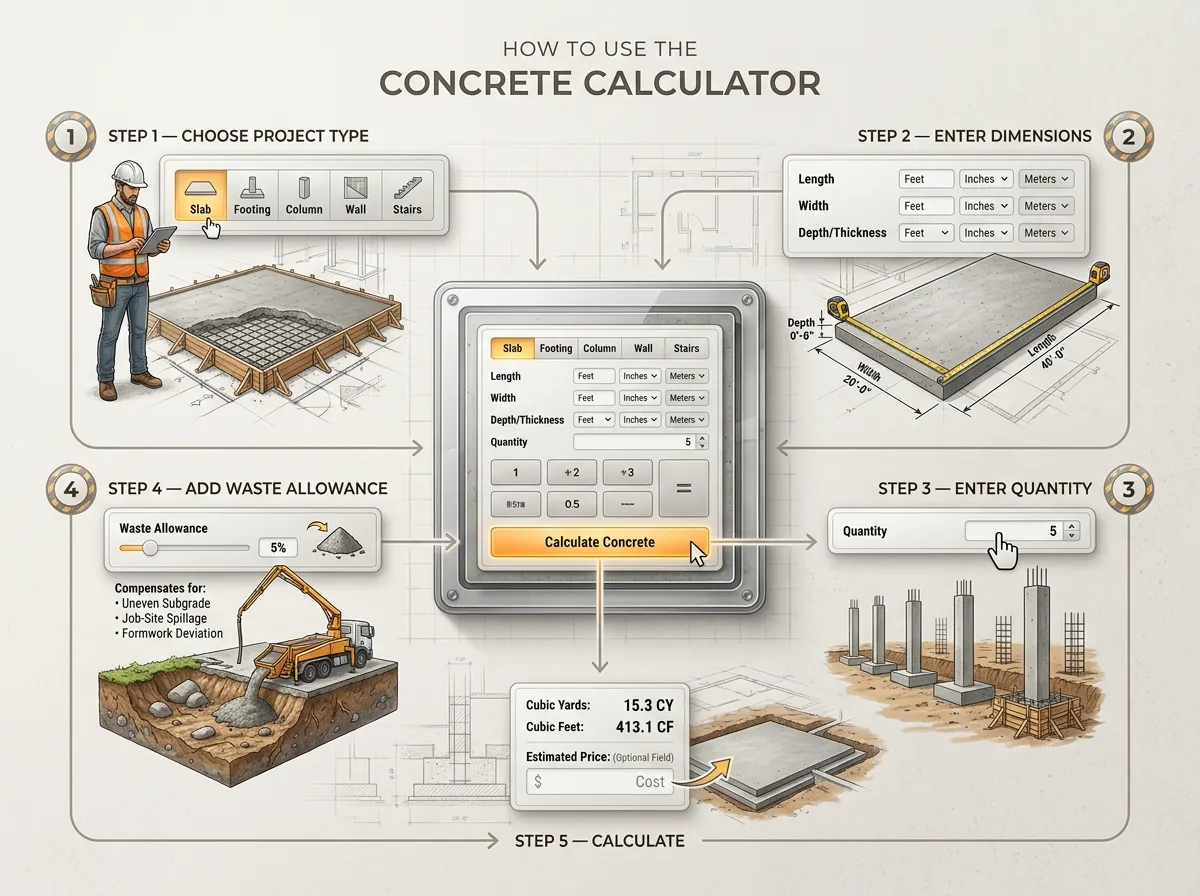
- 1 Choose the project type. Select your shape (slab, footing, column, wall, stairs, etc.) from the tabs at the top of the calculator.
- 2 Enter dimensions. Input the length, width, and depth/thickness. Make sure to select the correct unit (feet, inches, or meters) for each field.
- 3 Enter quantity. If you are pouring multiple identical forms, adjust the quantity field to multiply the total automatically.
- 4 Add waste allowance. Include a practical waste/overage margin to account for subgrade variations and spillage during the pour.
- 5 Calculate. Click "Calculate Concrete" to get your estimated volume in cubic yards and cubic feet. You can also enter a price to estimate cost.
How Much Concrete Do I Need?
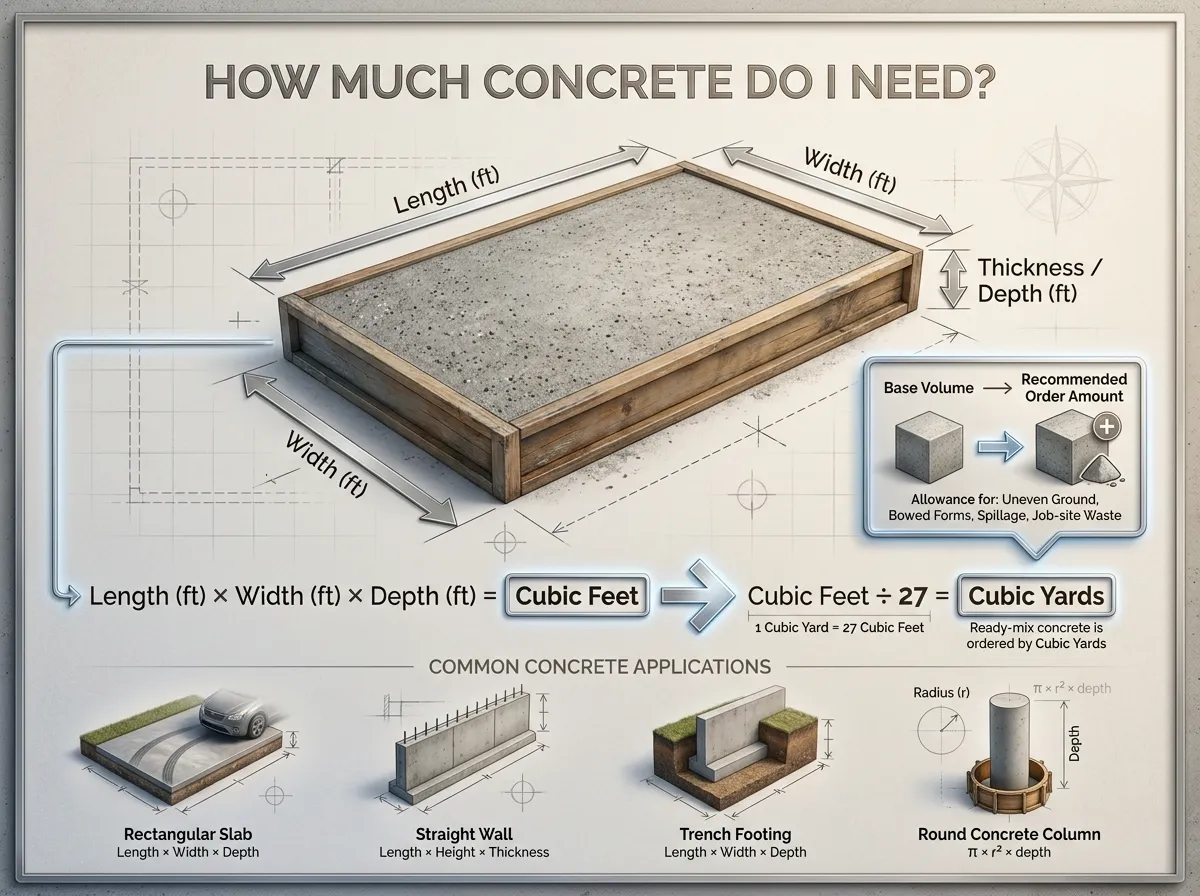
The amount of concrete you need depends on the physical dimensions of the space you are filling. To find the volume, you need accurate measurements of the project's length, width, and depth (or thickness).
Because the ground is rarely perfectly flat, forms can bow slightly, and material can be spilled, it is standard practice to order slightly more concrete than the exact mathematical base volume dictates. Our calculator provides the base mathematical volume and a recommended estimate that accounts for this practical overage.
Concrete Calculator Formula
For standard rectangular projects (like a basic slab, straight wall, or trench footing), the formula to find the base volume in cubic feet is:
Length (ft) × Width (ft) × Depth (ft) = Cubic Feet
Because ready-mix concrete is sold by the cubic yard, you must convert cubic feet to cubic yards by dividing the result by 27:
Cubic Feet ÷ 27 = Cubic Yards
Other shapes utilize their own standard geometric formulas, such as calculating the volume of a cylinder (π × r² × depth) for round columns or holes. Our calculator automatically handles these formulas behind the scenes.
Visual Volume Guide
Slabs, Footings & Walls
Columns & Holes
Concrete Calculator for Different Project Types
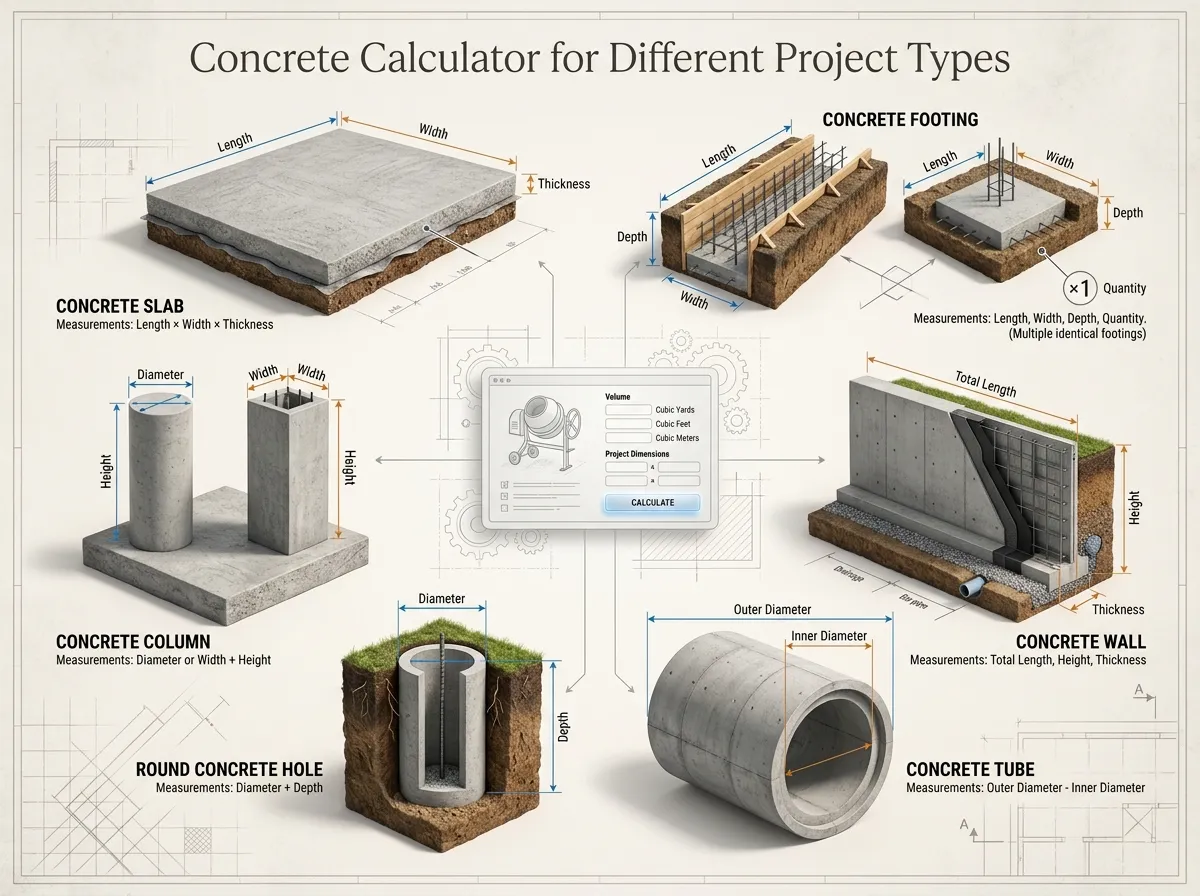
Our calculator supports several common concrete shapes and project types. Select the appropriate tab at the top of the calculator to access the correct input fields for your project.
Concrete Slab
Ideal for estimating concrete for patios, driveways, sidewalks, and shed pads. It uses the length, width, and thickness of the surface area.
Concrete Footing
Calculates trench footings or isolated structural pads. Includes a quantity field which is useful if you are pouring multiple identical footings.
Concrete Column
Supports both round/circular and square/rectangular vertical forms. Select your shape and input the width/diameter and total height.
Concrete Wall
Estimates volume for straight retaining or basement walls based on the total linear length, vertical height, and wall thickness.
Round Concrete Hole
Calculates cylindrical volume for post holes, drilled piers, or round footings using the diameter and depth.
Concrete Tube
Calculates hollow cylindrical shapes by subtracting the inner diameter volume from the outer diameter volume.
How to Calculate Concrete for a Slab
To manually calculate the concrete needed for a rectangular slab, ensure all dimensions are in feet. Multiply the length by the width and the thickness to find the cubic feet. Then, divide by 27 to find cubic yards.
Example: 20 ft × 10 ft slab that is 4 inches thick
1. Convert the 4-inch thickness to feet:
4 ÷ 12 = 0.3333 feet
2. Multiply length × width × depth:
20 × 10 × 0.3333 = 66.67 cubic feet
3. Convert to cubic yards:
66.67 ÷ 27 ≈ 2.47 cubic yards
If you add a practical 10% waste allowance to cover uneven subgrade or spillage, you would estimate ordering approximately 2.72 cubic yards.
How to Calculate Concrete for Footings
Basic Footing Calculation
A standard rectangular trench footing uses the same basic mathematical calculation as a slab. Measure the total trench length, the footing width, and the pour depth.
Multiple Footings
If you are pouring multiple isolated structural footings of the exact same size, you can calculate the volume of a single footing and then multiply that result by the quantity. Our calculator includes a "Quantity" field to handle this multiplier automatically.
How Much Concrete Should I Order?
When ordering concrete, it is important to understand the difference between the base mathematical volume and the final estimated amount to order.
BASE VOLUME
Geometrically perfect calculated volume
The exact mathematical calculation based strictly on your entered dimensions. It assumes a perfectly level site without any surface irregularities.
REAL-WORLD CONDITIONS
Ground conditions / forms / spillage
In reality, ground surfaces are rarely perfectly flat. Wooden forms can bow slightly under heavy pressure, and some wet material is inevitably lost during the pour.
FINAL ORDER AMOUNT
Base volume + appropriate overage
Contractors add a waste allowance (typically 5% to 10%) to prevent running short. The exact overage depends on your site conditions, form complexity, and subgrade.
Ordering a little extra upfront helps avoid costly short-load delivery fees later.
Concrete Ordering Tips
01
Confirm dimensions
Double-check your formwork dimensions right before ordering, as they may have changed during excavation.
02
Check units
Ensure you are using the same measurement units consistently (don't mix up inches and feet in calculations).
03
Account for overage
Always add a reasonable overage percentage based on your site's irregularities.
04
Ask about minimums
Check the concrete supplier's minimum order requirements or short-load fee policies.
05
Confirm access
Ensure the heavy delivery truck has safe access to the pour site.
06
Consider pumping
Ask about pump truck availability and charges if the mixer cannot reach the forms directly.
07
Verify the mix
Confirm the supplier's concrete mix design and PSI strength requirements for your specific project.
Our User Feedback about this Calculator
MR
Michael Reynolds
Homeowner
"Really easy to use. I entered my slab dimensions and got the cubic yard estimate in seconds. The waste option is especially helpful when ordering concrete."
JC
James Carter
General Contractor
"The multiple calculation modes make estimating concrete much faster. I can switch between slabs, footings, walls, and columns without doing each calculation manually."
RM
Robert Mitchell
Concrete Contractor
"A straightforward tool for checking concrete quantities before placing an order. The cubic feet and cubic yard results make it easy to compare my measurements with the supplier’s estimate."
SW
Sarah Williams
Homeowner
"I used this for a backyard slab project and found the instructions very clear. Entering the dimensions was simple, and the final estimate was easy to understand."
TA
Thomas Anderson
Site Supervisor
"The quantity option is a useful feature when working with multiple footings. It saves time and gives me a quick volume estimate before I prepare an order."
KB
Kevin Brooks
Builder
"I like that the calculator supports several common concrete shapes. It is convenient for getting a quick material estimate without having to work through the formulas manually."
RM
Rachel Morgan
Property Owner
"The waste percentage option is especially useful when planning a concrete pour. It gives me a more practical ordering estimate instead of relying only on the base volume."
CD
Christopher Davis
Remodeling Contractor
"Clean and practical calculator. The unit options and different project modes make it useful for checking measurements on different parts of a construction project."
AT
Amanda Turner
DIY Homeowner
"I was able to calculate the concrete needed for my project without complicated math. The step-by-step layout made the result much easier to understand."
BW
Brian Wilson
Construction Professional
"A useful reference when preparing a concrete order. I especially like being able to see the calculated volume in both cubic feet and cubic yards."
Frequently Asked Questions
First, select your project shape to determine the right geometric formula. Measure your dimensions accurately. For a slab, multiply Length (in feet) × Width (in feet) × Depth (in feet) to find cubic feet, then divide by 27 to get cubic yards. Our concrete calculator handles this conversion automatically.
There are precisely 27 cubic feet in one cubic yard. You can visualize this volume as a solid block measuring 3 feet wide by 3 feet long by 3 feet tall.
For a standard 10 ft by 10 ft slab poured at a 4-inch depth, the base volume is 33.33 cubic feet, equating to approximately 1.23 cubic yards. If you apply a standard 10% waste buffer, you should estimate needing about 1.35 cubic yards.
A rectangular footing uses the same basic calculation as a slab. Measure the total trench length, the footing width, and the pour depth. Multiply them together to find the volume, and adjust for the number of isolated footings if applicable.
A round column is geometrically a cylinder. The volume is calculated using the formula: π × radius² × height. Use the "Column" mode in our calculator and select the "Round" shape to calculate this accurately.
It is standard practice to order a 5% to 10% overage buffer to accommodate uneven subgrades, spillage, and formwork variations. The optimal percentage varies by the complexity of the job and specific site conditions.
Concrete material cost is typically estimated by multiplying your recommended volume (in cubic yards) by the local supplier's price per yard. Base estimates usually don't include extra surcharges for delivery fees or small-load penalties.
Need Help or Have Feedback?
Have a question, suggestion, or feedback about our calculators? We'd love to hear from you.
Contact Us →