
Free construction calculators for quick, accurate estimates, measurements, and project planning
Concrete Footing Calculator
Calculate concrete volume, waste, bag estimates, and cost for your footing project.
Concrete Footing Calculator: Quick Guide
Enter Dimensions
Input length, width, depth, or diameter.
Choose Type
Select strip, pad, or circular footing.
Add Waste
Include a 10–15% margin for uneven trenches.
Review Results
Check cubic yards, bags, and cost live.
Important: This calculator estimates concrete volume from the dimensions you enter. It does not determine the structural size, reinforcement, soil requirements, frost depth, or code requirements for a footing. Always follow approved plans and applicable local building codes.
How to Use the Concrete Footing Calculator

1
Choose footing type. Select between a continuous strip footing, a rectangular pad footing, or a circular footing.
2
Enter dimensions. Measure your excavated trench or forms. Input the length, width, depth, or diameter. Mix and match units seamlessly.
3
Enter quantity. If pouring multiple identical isolated spread footings or piers, adjust the quantity to multiply the total volume.
4
Set waste allowance. Trench footings often require more concrete due to uneven earth excavation. Keep the default 10% waste buffer or adjust accordingly.
5
Review live results. Check the dark blue results panel. The required ready-mix volume in cubic yards and bag estimates updates instantly as you type.
How to Calculate Concrete for Footings
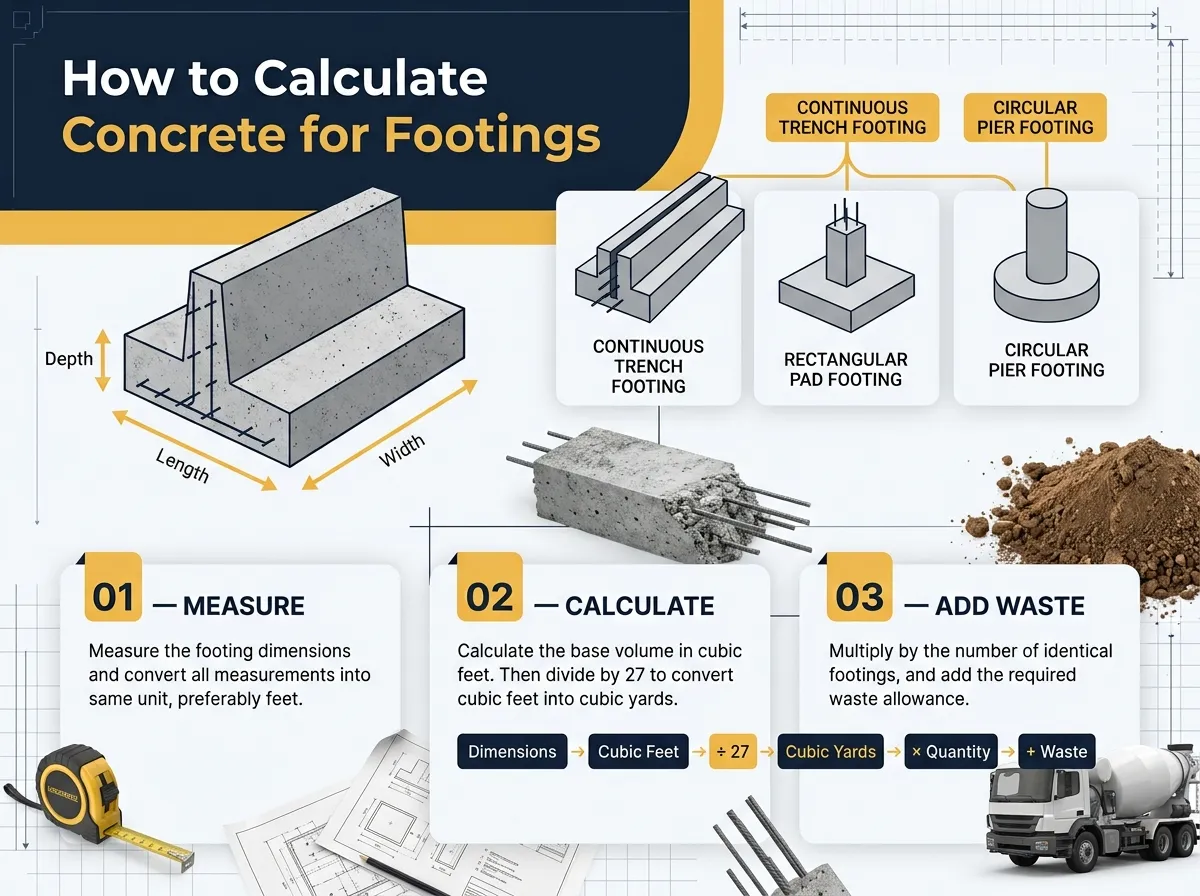
Estimating the concrete needed for a footing requires finding the internal volume of the excavated trench or constructed formwork. Whether digging a continuous trench, a rectangular pad, or drilling a circular pier, the approach relies on foundational geometry.
01 Measure
Measure the footing's dimensions. Ensure you convert all measurements into the same unit (usually feet) before multiplying.
02 Calculate
Calculate the base volume in cubic feet, then divide by 27 to convert that volume to cubic yards for ordering.
03 Add Waste
Multiply by the number of identical footings and add a waste allowance percentage for safety.
Concrete Footing Formula
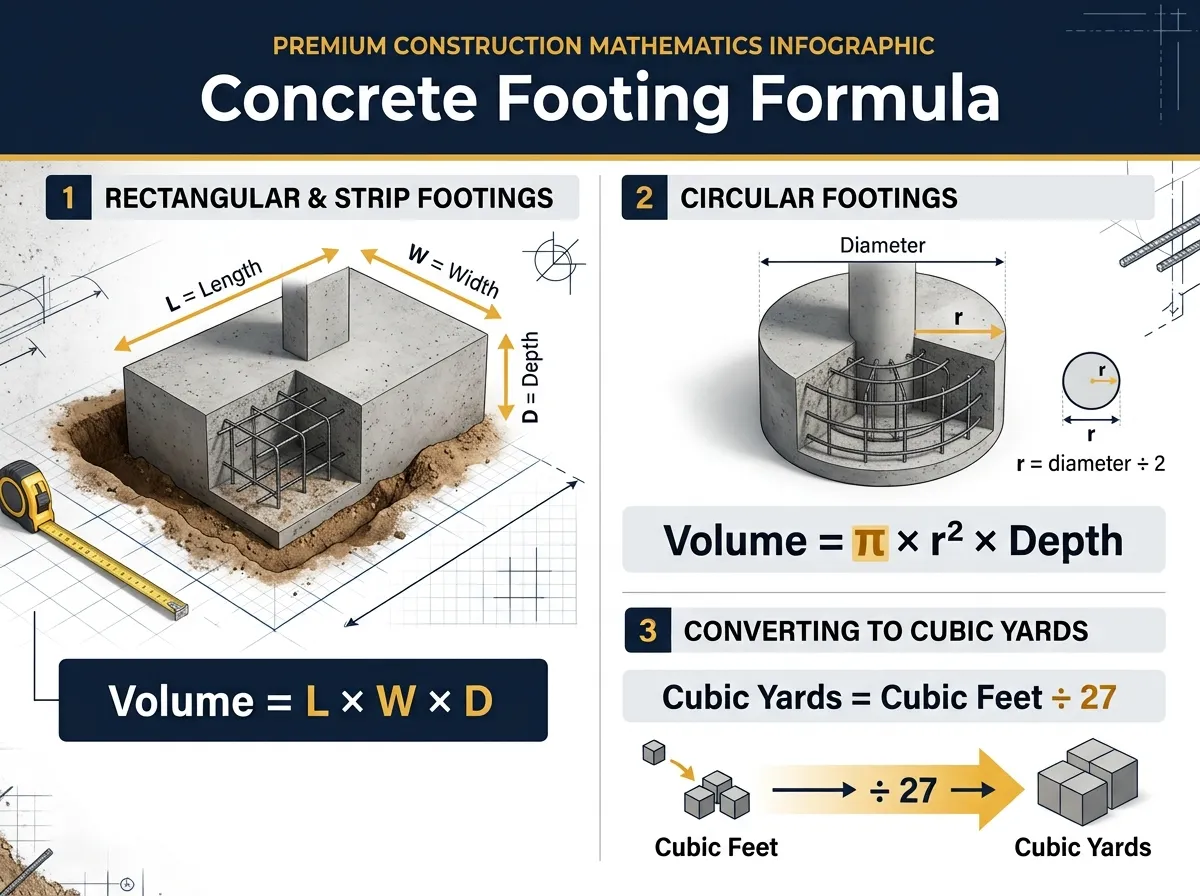
To calculate the base volume for rectangular or continuous footings, multiply the three dimensions together (in feet). For circular footings, use the formula for a cylinder.
Rectangular & Strip Footings
Volume = L × W × D
Length multiplied by Width multiplied by Depth.
Circular Footings
Volume = π × r² × Depth
Where 'r' is the radius (half of the full diameter).
Converting to Cubic Yards
Because ready-mix concrete is ordered and sold by the cubic yard, convert the cubic feet measurement:
Cubic Yards = Cubic Feet ÷ 27
Concrete Footing Types and Volume Calculations
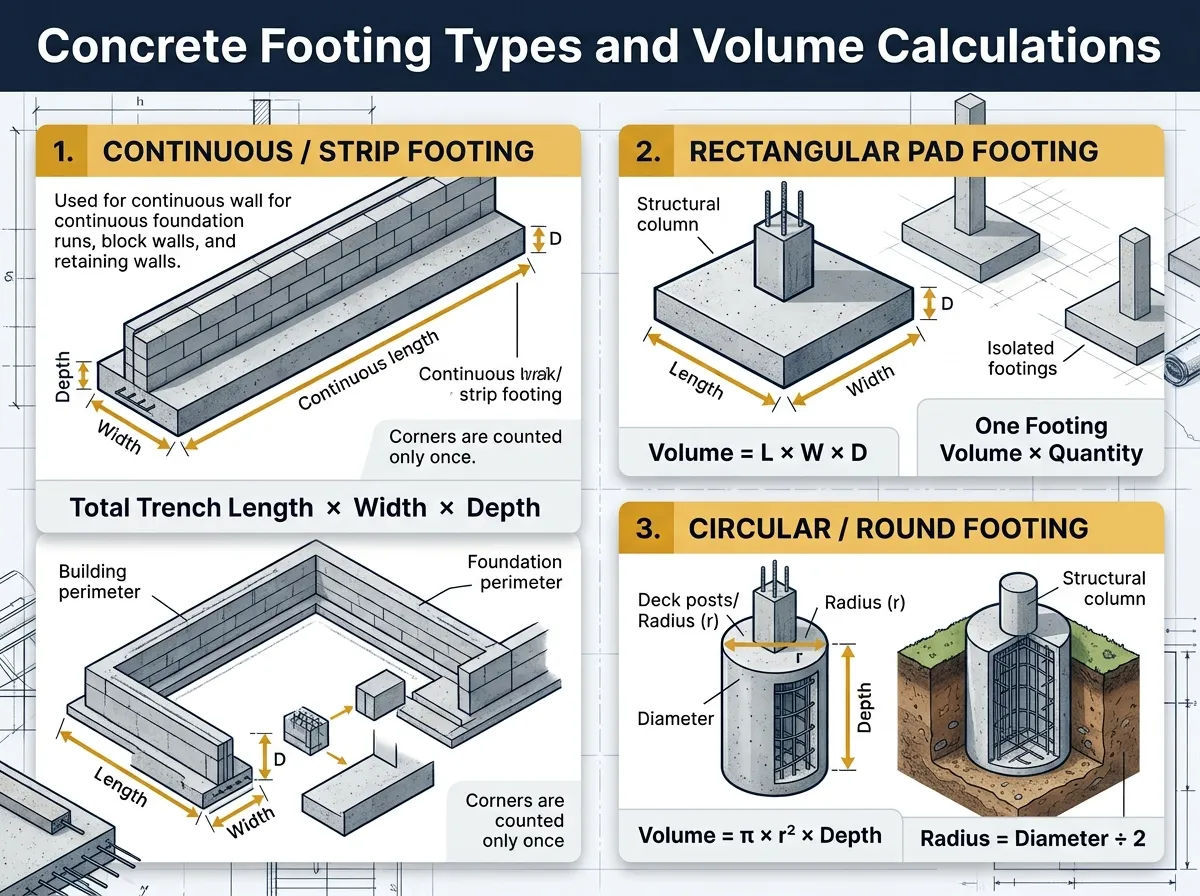
Continuous or Strip Footings
Continuous footings are long trenches used to support continuous foundation runs, block walls, or retaining walls.
Method: If calculating an entire building perimeter, simply add up the total linear length of the trench, taking care not to double-count the corners, and calculate it as one continuous length.
Rectangular Pad Footings
Pad footings are isolated square or rectangular supports typically used under individual columns, support beams, or deck posts.
Method: The calculation method is straight Length × Width × Depth. If your structure uses multiple identical pad footings, calculate the volume for one and multiply by the total quantity.
Circular or Round Footings
Circular footings are used for drilled piers, deck posts, or cylindrical cardboard forming tubes.
Method: The formula relies on finding the area of the circle and multiplying it by the depth of the hole. Our calculator automatically handles the radius conversion when you enter the full diameter.
How Much Concrete Do I Need for a Footing?
To find out exactly how much concrete you need, you must first calculate the mathematically perfect base volume. However, because the earth is rarely excavated perfectly flat, plumb, or straight, earth-formed footings almost always consume more material. Therefore, the recommended amount to order is your base volume plus a reasonable waste percentage.
Base Volume
Mathematical Size (L × W × D)
Waste Allowance
Typically 10% – 15% added
Recommended Order Amount
The total volume you should request from the ready-mix supplier.
Concrete Footing Calculation Example
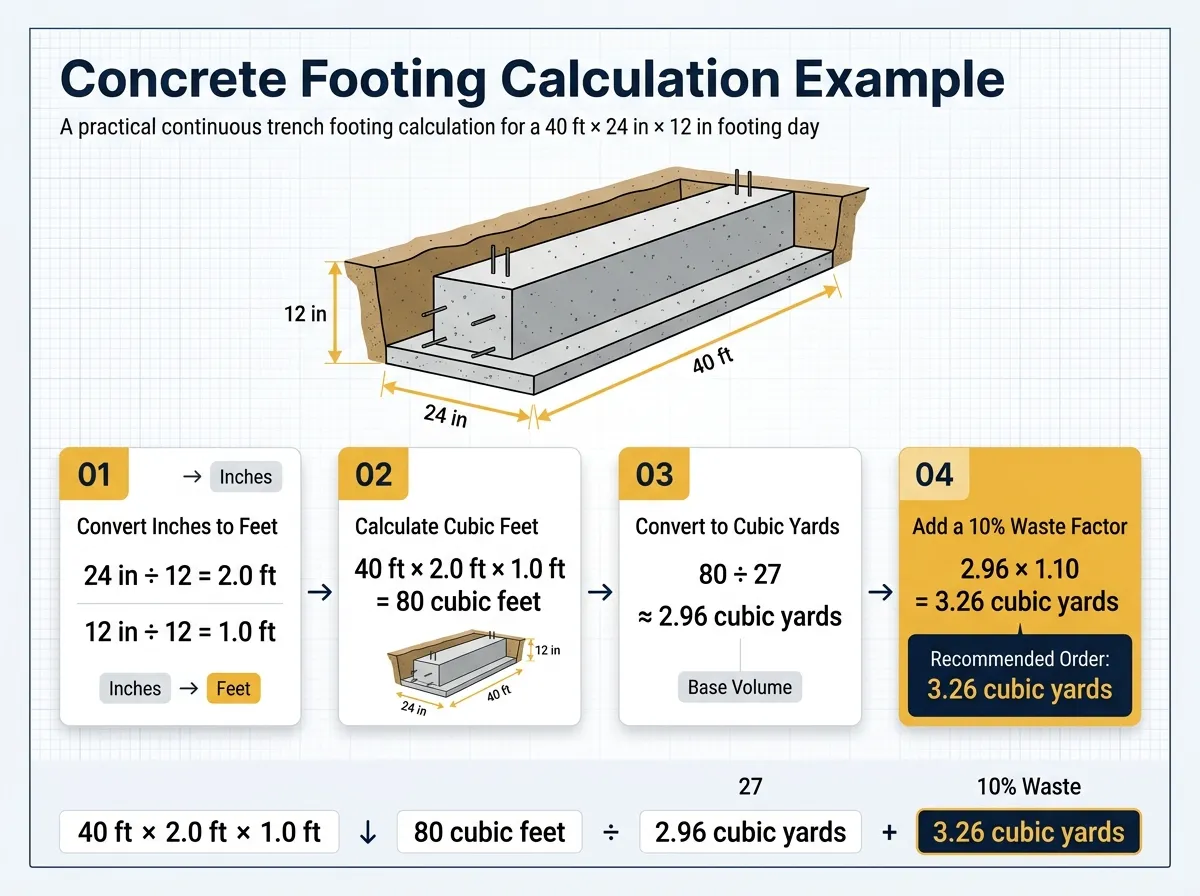
Let's walk through a practical example of calculating concrete for a continuous trench footing. Assume you are pouring a footing that is 40 feet long, 24 inches wide, and 12 inches deep.
Step 1
Convert inches to feet
24 in ÷ 12 = 2.0 ft | 12 in ÷ 12 = 1.0 ft
Step 2
Calculate cubic feet
40 ft × 2.0 ft × 1.0 ft = 80 cubic feet
Step 3
Convert to cubic yards
80 ÷ 27 ≈ 2.96 cubic yards (Base Volume)
Step 4
Add a 10% Waste Factor
2.96 × 1.10 = 3.26 cubic yards (Recommended Order)
How Much Extra Concrete Should I Order?
For footings poured directly into earth trenches, it is highly recommended to add a 10% to 15% waste allowance to your order. Running short on concrete during a continuous foundation pour can result in expensive short-load delivery fees or weak cold joints.
The Base Volume
The exact mathematical calculation based strictly on your entered dimensions. It assumes perfectly smooth, straight, and plumb trench walls.
Uneven Excavation
Excavators and hand-digging naturally create wider spots, deeper dips, and irregular sides. Concrete effortlessly fills all of these imperfections.
Recommended Overage
A practical 10% buffer prevents running short. You can adjust this percentage in the calculator depending on the quality of your excavated trench.
Concrete Footing Cost Estimate
Our calculator provides a straightforward material cost estimate based on the local ready-mix price you provide. To determine this cost, the calculator takes your recommended final volume (including waste) and multiplies it by the price per cubic yard.
Estimated Cost = Recommended Volume × Price per Cubic Yard
Potential Additional Charges
Note: This is an estimate for raw material volume only. When contacting a ready-mix supplier, be prepared to discuss potential additional costs such as:
- Delivery fees
- Minimum load charges
- Environmental surcharges
- Local taxes
- Wait-time fees
Concrete Footing Ordering Tips
1. Re-measure after digging
Never rely solely on your blueprint dimensions. Always measure the actual excavated trench width and depth before ordering.
2. Confirm the mix
Ensure you order the correct PSI mix design (compressive strength) required by your structural engineer or local building codes.
3. Check truck access
Footings are often in the back of properties. If the ready-mix truck cannot reach the trench, you may need a concrete pump.
4. Account for waste
Consistently apply a 10% to 15% waste allowance for earth trenches. Running short creates a weak cold joint.
Concrete Footing Calculator at a Glance
Footing Types
Strip, Pad, Circular
Measurements
L, W, Depth, Diameter
Outputs
cu yd, cu ft, cu m
Extras
Waste, Bags, Cost
What Users Say
Practical feedback from people using the calculator for footing volume and material estimates.
Construction Professional
Foundation Contractor
"Being able to use feet for length and inches for width and depth makes footing calculations much easier. I don't have to convert everything manually."
Construction Professional
General Contractor
"The quantity option is useful when several footings have the same dimensions. It makes the total volume quick to check."
Construction Professional
Concrete Contractor
"I like being able to compare cubic feet and cubic yards before placing a concrete order. The live updates save a lot of clicking."
Site User
Homeowner
"The footing diagrams make it much easier to understand which dimensions to enter. Figuring out bags for my retaining wall was straightforward."
Construction Professional
Site Supervisor
"The waste percentage is useful for trench footings where the excavation is not perfectly uniform. Good addition to the tool."
Construction Professional
Fencing Contractor
"The circular footing option makes it easy to estimate concrete for round post footings. Just enter the diameter and get the numbers."
Concrete Footing Calculator FAQs
Measure the length, width, and depth of your footing trench. Ensure all measurements are converted to feet. Multiply Length × Width × Depth to find the volume in cubic feet. Divide by 27 to convert it to cubic yards. Our calculator handles the mixed-unit conversions automatically.
It is standard practice in the construction industry to order a 10% to 15% overage for footings poured directly into earth trenches. Uneven digging, deeper dips, and slightly wider sections naturally consume more material than the exact mathematical base volume.
Select the "Circular / Round" option in the calculator. You will need the diameter of the hole or tube form, and the depth. The math formula behind it is Pi times the radius squared, multiplied by the depth (π × r² × d).
For a standard continuous footing that is 24 inches wide and 12 inches deep, every 1 linear foot of the trench will require exactly 2 cubic feet of concrete base volume, which is approximately 0.074 cubic yards.
Yes. Enter the dimensions for a single footing, and then adjust the "Quantity" field to the number of footings you are pouring. The calculator will automatically multiply the volume and provide the total concrete needed for all of them combined.
Our calculator automatically provides pre-mix bag estimates alongside the cubic yardage. Generally, one 80 lb bag of concrete yields about 0.60 cubic feet when mixed with water. Note that bag yields can vary slightly by manufacturer.
The estimated cost is calculated by multiplying your total recommended concrete volume (in cubic yards) by the price per yard you provide. Be aware this is a raw material estimate; local ready-mix suppliers may charge extra for delivery, environmental fees, or short loads.
Yes. Our calculator automatically handles mixed unit conversions, allowing you to use feet for length and inches for depth seamlessly.
No, this tool estimates the material volume based on dimensions you provide. The required width and depth of a concrete footing must be determined by structural engineers and local building codes based on soil bearing capacity and the weight of the structure.
Need Help or Have Feedback?
Have a question, suggestion, or feedback about our calculators? We'd love to hear from you.
Contact Us →