Free construction calculators for quick, accurate estimates, measurements, and project planning
Artificial Grass Installation Cost Calculator
Get a quick and reliable cost estimate for your synthetic turf project.
Project Area & Dimensions
ft
OR
sq ft
Artificial Grass Quality
Optional Project Features
Removal and disposal of old grass/sod. (Est. $1.50 / sq ft)
For very uneven surfaces needing extra leveling. (Est. $1.00 / sq ft)
Professional-grade fabric to prevent weed growth. (Est. $0.50 / sq ft)
Your Estimated Project Cost
Detailed Cost Breakdown
Total Area:
0 sq ft
Artificial Grass:
Includes standard 10% material waste factor
$0
Base & Infill Materials:
Crushed rock base & standard infill
$0
Professional Labor:
Installation crew ($500 minimum fee)
$0
Optional Services:
$0
Grand Total:
$0
Disclaimer: This calculator provides an estimate for informational purposes based on industry averages. Actual costs may vary based on location, site accessibility, and installer pricing. Always get a formal quote from a professional.
Did this calculator solve your problem?
How to Use the Cost Calculator
Get your project estimate in four simple steps.
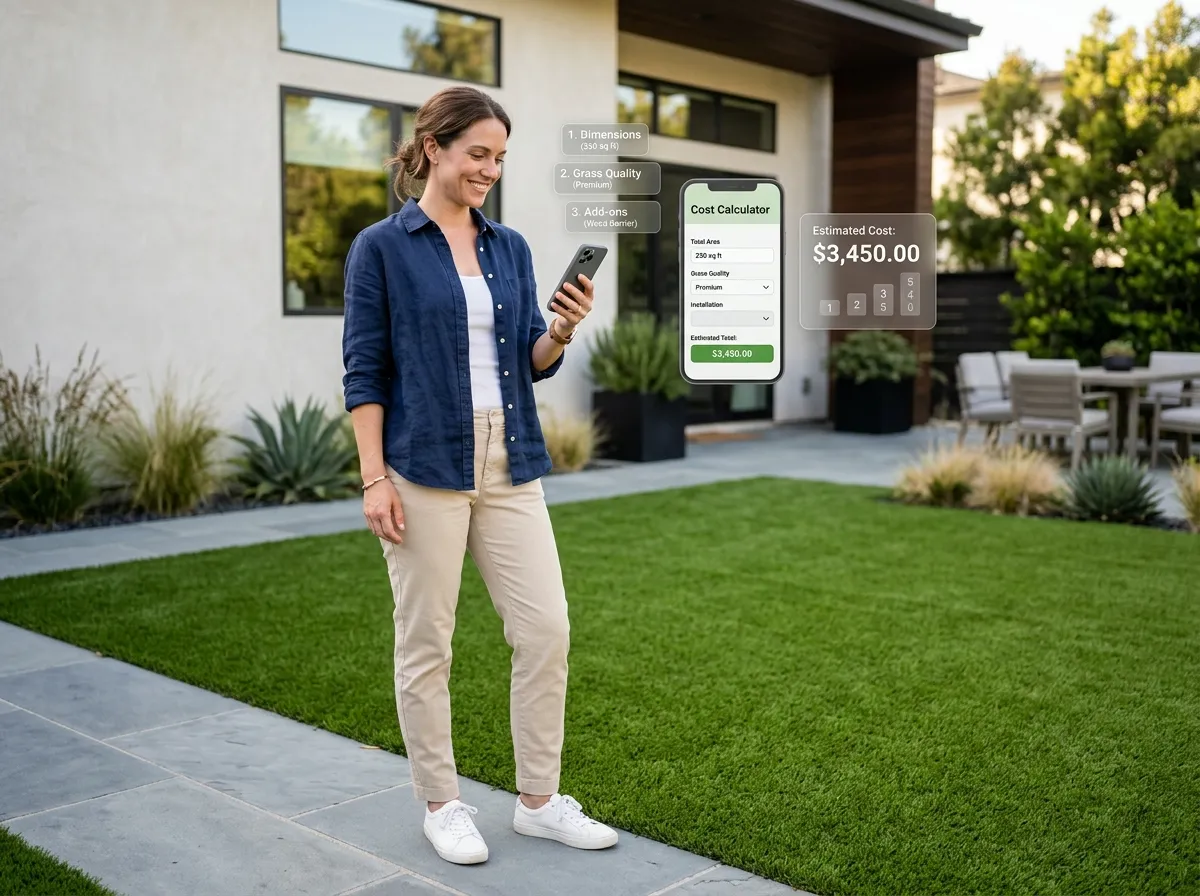
Enter Dimensions
Provide the length and width of your area, or enter the total square footage directly to begin.
Select Grass Quality
Choose a turf grade that matches your budget and needs, from budget-friendly to premium turf.
Choose Add-ons
Select any optional services you require, such as old lawn removal or ground preparation.
Get Your Estimate
Review the instant, detailed cost breakdown for your entire artificial grass installation project.
Why Use Our Artificial Grass Calculator?
Our tool is designed to provide quick, transparent, and comprehensive estimates for your landscaping projects.
Instant & Free Estimates
Get a reliable cost estimate in seconds to help you budget and plan your project effectively.
Detailed Cost Breakdown
Understand exactly where your money goes. We separate costs for turf, materials, labor, and add-ons.
Customizable Options
Tailor the estimate to your exact needs by selecting different grass qualities and optional services.
Key Factors Influencing Your Cost
Several variables can affect the final price of your installation. Here's what to keep in mind.
Total Area Size (Square Footage)
This is the single biggest factor. The larger the area, the more materials and labor will be required. Keep in mind that turf comes in rolls, so complex shapes may result in more material waste.
Type and Quality of Artificial Grass
Artificial turf comes in a wide range of styles and pile heights. Premium or specialty grasses cost more per square foot than basic options.
Site Preparation & Groundwork
The existing condition of the area is crucial. A project may require removing the old lawn, extensive leveling, or adding a sub-base, all of which add to the cost.
Labor and Installation Complexity
Labor is a significant portion of the cost. A simple, rectangular lawn is cheaper to install than a complex area with many curves, trees, or obstacles.
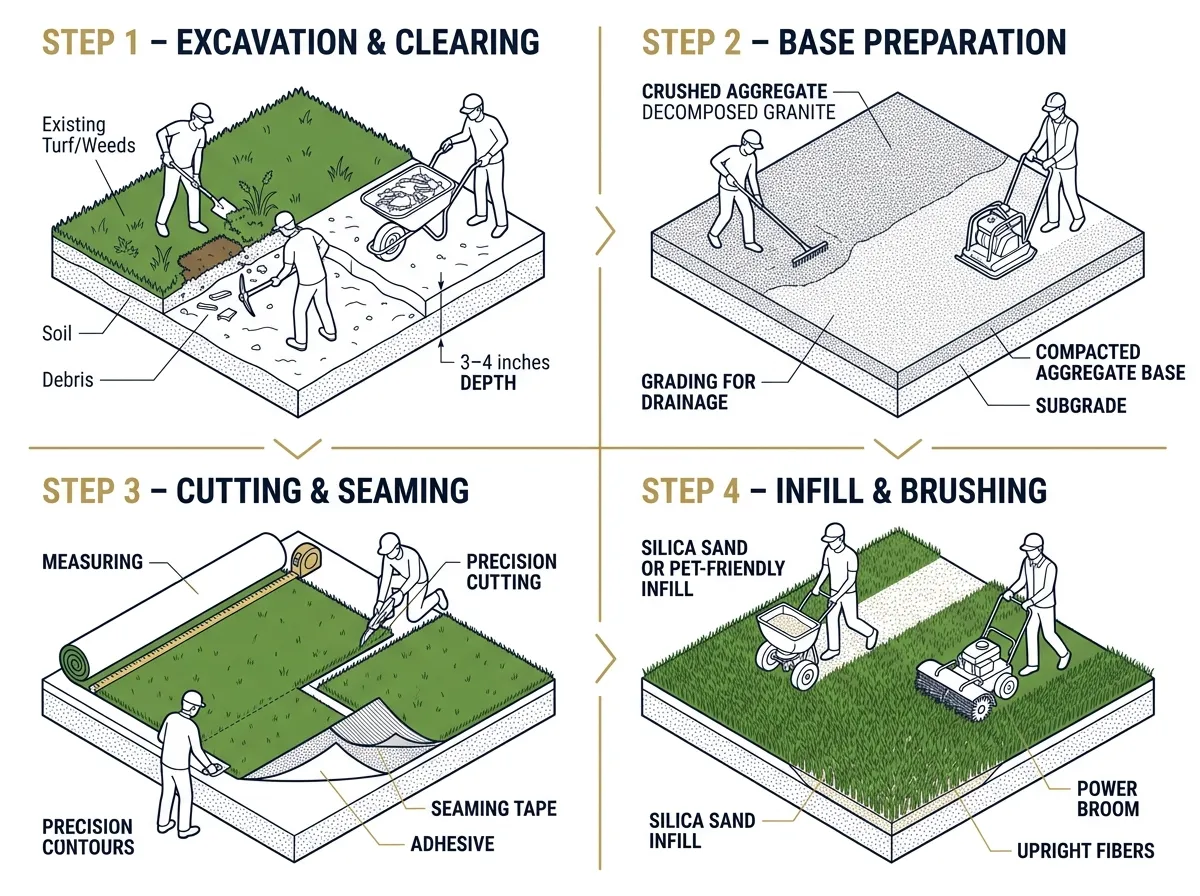
The 4-Step Installation Process
Understanding the physical labor required explains why professional installation is a valuable, long-term investment.
1
Excavation & Clearing
The existing soil, grass, and debris are excavated to a depth of 3 to 4 inches to make room for the new sub-base, ensuring proper elevation.
2
Base Preparation
A heavy layer of crushed aggregate (like decomposed granite) is laid down, leveled, graded for drainage, and heavily compacted to create a solid foundation.
3
Cutting & Seaming
The turf rolls are rolled out, precision-cut to match your yard's unique borders, and expertly seamed together using specialized tape and adhesive to hide the joints.
4
Infill & Brushing
Sand or specialized pet infill is spread evenly across the surface and power-brushed into the fibers. This weighs the turf down and keeps the blades standing tall.
Cost Distribution Overview
Look beyond the per-square-foot price to understand the complete financial picture of your project.
Material vs. Labor Costs
Your total cost is typically a 40/60 split: about 40% for the turf and base materials, and 60% for the specialized labor required for a flawless, long-lasting installation.
The Value of Professional Installation
Pros handle crucial steps like creating a stable sub-base, ensuring proper drainage, and expertly seaming turf rolls together for an invisible finish that DIY projects often miss.
Typical Cost Distribution
60%
Labor
40%
Materials
Labor
Materials
Selecting Your Ideal Artificial Grass
Not all turf is created equal. Here’s what to look for to find the perfect match for your home and lifestyle.
Know the Terminology
Look at "Pile Height" for grass length, and "Thatch," a brown layer at the base that adds realism. A higher Face Weight means a denser, better product.
Match the Turf to Its Use
A soft, dense turf is great for play areas, while a highly durable, shorter pile is essential for heavy foot traffic or pet-specific zones.
Consider the Material
Most modern residential turf is made from Polyethylene (soft and realistic) or Polypropylene (durable). Some high-end options use Nylon for superior resilience.
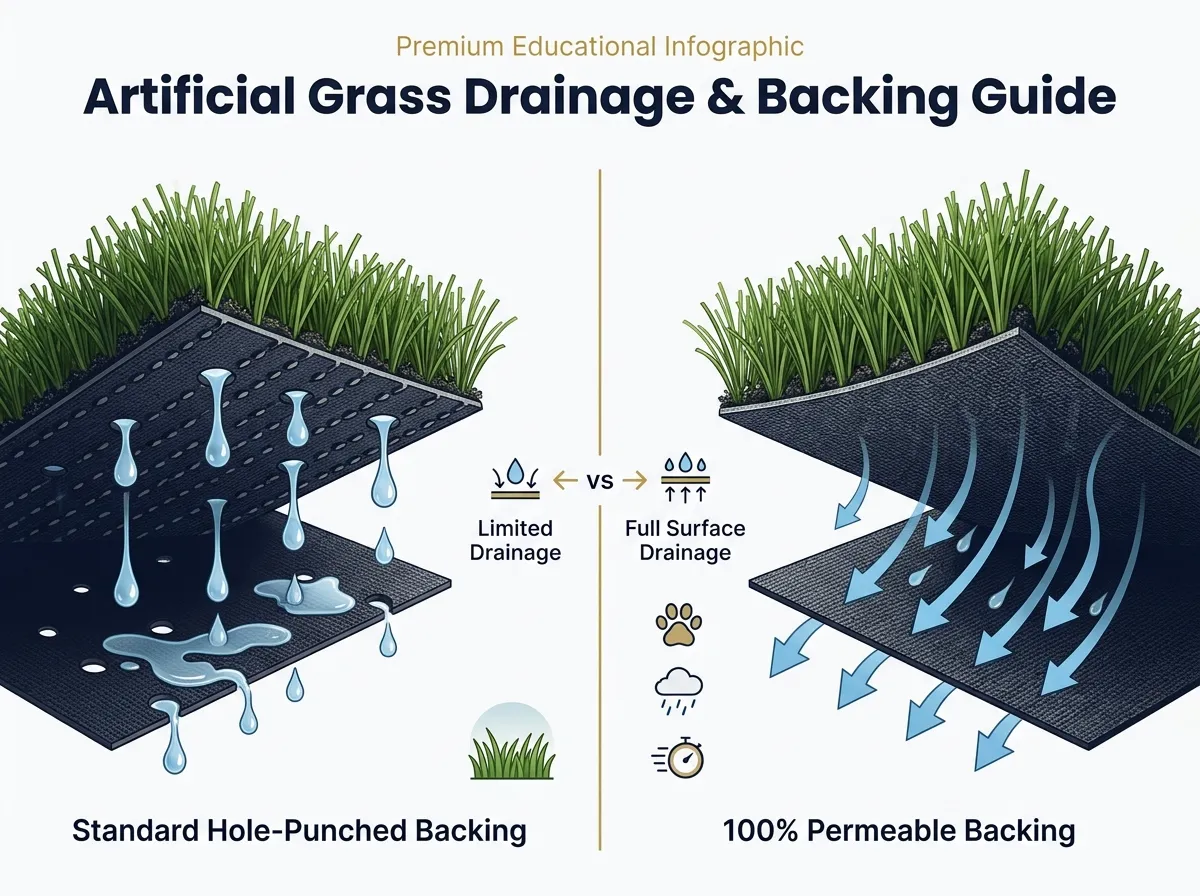
Understanding Drainage & Backing
The part of the artificial grass you never see is actually one of the most critical factors in its price and performance.
Standard Hole-Punched Backing
Found on budget and mid-range turfs, this backing relies on small holes punched every few inches to allow water to drain. It is perfectly fine for standard landscape applications with average rainfall.
100% Permeable (Edge-to-Edge) Backing
Found on premium and specialty turfs, this backing allows water to pass through anywhere on the surface instantly. This is practically mandatory for households with multiple dogs to prevent urine odors from pooling.
Comparing Artificial Grass Grades
| Grass Quality | Price / Sq Ft | Best For |
|---|---|---|
| Budget-Friendly | $3.00 | Low-traffic areas, temporary setups, flipping houses. |
| Mid-Range / Popular | $5.00 | Residential lawns, general use with moderate foot traffic. |
| Premium / Luxury | $7.00 | High-end residential, areas where maximum realism is key. |
| Specialty / Pet-Friendly | $9.00 | Dog runs, areas requiring max durability and 100% permeable drainage. |
Frequently Asked Questions
Common questions about artificial grass installation and costs.
High-quality artificial grass is designed to last 15 to 25 years, depending on the volume of foot traffic and how well it is maintained. Premium options with UV inhibitors will also resist fading for over a decade.
Yes, it is highly durable, non-toxic, and resistant to digging. For households with dogs, it is highly recommended to select a turf with a 100% permeable backing and use a specialized antimicrobial pet infill to prevent urine odors from developing.
Artificial grass does retain more heat than natural grass and can get warm in direct, intense sunlight. However, it cools down rapidly when shaded or quickly rinsed with a hose. You can also opt for specialized cooling infills that reduce surface temperatures by up to 50 degrees.
It is very rare, but occasionally weeds can grow around the edges or sprout up from airborne seeds landing in the infill. Including a high-quality weed barrier fabric during installation heavily mitigates this risk.
Maintenance is incredibly minimal compared to a natural lawn. There is no mowing, watering, or fertilizing. Routine maintenance simply involves occasionally brushing the fibers upright with a stiff push broom and rinsing away dust, debris, or pet waste with a hose.
Yes, a professionally installed artificial lawn can increase your property value. It boosts curb appeal, offers a pristine look year-round, and appeals to buyers looking for low-maintenance, drought-tolerant landscaping that saves on water bills.
While DIY installation is possible and saves on labor costs, it is highly physically demanding and requires specialized equipment. Professional installation is strongly recommended to ensure proper drainage, a perfectly level sub-base, and seamless, invisible joints that prevent long-term issues.
Yes, artificial turf can be installed directly over hardscapes like concrete, asphalt, or pavers. However, a specialized padding (shock pad) is usually placed underneath to provide a softer feel and improve drainage, which may slightly increase the material cost.
High-quality artificial turf is designed with a permeable backing that allows water to drain right through it, often faster than a natural lawn. A properly installed sub-base ensures that rainwater is efficiently directed away from the surface, preventing puddles and flooding.
In many drought-prone states, laws actually prevent HOAs from banning artificial grass. However, rules vary by community. It is always best to check your specific HOA guidelines regarding approved materials and required aesthetic standards before beginning your project.
What Our Users Are Planning
JS
Jane Smith
Homeowner
This calculator was a lifesaver for budgeting our backyard makeover. It gave us a realistic idea of the costs, which helped us choose the right turf for our family.
MB
Mark Brown
Dog Owner
Tired of muddy paws. Used this to compare pet-friendly turf vs. regular. The breakdown was super helpful in making our decision. Great tool!
DL
David Lee
DIY Enthusiast
I installed turf on my balcony myself. This tool helped me figure out material costs so I could budget for the turf, base, and infill. Incredibly simple and useful.
SJ
Sarah Jenkins
Landscaping Contractor
I actually use this tool with my clients during initial consultations. It's highly accurate and helps set realistic budget expectations right from the start before I draft a formal quote.
TR
Tom R.
Homeowner
We were on the fence about artificial grass due to the upfront cost. The detailed breakdown showed us exactly where the money was going, and it made total sense. We went for it!
EC
Emily Chen
Mother of Two
Wanted a safe, mud-free play area for the kids. The calculator was super easy to use, and the final estimate was surprisingly close to the local quotes we received.
MO
Michael O.
Property Investor
Flipping a house and wanted low-maintenance curb appeal. I love that I could instantly toggle between budget and premium turf options to see how it affected my bottom line.
AJ
Alex & Jamie
New Homeowners
The 'Extensive Ground Prep' option was a great addition. Our yard is super uneven, so knowing that extra leveling cost beforehand saved us a big surprise later on.