
Free construction calculators for quick, accurate estimates, measurements, and project planning
Brick Calculator
Calculate how many bricks you need for a wall, brick face, or masonry project based on dimensions, brick size, mortar joints, and waste.
Project & Brick Specifications
Project Dimensions
Brick Size & Mortar Joint
Waste & Material Cost (Optional)
5%
Brick Quantity
0
Base Bricks:
0
Waste Bricks:
0
Wall Coverage
0.00 sq ft
Total Area:
0.00 sq ft
Material Estimate
-
Cost per Brick:
-
Bricks per sq ft:
0.00
Brick Calculation Summary: Your estimate includes selected dimensions, mortar joint specifications, total wall area, and waste allowance.
More Related Tools
Explore related calculators for your construction and masonry projects.
Brick Circle Calculator
Calculate the number of bricks needed for circular walls and curved masonry projects.
Brick Course Height Calculator
Calculate brick course height based on brick dimensions and mortar joint thickness.
Paint Calculator
Estimate the amount of paint needed for walls, rooms, and other surfaces.
Concrete Calculator
Calculate the amount of concrete needed for slabs, foundations, footings, and other projects.
Concrete Footing Calculator
Calculate concrete volume and material requirements for concrete footings.
Retaining Wall Calculator
Calculate materials and dimensions for retaining wall construction.
How to Use the Brick Calculator
Accurately determine how many bricks you need for your masonry construction project.
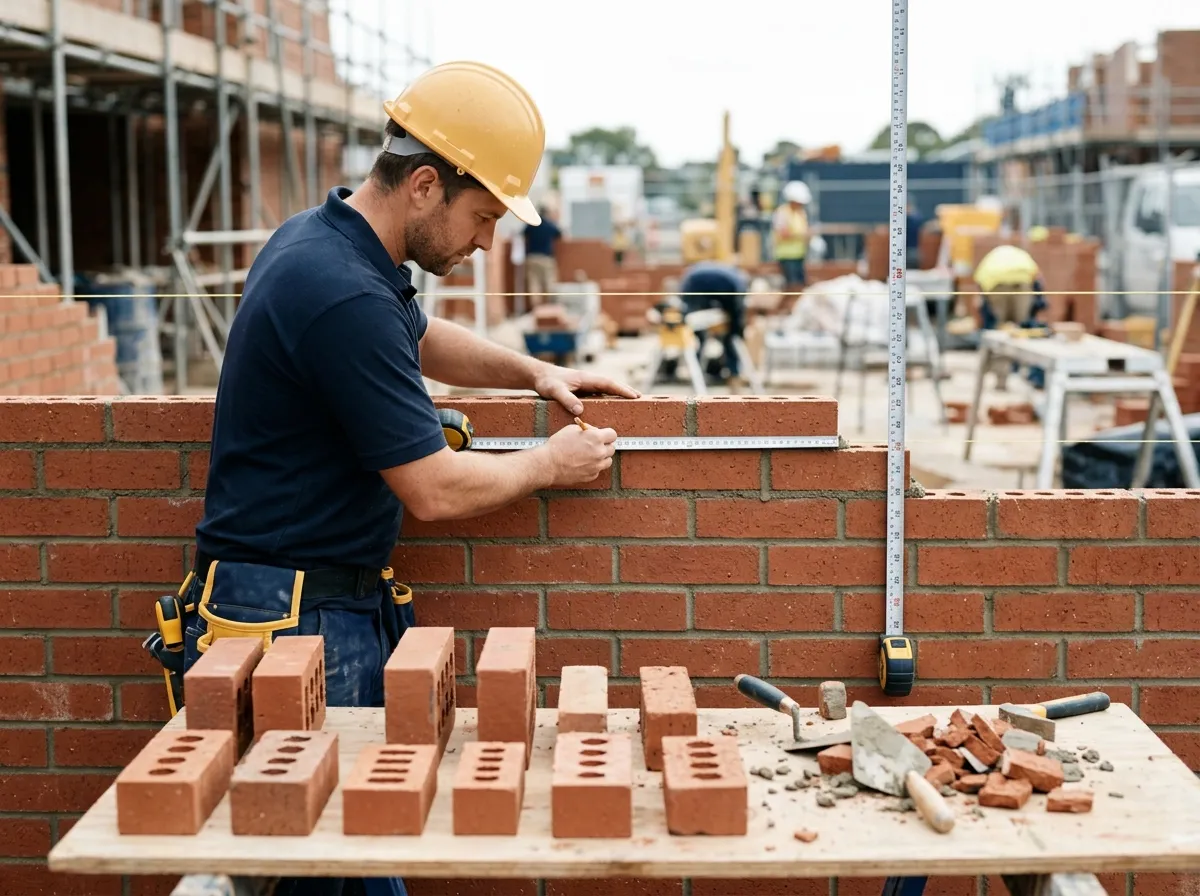
Measure Dimensions
Measure the overall length and height of the wall or masonry structure in feet or meters.
Choose Brick Size
Select standard US brick or modular dimensions, or input custom brick face measurements.
Factor Mortar & Waste
Include standard mortar joint thickness and add a waste buffer slider for cuts and breakage.
How Many Bricks Do I Need?
Quick Planning Note: Estimating masonry materials requires factoring in both individual brick face sizes and mortar joint thickness. This tool provides an efficient material estimate for planning purchases.
Estimating brick quantities requires factoring in both the nominal size of the masonry unit and the mortar joint that separates each brick. A standard US brick measures 7.625 inches long by 2.25 inches high, but when combined with mortar joints, each brick effectively occupies an expanded dimensional space on the wall face.
Whether you are building a small garden retaining wall, a brick veneer facade, or undertaking a large residential masonry construction project, using an accurate brick quantity calculator ensures you order the right number of bricks while avoiding costly material shortages or excessive pallet waste.
How to Calculate Bricks for a Wall
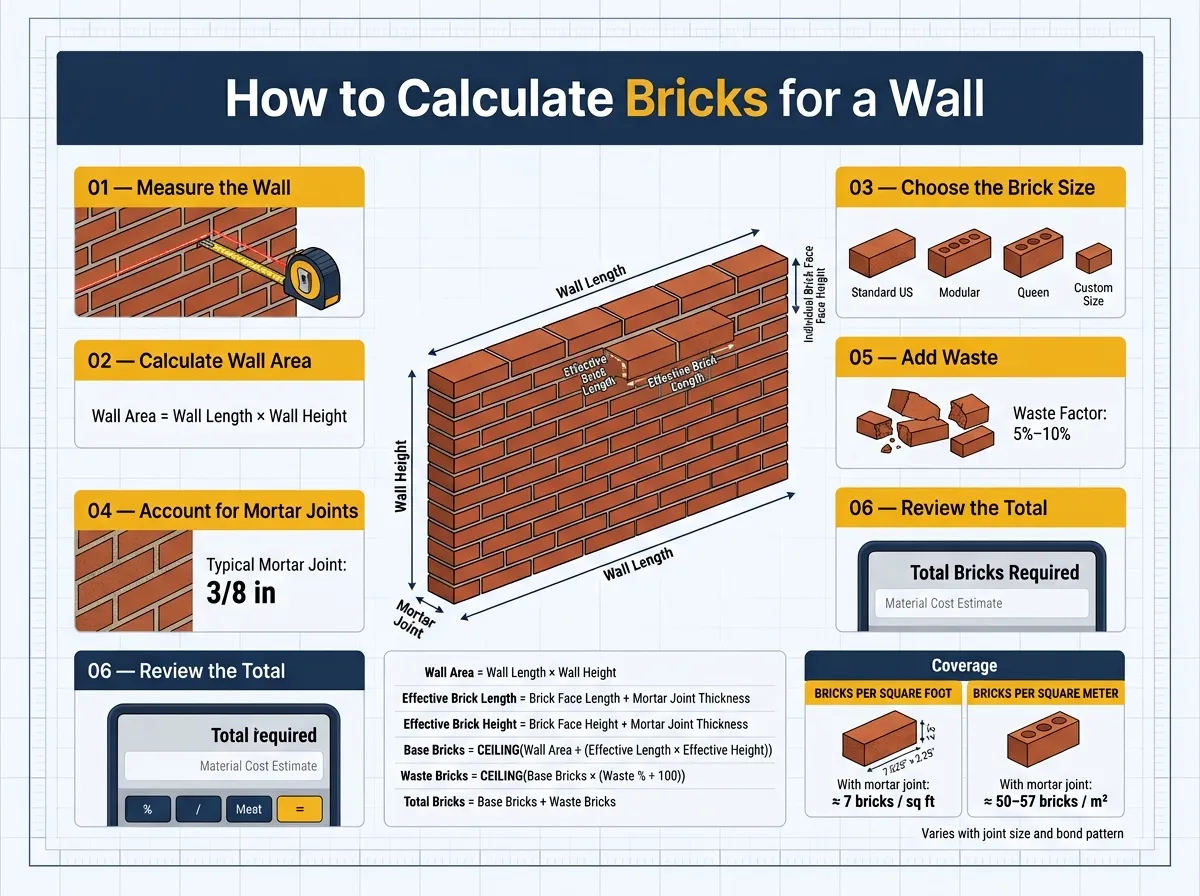
Follow these straightforward steps to manually or digitally determine your masonry material requirements:
Step 1 — Measure the Wall
Measure the total length and height of the structure accurately using a tape measure or laser distance meter.
Step 2 — Calculate Wall Area
Multiply wall length by wall height to find the gross square footage or square meter area of the project.
Step 3 — Choose the Brick Size
Select your brick format preset (Standard US, Modular, Queen) or enter custom face dimensions.
Step 4 — Account for Mortar Joints
Add standard mortar joint thickness (typically 3/8 inch) to calculate effective unit coverage.
Step 5 — Add Waste
Incorporate a 5% to 10% waste factor to accommodate cuts, chips, and transport breakage.
Step 6 — Review the Total
Check your total brick count and optional material cost estimates before placing your masonry order.
Brick Calculation Formula
This brick estimation tool uses structured mathematics to calculate material counts:
1. Wall Area = Wall Length × Wall Height
2. Effective Brick Length = Brick Face Length + Mortar Joint Thickness
3. Effective Brick Height = Brick Face Height + Mortar Joint Thickness
4. Base Bricks = CEILING(Wall Area / (Effective Length × Effective Height))
5. Waste Bricks = CEILING(Base Bricks × (Waste Percentage / 100))
6. Total Bricks = Base Bricks + Waste Bricks
Bricks Per Square Foot
The exact number of bricks per square foot varies depending on brick dimensions and mortar joint thickness. For standard US bricks (7.625" × 2.25") combined with standard ⅜-inch mortar joints, coverage averages approximately 7 bricks per square foot.
Bricks Per Square Meter
For metric construction projects, brick coverage is calculated per square meter. Standard metric modular bricks typically require around 50 to 57 units per square meter depending on joint sizing and bond pattern specifications.
Standard Brick Sizes
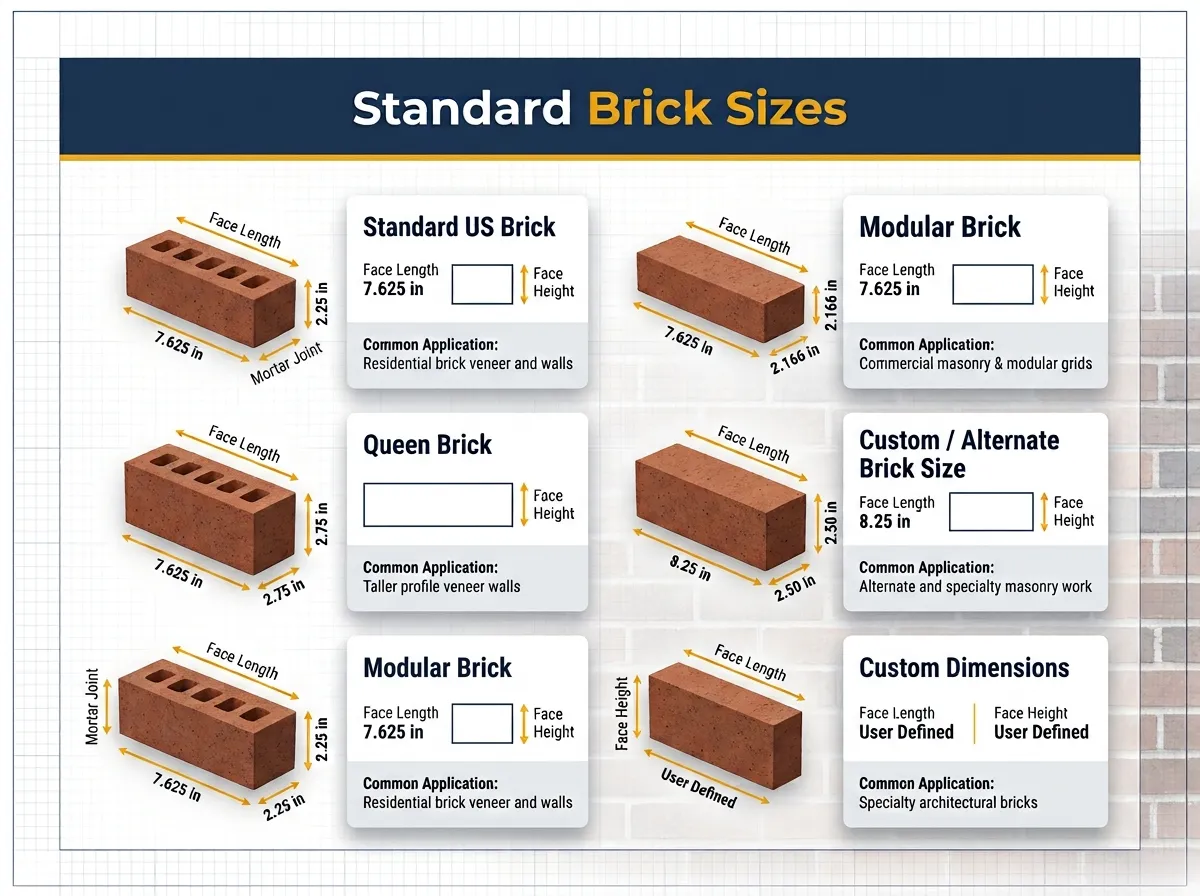
Refer to this quick reference guide for common brick formats supported by our calculator:
| Brick Format | Face Length | Face Height | Common Application |
|---|---|---|---|
| Standard US Brick | 7.625 in | 2.25 in | Residential brick veneer and walls |
| Modular Brick | 7.625 in | 2.166 in | Commercial masonry & modular grids |
| Queen Brick | 7.625 in | 2.75 in | Taller profile veneer walls |
| Custom / Alternate Brick Size | 8.25 in | 2.50 in | Alternate and specialty masonry work |
| Custom Dimensions | User Defined | User Defined | Specialty architectural bricks |
How Mortar Joints Affect Brick Quantity
Mortar joints serve a dual purpose: they structurally bond masonry units together and compensate for slight dimensional variances in clay bricks. Because mortar takes up space between each brick, a thicker joint means fewer total bricks are required per square foot.
Thinner Mortar Joint
Decreasing joint spacing reduces intervening mortar space, requiring a higher total brick count per square foot.
Thicker Mortar Joint
Increasing joint thickness expands effective unit coverage, lowering the overall brick quantity needed for the wall.
The standard residential mortar joint thickness is ⅜ inch (0.375"). Adjusting this value in our calculator instantly recalculates effective brick face dimensions to preserve estimation accuracy.
How Much Brick Waste Should I Allow?
Construction waste is an inevitable part of masonry work. Bricks frequently get chipped during transport, cracked during cutting around windows or corners, or broken during jobsite handling.
| Project Type / Condition | Suggested Planning Range |
|---|---|
| Simple Rectangular Wall | 5% to 7% |
| Standard Residential Veneer | 8% to 10% |
| Complex Facades / Arches / Openings | 12% to 15% |
Brick Cost Calculation
By entering an optional cost per brick, the calculator automatically estimates your total brick material expenses using the formula:
Total Brick Cost = Total Bricks × Cost Per Brick
Note: This subtotal covers brick units only and does not automatically factor in mortar bags, masonry sand, wall ties, flashing, reinforcement wire, or contractor labor fees.
Brick Calculator Example
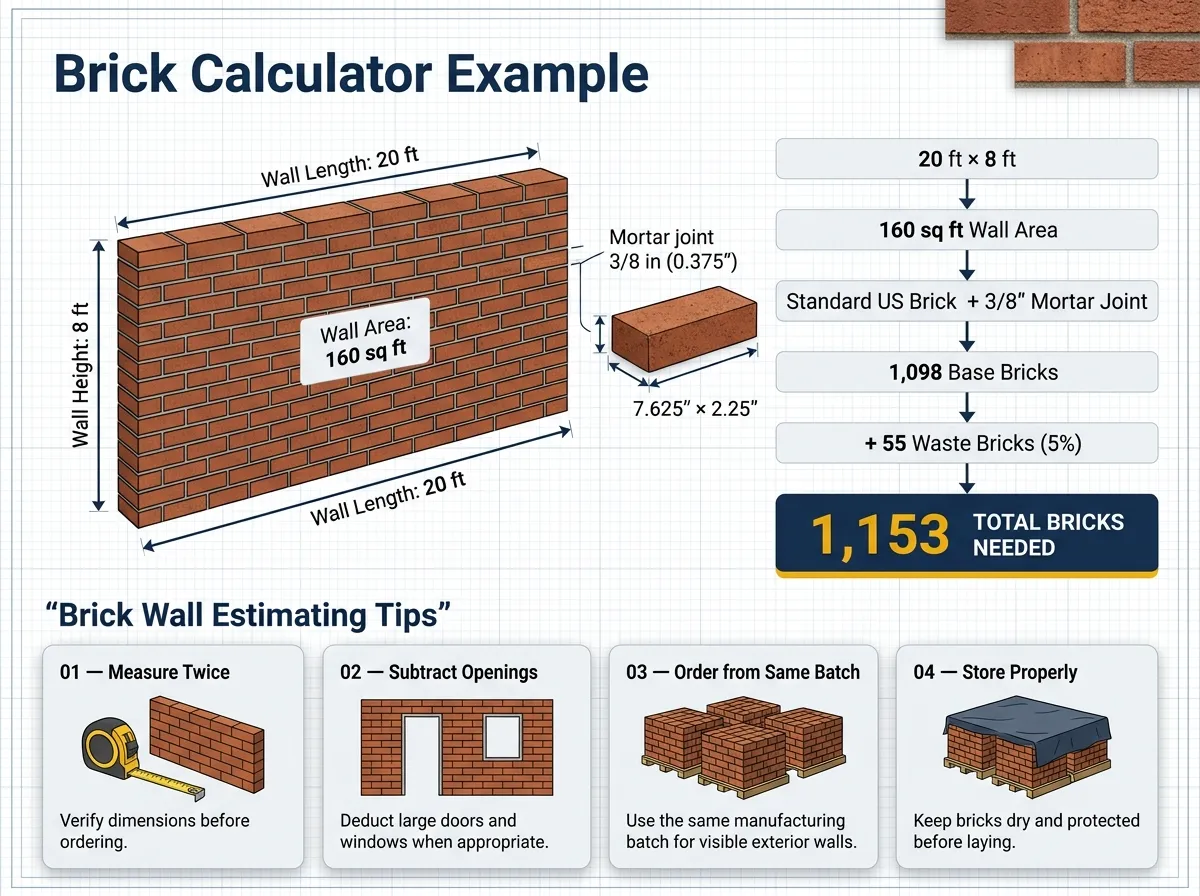
Consider a standard masonry construction scenario:
- Wall Length: 20 feet
- Wall Height: 8 feet
- Brick Format: Standard US Brick (7.625" × 2.25")
- Mortar Joint: 3/8 inch (0.375")
- Waste Allowance: 5%
Calculation Result: 160 sq ft wall area → 1,098 base bricks + 55 waste bricks = 1,153 total bricks needed.
Brick Wall Estimating Tips
- Measure Twice: Always verify dimensions before ordering to prevent costly ordering mistakes.
- Subtract Openings: For large projects, deduct the square footage of large doors and windows if necessary, though retaining some waste for cuts around frames is wise.
- Order from Same Batch: Ensure all bricks for visible exterior walls are ordered from the same manufacturing batch to guarantee color consistency.
- Store Properly: Keep brick pallets elevated on dry ground and covered with tarps to protect against moisture prior to laying.
Frequently Asked Questions (FAQ)
For a 20ft by 8ft wall (160 sq ft total area), using standard US bricks (7.625" × 2.25") with ⅜-inch mortar joints and a 5% waste factor, you will need approximately 1,153 total bricks (1,098 base bricks plus 55 waste bricks).
Measure your wall length and height to get square footage, select your brick size and mortar joint thickness, and apply a 5% to 10% waste factor using our calculator for instant results.
Standard US bricks with ⅜-inch mortar joints typically require approximately 7 bricks per square foot of wall face coverage.
Metric masonry projects typically require between 50 and 57 bricks per square meter depending on standard brick dimensions and mortar joint widths.
Yes. Mortar joint thickness expands the effective coverage space of each individual brick, meaning thicker joints reduce total brick counts.
A standard US brick face measures 7.625 inches long by 2.25 inches high (often referred to in nominal terms as 8" × 2⅔" including mortar).
Modular bricks have a slightly shorter face height (2.166 inches) engineered to align cleanly with standard building dimensions and masonry grids.
It is standard industry practice to add 5% to 10% extra bricks to your order using our waste percentage slider to account for cuts, chipping, and breakage.
Yes! Simply select "Custom Dimensions" from the brick preset dropdown menu to unlock and edit custom length and height values.
Yes, you can input your cost per individual brick to calculate total material expenses for your order.
No, the cost estimate covers brick units only. For mortar bag estimates, please use our dedicated Brick Mortar Calculator.
Yes, you can toggle measurement units between feet, inches, and meters for both wall length and height inputs.
What Our Users Say
MC
Mark Collins
Masonry Contractor
★★★★★
"This brick calculator helps streamline bidding on residential masonry jobs. Being able to factor mortar joints and waste is very practical."
JS
Jessica Scott
Homeowner
★★★★★
"We built a backyard garden retaining wall and this tool helped us estimate the number of bricks without having excess materials left over."
DR
David Reynolds
General Contractor
★★★★★
"Clean layout and works seamlessly on mobile devices right on the job site. Highly recommended for quick estimates."
AL
Andrew Larson
Construction Estimator
★★★★★
"Reliable calculation logic. The waste percentage slider and cost calculation feature make preparing client material estimates straightforward."
TM
Thomas Miller
Bricklayer
★★★★★
"I use this tool frequently. Being able to switch between standard and modular brick dimensions easily is very helpful."
SK
Sarah King
Renovation Contractor
★★★★★
"Clean interface with zero clutter. The ability to share calculations with clients via link has streamlined our preliminary proposals."
RP
Robert Patel
Site Supervisor
★★★★★
"Straightforward and dependable for our brick veneer jobs when planning material orders."
EW
Emily Watson
DIY Homeowner
★★★★★
"As someone with limited masonry experience, this tool helped me measure our courtyard wall and determine required quantities."
BH
Brian Henderson
Project Manager
★★★★★
"Fast loading and responsive. The math aligns well with standard masonry planning practices."
LN
Lisa Nelson
Small Builder
★★★★★
"The print report feature is convenient for generating clean breakdowns for material suppliers."
KG
Kevin Garcia
Construction Professional
★★★★★
"No annoying setup. Just enter dimensions and get straightforward brick and cost estimates."
AM
Amanda Moore
Homeowner
★★★★★
"Helpful calculator that made planning our backyard mailbox and BBQ island pillars much easier."