
Free construction calculators for quick, accurate estimates, measurements, and project planning
Cubic Yards Calculator
The perfect tool for any landscaping or construction project.
Total Volume Required
Cubic Yards
-
Cubic Feet
-
Cubic Meters
-
Cost Estimator (Optional)
$
Total Estimated Cost
-
How This Tool Calculates Cubic Yards
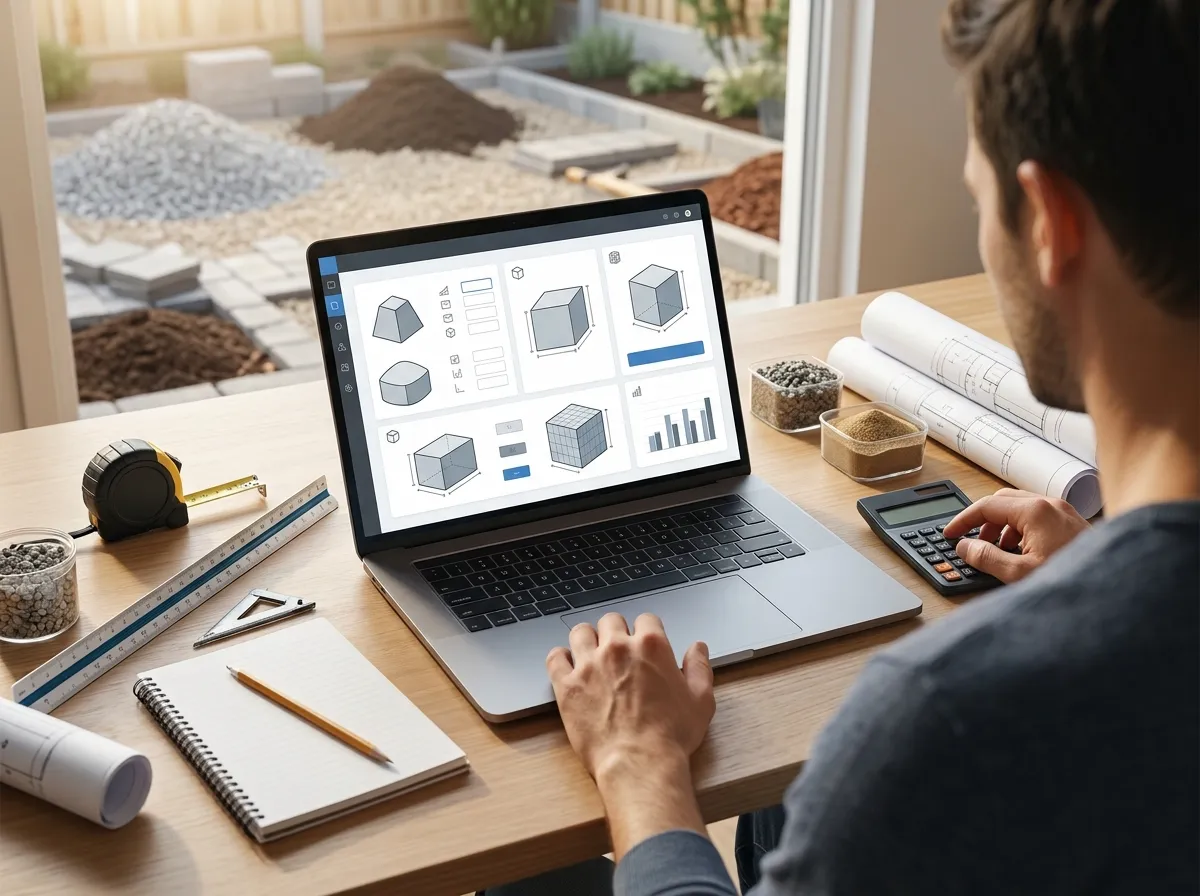
Our calculator follows a precise four-step process for accurate results.
Standardize Units
First, all your dimensions are converted into feet to ensure every measurement is consistent before any calculation begins.
Calculate Area
Using the correct geometric formula for your selected shape, the tool calculates the total surface area in square feet.
Find Total Volume
The surface area is then multiplied by the depth (in feet) to determine the project's total volume in cubic feet (ft³).
Convert to Yards
Finally, the total cubic feet is divided by 27 (since 1 cubic yard = 27 cubic feet) to give you the final measurement in cubic yards.
Understanding Cubic Yard Measurements
A cubic yard is the standard volume measurement for bulk construction and landscaping materials. Understanding this measurement ensures you order the exact amount needed for a successful, cost-effective project.
What is a Cubic Yard?
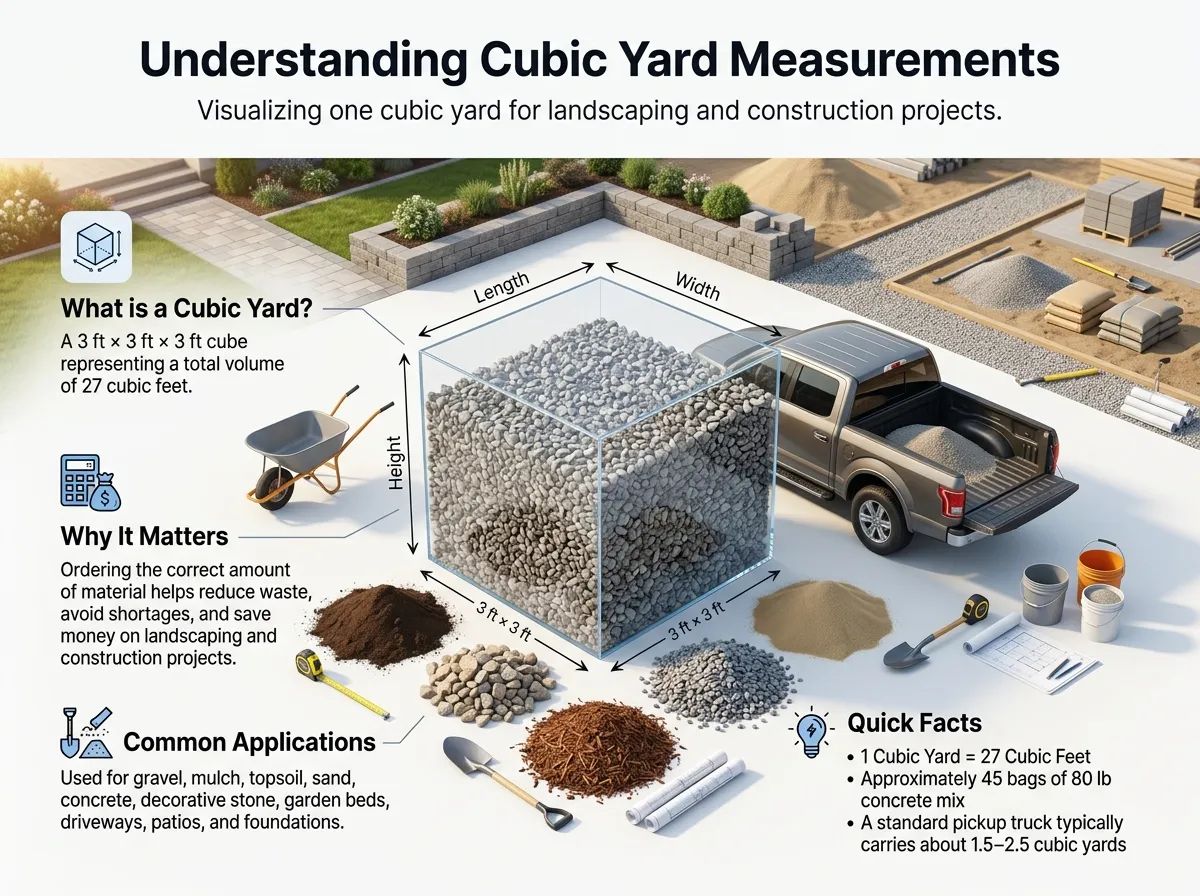
Picture a perfect cube that measures exactly 3 feet long, 3 feet wide, and 3 feet deep. This specific volume equals one cubic yard, which is also equivalent to 27 cubic feet.
Why It Matters
Suppliers sell most bulk materials by the cubic yard. Calculating this number accurately prevents you from overpaying for excess material or running short mid-project.
Common Applications
You will use this measurement for almost any major outdoor job. It's the standard metric for pouring concrete foundations, building garden beds, or laying a stone driveway.
Quick Facts
-
1 Cubic Yard is precisely equal to 27 Cubic Feet.
-
It takes approximately 45 standard bags (80 lb each) of concrete mix to make one cubic yard.
-
A standard full-size pickup truck bed typically holds between 1.5 to 2.5 cubic yards of material.
Tips for Getting the Most Accurate Results
Follow these best practices to avoid common measuring mistakes and ensure a successful project.
Measure Depth Correctly
Depth is often the smallest measurement but causes the largest errors. Measure your depth in inches, check multiple spots across the area, and use the average thickness for your calculation.
Use Consistent Units
Mixing feet and inches is a common pitfall. Our calculator handles this for you by allowing you to select specific units per dimension, ensuring all math is properly standardized.
Account for Uneven Ground
If your project site has slopes, bumps, or irregular grading, take depth measurements at the highest and lowest points. Average these numbers to get a more accurate representation.
Order Extra Material
Materials like soil, gravel, and mulch will settle and compact over time. Always order an additional 5-10% to account for compaction, spills, and slight measuring errors.
Double-Check Dimensions
The old rule "measure twice, order once" applies perfectly here. Verify your length, width, and depth one last time before placing your final material order with the supplier.
Common Project Applications
See how our calculator can be used for various landscaping and construction jobs.
Concrete Slabs & Patios
Accurately calculate the concrete needed for a new patio, shed foundation, or sidewalk. Use the 'Rectangle' or 'Square' shape for perfect estimates.
Garden Beds & Mulch
Determine the exact amount of topsoil, compost, or mulch for your garden beds. Prevents over-ordering and saves you money.
Gravel Driveways
Calculate the volume of gravel or crushed stone required for a new driveway or for refreshing an existing one. Ensures a solid, even surface.
Material Weight Estimates
Planning your project requires knowing more than just volume. Below are common material weight estimates per cubic yard to help you arrange for delivery and equipment.
| Material | Approx. Weight per Cubic Yard (lbs) |
|---|---|
| Concrete (wet) | ~4050 lbs (2.0 tons) |
| Gravel / Crushed Stone | ~2400 - 2900 lbs (1.2 - 1.45 tons) |
| Topsoil (dry) | ~2000 - 2200 lbs (1.0 - 1.1 tons) |
| Sand (dry) | ~2600 - 3000 lbs (1.3 - 1.5 tons) |
| Mulch (wood, dry) | ~500 - 800 lbs (0.25 - 0.4 tons) |
Note: Weights are estimates. Always confirm with your material supplier for precise figures.
Pro Tips for Accurate Orders
Order a Little Extra
It's wise to order 5-10% more material than calculated. This covers spills, uneven ground, and compaction, ensuring you don't run short.
Double-Check Depths
For slabs and foundations, uniform depth is critical. Measure depth at several points across the area and use the average for your calculation.
Consult Your Supplier
Before placing a final order, discuss your project with your material supplier. They can provide advice on material types and account for local factors.
Frequently Asked Questions (FAQ)
A cubic yard is a measure of volume. It's the volume of a cube with sides that are 1 yard (3 feet) in length. One cubic yard is equal to 27 cubic feet (3 ft × 3 ft × 3 ft). It's a common unit for materials like concrete, mulch, and soil.
To calculate cubic yards for a rectangular slab:
- Measure the length and width in feet.
- Measure the depth (thickness) in inches.
- Use our calculator and select the "Rectangle" shape.
- Enter your measurements. The formula is: (Length ft × Width ft × (Depth in / 12)) / 27. Our calculator does this for you automatically.
The weight of a cubic yard depends heavily on the material. For example:
- Concrete: ~4050 lbs
- Gravel: ~2400-2900 lbs
- Topsoil (dry): ~2000 lbs
- Mulch (dry): ~500-800 lbs
This depends on the bag size. A standard 80 lb bag of concrete mix yields about 0.6 cubic feet of concrete. Therefore, you would need approximately 45 bags (27 cubic feet / 0.6 cubic feet per bag) to make one cubic yard. For mulch, a 2-cubic-foot bag would require 13.5 bags to make a cubic yard.
Yes, especially for materials like topsoil, mulch, and gravel. These materials will settle and compact over time. As a rule of thumb, it's a good idea to add 5-10% more to your total calculated volume to account for compaction and ensure you have enough material for your project.
For complex or irregular shapes, the best approach is to break the area down into smaller, regular shapes (like rectangles, squares, and triangles). You can then calculate the volume for each smaller shape using this tool and add all the volumes together to get your final total.
It is always recommended to round up your final volume measurement. It's far better to have a small amount of leftover material than to run short and have to place a second, often more expensive, small delivery order. Our "Order a Little Extra" pro tip is based on this principle.
Our calculator provides a precise mathematical volume based on the dimensions you enter. The accuracy of your final material order depends entirely on the accuracy of your measurements. Always double-check your length, width, and especially depth measurements at multiple points before ordering.
Trusted by Professionals and DIYers
See what our users are saying about this tool.
John Sullivan
General Contractor
"This calculator is a lifesaver. I use it on-site daily to get quick and accurate concrete estimates for slabs and footings. The multiple shape options are fantastic."
Maria Lopez
Landscaper
"Perfect for calculating mulch for garden beds, even the weirdly shaped ones! The cost estimator helps me give my clients instant quotes. Highly recommend."
David Bennett
Homeowner
"I needed to figure out how much gravel I needed for a driveway project. This tool was super easy to use, and I ended up ordering the perfect amount. No waste!"
Sarah Chen
Architect
"The accuracy of this calculator is impressive. It handles complex shapes like trapezoids flawlessly, which is essential for foundation estimates. A vital tool for architects and designers."
Michael Rodriguez
DIY Enthusiast
"Finally, a calculator that makes sense! I was planning a backyard patio and this tool helped me figure out the exact amount of gravel and sand I needed. The infographic is a brilliant touch."
Emily White
Event Planner
"Used this to calculate filler for large decorative planters for an outdoor wedding. It saved me from guessing and buying too much material. Simple, fast, and very practical."
Help Us Improve!
We are constantly working to make our tools better for you. If you have an idea for a new feature, a suggestion, or have noticed an issue, we would be grateful to hear from you.
Suggest an Improvement