
Free construction calculators for quick, accurate estimates, measurements, and project planning
Drainage Pipe Slope Calculator
Calculate exact pipe slope, drop, and flow for compliant drainage.
Input Parameters
Affects friction & flow capacity
Select specific fixture or system type
Override standard slope calculations
Calculate slope based on existing drop
Entering this enables the "Self-Cleaning Velocity" check.
Calculation Results
Live AnalysisCalculated/Rec. Slope
--
Enter length to calculate
Max Pipe Capacity
--
Maximum gravity flow potential
Total Drop Required
--
Requires run length
Self-Cleaning Check
Awaiting inputs
Target: > 2.0 ft/s (Scouring)
Est. Flow Velocity
--
Based on your Flow Rate input
Code Compliance
PENDING...
Standard Range: 1/8" - 1/2" per ft
Low Slope Warning
The calculated slope is below 1%. While this may be necessary for long runs, it requires perfect pipe bedding (gravel/sand) to prevent bellies (dips) where solids can settle and cause blockages.
Mastering Drainage Dynamics
Understanding the science behind gravity flow is crucial for preventing clogs, leaks, and system failures. This guide covers everything from velocity physics to soil mechanics.
1. Velocity & Standards
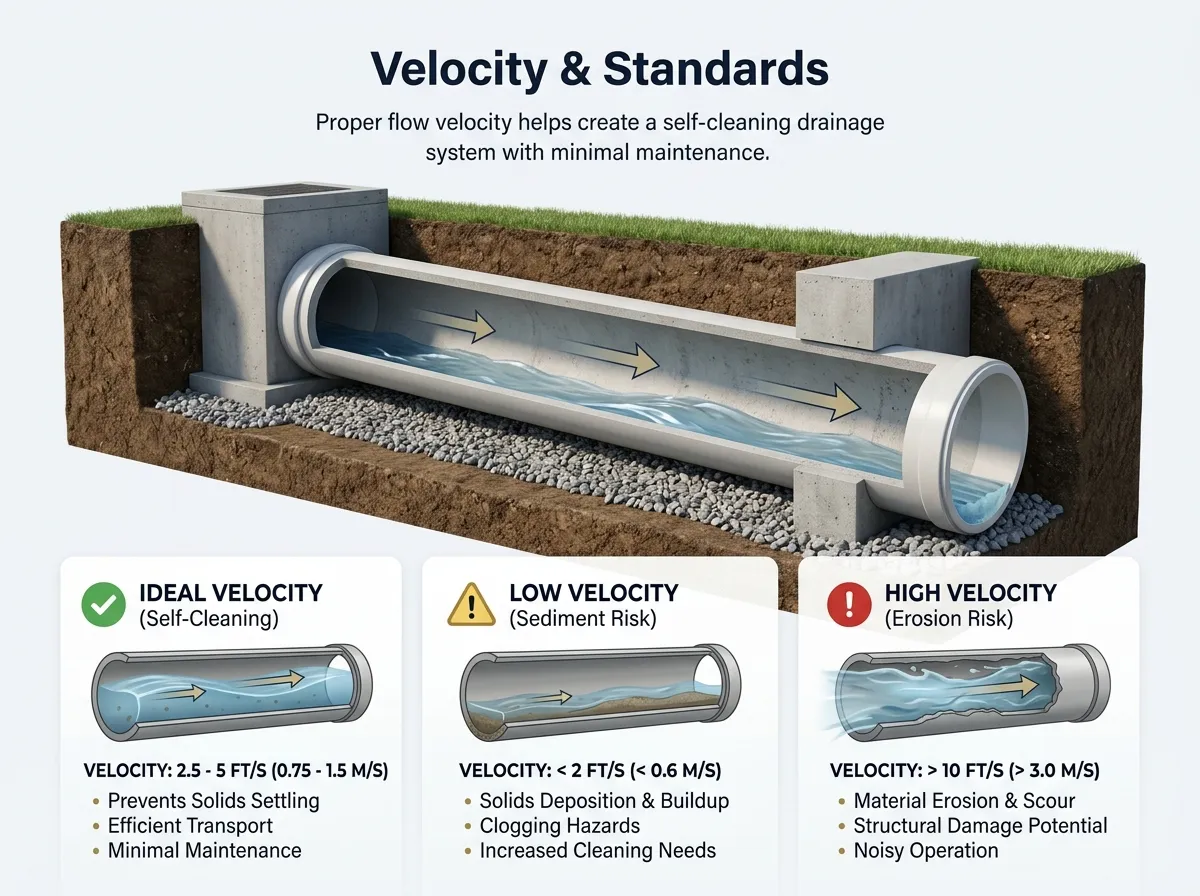
Achieving the correct flow velocity is the most critical aspect of drainage design. Understanding these fundamental physics principles ensures a self-cleaning system that requires minimal maintenance.
Velocity Sweet Spot
Drainage isn't simply about water running downhill; it's about solids suspension. The water acts as a conveyor belt for waste.
If the slope is too flat (Low Velocity), the water moves too slowly to carry the solids, causing them to settle at the bottom of the pipe and form a clog.
If the slope is too steep (High Velocity), the water rushes past the solids, leaving them stranded dry on the pipe floor.
The industry standard "Sweet Spot" is 2 feet per second (fps), known as scouring velocity, which self-cleans the pipe walls.
Too Slow (Clogs)
Target: 2 ft/s
Too Fast (Dry)
Standard Rules
-
1Pipe ≤ 3 inches
Requires a minimum slope of 1/4" per foot (2.08%). Smaller pipes have higher friction relative to their volume, so they need a steeper angle to maintain scouring velocity.
-
2Pipe ≥ 4 inches
Requires a minimum slope of 1/8" per foot (1.04%). Larger pipes allow for deeper water flow, which maintains velocity better even at flatter angles.
2. Slope by System Type
Drainage requirements vary significantly depending on what the pipe is carrying. Solid waste systems demand strict adherence to slope codes compared to simple water runoff.
Sanitary Sewer (Blackwater)
This system carries toilet waste and other solids. Strict adherence to the 1/4" or 1/8" per foot rule is mandatory.
Deviating from this slope significantly increases the risk of "solids dropout" and necessitates frequent, expensive hydro-jetting to clear blockages.
Storm / French Drain (Greywater)
These systems primarily carry rainwater or groundwater. Because they transport fewer heavy solids, they are much more forgiving.
In challenging terrain with limited elevation drop, slopes as shallow as 0.5% to 1% can effectively move water to a discharge point.
3. Pipe Roughness Impact
Not all pipes are created equal. The interior roughness, measured by the Manning's Roughness Coefficient (n), determines how much friction the water encounters. Smoother pipes can move more water at the same slope.
PVC / ABS (Plastic)
Best Flow (n=0.009)
The modern standard for residential drainage. Its glass-smooth interior offers the least resistance, allowing for maximum capacity and velocity.
Cast Iron
Good (n=0.012)
Often used in commercial buildings for its durability and sound-dampening qualities. It is slightly rougher than plastic, reducing flow velocity by 10-15%.
Corrugated Pipe
High Friction (n=0.024)
Common in landscape drainage. The internal ridges create significant turbulence, slowing water down. It requires a much steeper slope to achieve the same self-cleaning results as smooth pipe.
4. Impact of Soil Type
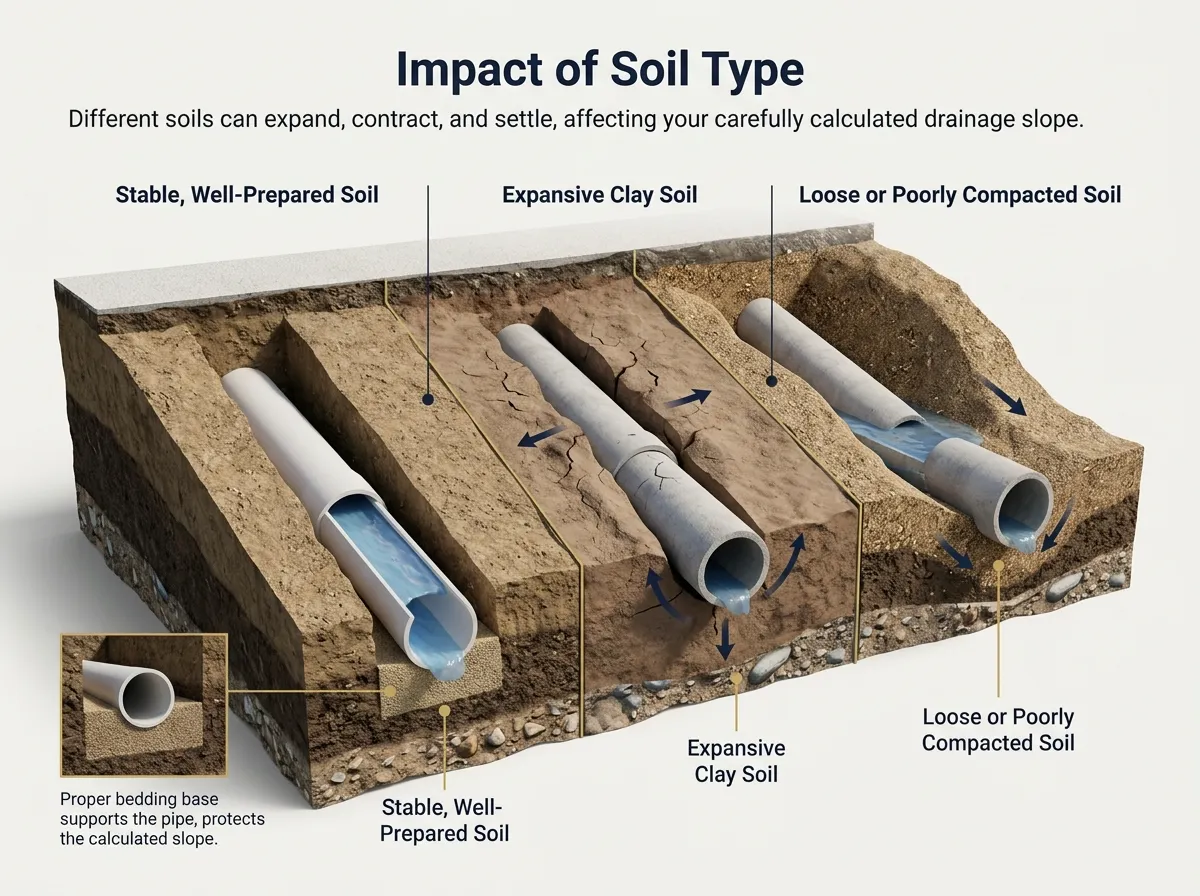
The soil surrounding your pipe dictates how much preparation you need to do. Different soils expand, contract, and settle differently, which can ruin your perfectly calculated slope if ignored.
Sandy Soil
Highly permeable and relatively stable. Water drains away quickly, reducing hydrostatic pressure on the pipe structure.
Bedding: 2-3" Sand/Gravel
Loam / Mix
A mix of sand, silt, and clay. Offers moderate drainage capabilities. Standard compaction practices usually suffice.
Bedding: 4" Crushed Stone
Heavy Clay
Retains water and expands/contracts significantly (heaving). This movement can create detrimental "bellies" in your line.
Bedding: 6"+ Comp. Gravel
5. Drainage Layout Patterns
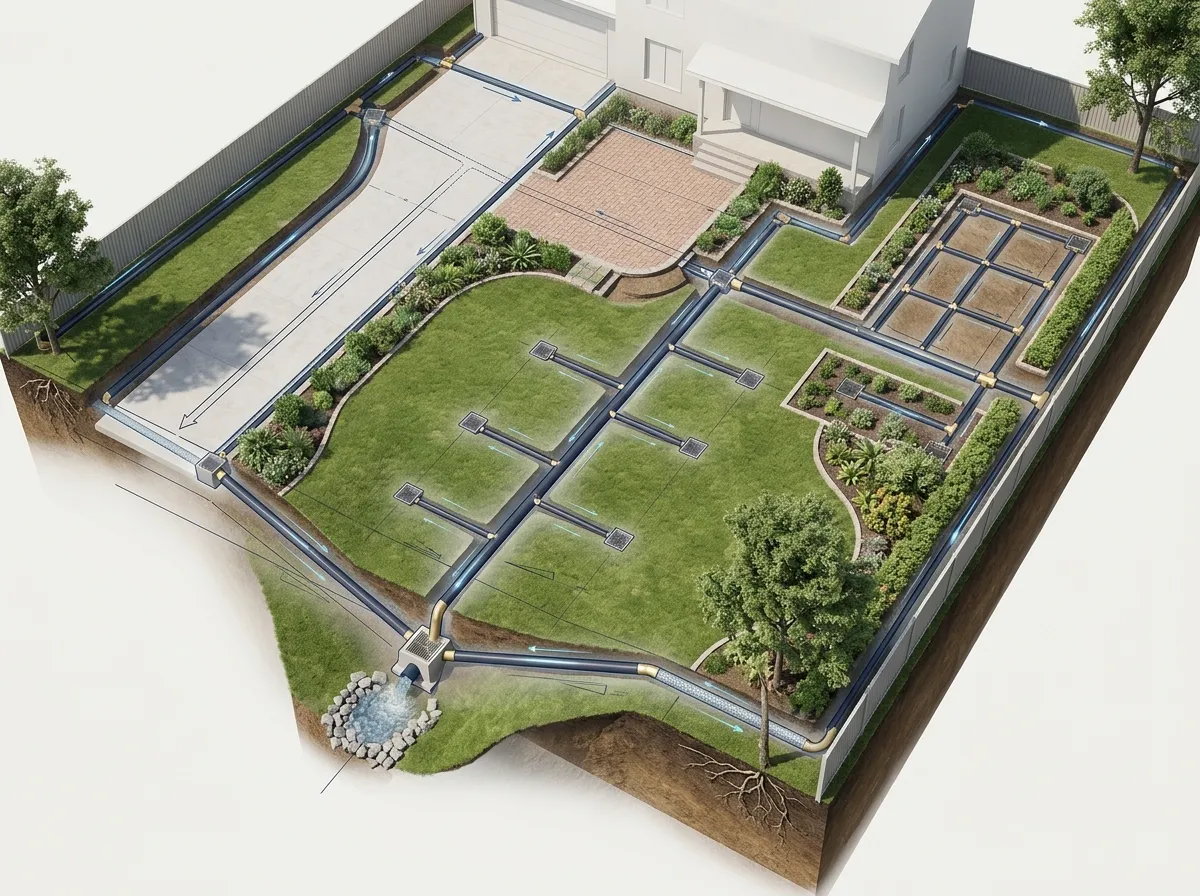
Choosing the right physical layout pattern maximizes water collection and optimizes flow paths for your specific yard or site geometry.
Herringbone
BEST FOR: LARGE YARDS
This pattern uses angled lateral lines that feed into a central main line, resembling fish bones. It covers maximum surface area efficiently.
Gridiron
BEST FOR: OBSTACLES
Features parallel lateral lines that connect to a main perpendicular line. Easier to install around rectangular perimeters, fences, or sports fields.
Single Line
BEST FOR: DOWNSPOUTS
A focused, direct approach used to extend a gutter downspout far away from the foundation or to quickly drain a single low-lying depression.
6. Essential Gear
Professional results require professional measurement tools. Relying solely on 'eyeballing' a trench slope guarantees failure over long distances.
Laser Level
The absolute gold standard for accuracy over extended distances.
Smart Level
Provides instant digital % grade readouts for checking pipe sections.
String Line
A low-tech but highly effective visual guide for keeping trenches straight.
Marking Paint
Essential for precisely mapping out the excavation route before digging.
7. How to Measure Slope
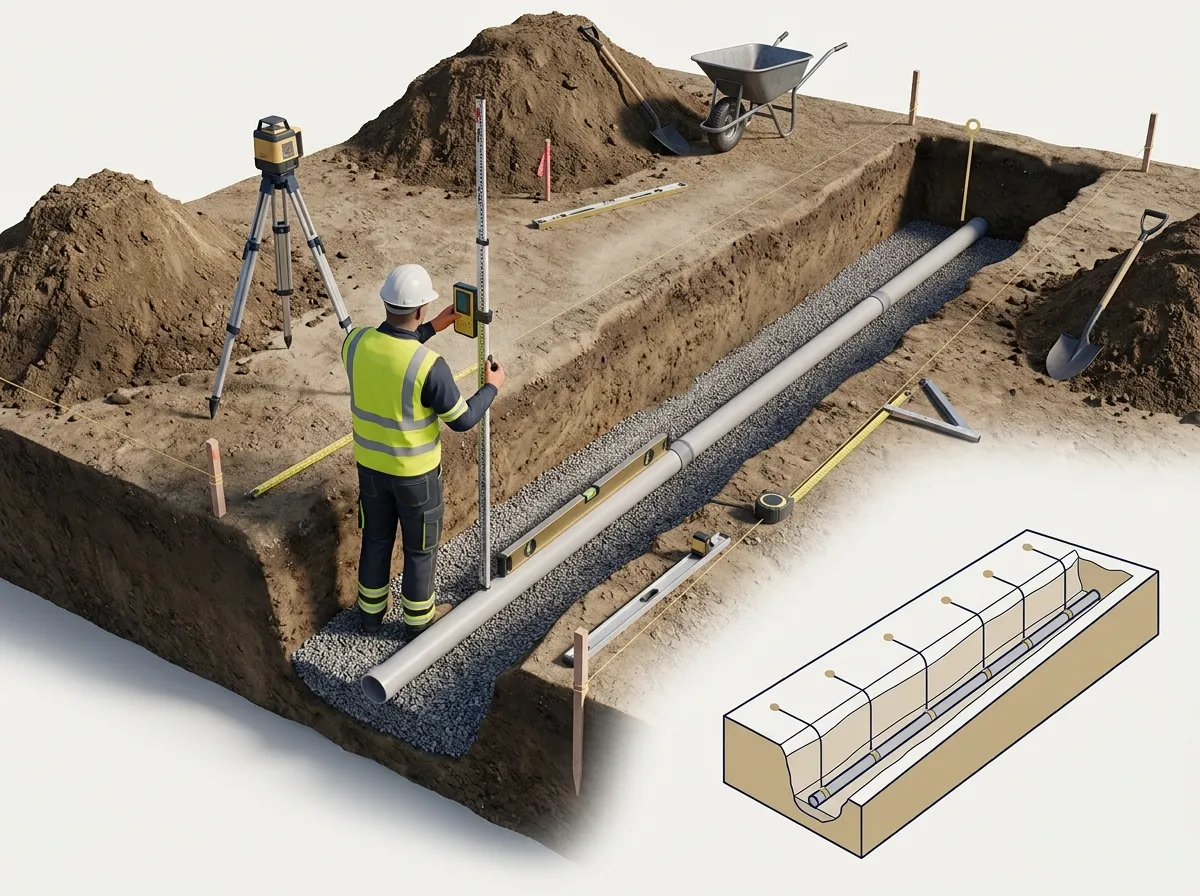
Translating your calculated slope into a physical trench requires a methodical approach to ensure accuracy over long distances.
1
Establish Elevations
Determine the "Invert Elevation" (the bottom inside of the pipe) at your source (where water enters) and your discharge point (where water exits).
The source elevation must be physically higher than the discharge elevation to allow for gravity flow.
2
Calculate Total Drop
Measure the total length of the intended pipe run in feet or meters.
Use our calculator above to determine exactly how many inches of vertical drop you need over that specific distance to maintain a proper 1/4" or 1/8" per foot slope.
3
Set Stakes & String
Drive sturdy wooden stakes every 10 feet along your path. Mark the intended excavation depth on each stake, adding deeper marks as you move downstream.
Run a tight string line between these marks to act as a visual guide for your digging.
8. Troubleshooting Guide
Even well-planned systems can experience issues. Identifying the physical symptoms early can pinpoint where the slope or installation failed, saving thousands in repair costs.
Gurgling Drains
Likely Cause: Poor venting or negative slope.
When a pipe lacks air, water creates a vacuum as it drains, pulling air forcefully through P-traps (causing the gurgling sound).
Check roof vents for bird nests or verify the horizontal pipe isn't back-pitched.
Soggy Yard Zones
Likely Cause: Pipe "Belly" (Sag).
If the ground wasn't compacted correctly during installation, the pipe sinks in the middle.
Water constantly sits in this low spot, slowly leaking out or creating a swampy area directly above it. Requires re-trenching.
Frequent Clogs
Likely Cause: Slope too Flat.
If you consistently get clogs despite careful use and proper venting, your slope is highly likely below the required 1/8" per foot.
Solids are settling because velocity is too low. You may need to install a sewage ejector pump if gravity falls short.
9. Permits, Safety & Glossary
Navigating legal requirements and understanding industry terminology is a crucial final step before beginning any significant excavation or connection.
Permits & Safety
-
Call 811 Before You Dig Striking a utility line is extremely dangerous and expensive. This free service marks all underground utility lines for you before you start.
-
City Connections Connecting to a municipal sewer main almost always requires hiring a licensed plumber and obtaining a formal city inspection permit.
-
Daylighting Rules You cannot simply dump diverted water onto a neighbor's property. Ensure your discharge point is contained within your property lines or feeds a legal storm drain.
Pro Glossary
- Invert Elevation
- The exact elevation of the lowest point on the inside of the pipe. All rigorous slope calculations use this specific measurement, not the top of the pipe.
- Crown
- The very top (outside diameter) of the physical pipe structure.
- Cleanout
- An accessible surface-level opening in a drainage line equipped with a removable cap, used to allow snake or camera access for maintenance.
- Effluent
- Liquid waste (sewage or industrial) that is discharged into a river, the sea, or a septic field system.
10. Final Inspection Checklist
Always conduct a thorough inspection before backfilling. Once the trench is buried, correcting slope mistakes becomes exponentially more difficult and expensive.
What Our Users Say
AD
Alex Dawson
DIY Homeowner
"This tool was a lifesaver for my backyard drainage project. The calculations were spot-on, and the advice on self-cleaning velocity helped me avoid a major mistake. Highly recommended!"
MK
Maria Kowalski
Landscape Architect
"As a professional, I was intimidated by the math involved in laying pipe initially. This calculator made it incredibly simple. The known drop feature is fantastic! Saved me hours of guesswork."
JT
James Thompson
Professional Plumber
"Accurate and easy to use. I use this for quick checks on job sites. The pipe material selection is a great touch for getting precise flow data."
SW
Sarah Williams
Site Manager
"Finally a tool that explains the 'why' behind the numbers. The velocity warnings helped us correct a flat run before inspection."
RC
Robert Chen
Civil Engineer
"I appreciate the inclusion of Manning's equation variables. It's rare to find a free online tool that adjusts for pipe material roughness accurately."
ED
Emily Davis
Garden Designer
"Great for planning French drains. It would be nice to have a print-friendly version, but the share feature works well enough for my clients."
MB
Michael Brown
General Contractor
"Simple, fast, and no annoying popups. I use this on my phone right in the trench to verify the grade before we glue anything."
LM
Linda Martinez
Real Estate Developer
"Helped us plan the sewer connection for a new sub-division. The 'Pipe Capacity' check is a very useful feature for preliminary planning."
DW
David Wilson
Home Inspector
"I recommend this to clients who are worried about their basement drainage. It helps them understand why proper slope is non-negotiable."
Frequently Asked Questions
Most codes require 1/4 inch per foot (2%) for pipes 3" or smaller, and 1/8 inch per foot (1%) for pipes 4" or larger. This ensures water moves fast enough to clean the pipe.
The absolute minimum allowed by most plumbing codes (IPC/UPC) for a 4-inch pipe is 1/8 inch per foot (approx. 1.04% grade). However, nearly all professional plumbers recommend sticking to 1/4 inch per foot whenever possible to provide a better safety margin against clogs.
For a standard 1/4 inch per foot slope, you need 25 inches of drop over 100 feet.
For a minimum 1/8 inch per foot slope, you need 12.5 inches of drop over 100 feet.
Always measure from the bottom (invert) of the pipe, not the top.
Yes. If the slope exceeds 1/2 inch per foot (approx 4%), you risk "liquids outrunning solids," where water flows too fast to carry waste, leading to dry clogs. If you need to drop elevation quickly, use a vertical drop (stack) rather than a steep diagonal run.
The basic formula is: Slope = Total Drop / Length of Run.
To get a percentage, multiply the result by 100.
Example: A 6-inch drop over 50 feet (0.5 ft / 50 ft) = 0.01, which is a 1% slope.
Technically, yes. PVC (Plastic) has a smoother interior (Manning's n = 0.009) than Cast Iron (n = 0.012), meaning water flows faster in PVC at the same angle. While building codes usually enforce the same minimums for both, PVC performs significantly better in low-slope situations.
A French drain is a trench filled with gravel and a perforated pipe that redirects surface water and groundwater away from an area. It relies on the same slope principles (minimum 1%) as solid pipe to function correctly without silting up.
Generally, yes, for outdoor gravity sewer lines. SDR 35 has a thinner wall than Schedule 40 but flows slightly better due to a larger internal diameter. However, Schedule 40 is stronger and is legally required under buildings or driveways.