
Free construction calculators for quick, accurate estimates, measurements, and project planning
LVL Beam Span Calculator
Calculate the preliminary LVL beam size based on span, uniform load, and tributary width.
Distance between supports.
Pounds per Square Foot (Live + Dead).
Width of floor/roof area supported by this beam.
Additional Considerations
Advanced Engineering Required
Point loads, cantilevers, and multi-span beams involve complex forces that this simple calculator cannot safely predict. Results are disabled for these conditions. Please consult a structural engineer.
Results
Preliminary Beam Size:
--
Number of Plies:
--
Structural Checks (2.0E 2850Fb LVL):
Total Deflection
--
Limit: L/360
Bending (Strength)
--
Limit: 2850 psi
Shear (Slicing)
--
Limit: 285 psi
Maximum Deflection:
0.000
inches
Bearing Required:
0.00
inches
Calculations include beam self-weight. Assumes standard 2.0E 2850Fb LVL.
Important Limitations: This calculator is a preliminary sizing tool for simple, uniformly distributed loads only. It does not replace structural-engineer review, manufacturer-specific design tables, local building code requirements, or stamped drawings where required.
LVL Span & Size Chart PDF
Download our quick-reference LVL beam size and span chart for common 2.0E LVL applications.
How to Use the LVL Beam Calculator
Size your beams correctly for safe residential construction.
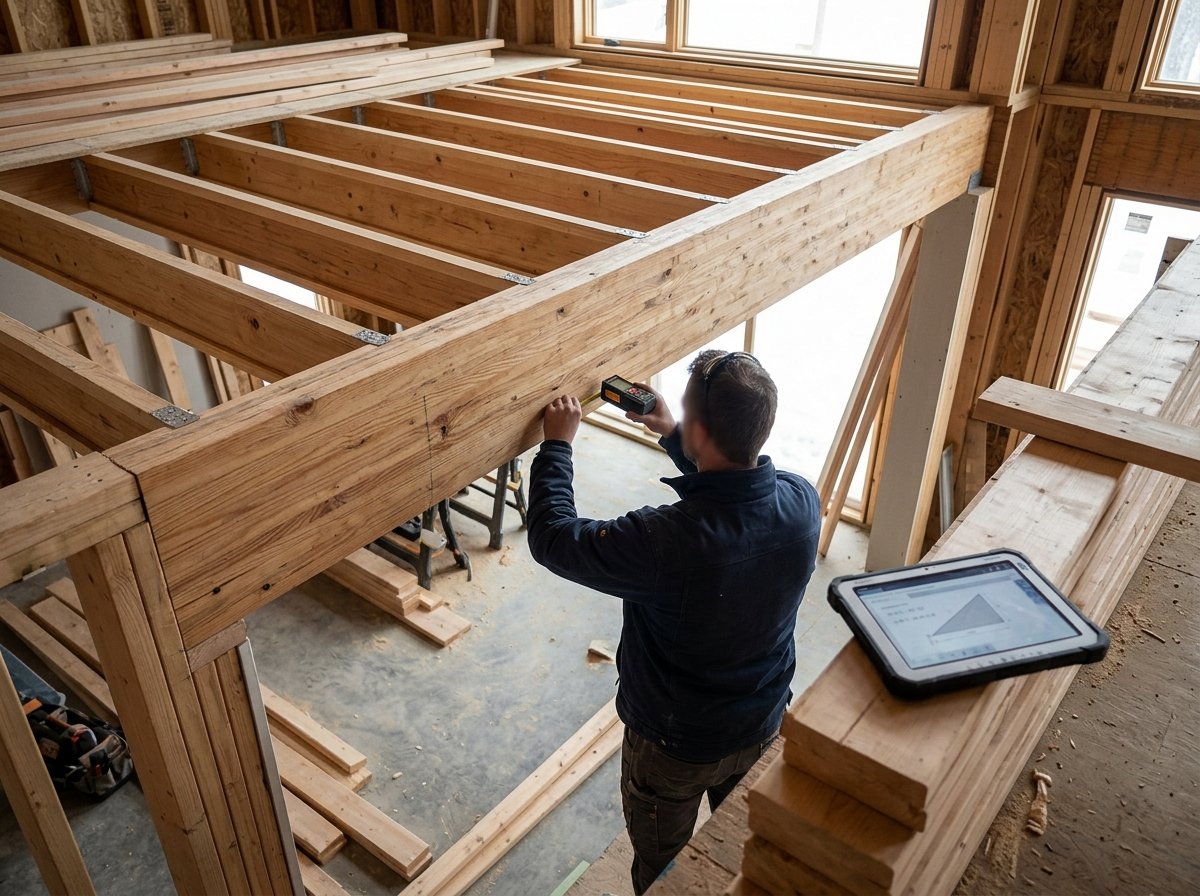
Measure the Span
Determine the clear distance between the supporting posts or walls. This is your "Beam Span".
Identify Load Width
Calculate the "Tributary Width"—how wide of a floor strip this beam supports. Usually half the joist span on each side.
Get Instant Results
The tool instantly calculates the required depth and number of plies (layers) of LVL needed for your load.
Common LVL Applications
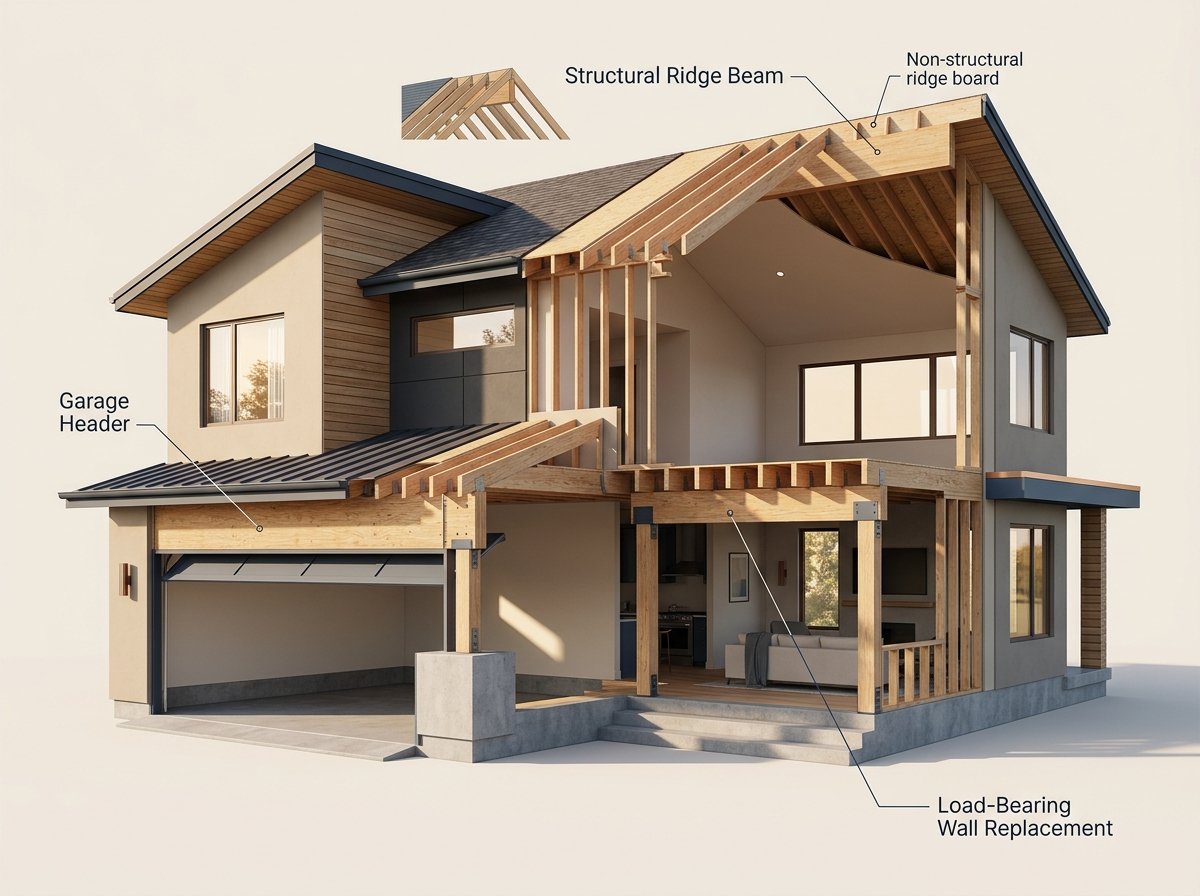
Sizing Garage Door Headers
Garage headers are the most common use for LVLs. For a standard 16-foot double car door, typical spans require substantial depth to prevent sagging. Ensure you calculate for roof loads if there is a second story above.
Replacing Load-Bearing Walls
When opening up a floor plan, you are replacing a continuous wall with a single beam. This concentrates weight on two points (posts). Check your "Point Loads" carefully to ensure your foundation can handle the concentrated weight.
Ridge Beams vs. Ridge Boards
A ridge board is non-structural. A ridge beam (often LVL) carries half the roof load. If you are vaulting a ceiling and removing rafter ties, you need a structural ridge beam sized correctly.
Understanding Structural Loads
What is Tributary Width?
Tributary width is the strip of floor or roof that relies solely on your beam for support. Imagine it as the "zone of influence" for that beam.
Load Types Explained
Loads determine how much strength is needed. Most floor beams carry a "Uniform Load" spread evenly across the span.
DL
Dead Load (10-20 PSF)
Permanent weight: joists, subfloor, drywall, flooring.
LL
Live Load (30-40 PSF)
Variable weight: people, furniture, snow.
Understanding LVL Grades
Laminated Veneer Lumber comes in different grades. Our calculator assumes the industry standard.
2.0E 2850Fb (Standard)
The most common grade. *Used in this calculator
Stiffness (E): 2.0 Million PSI
Strength (Fb): 2850 PSI
Common Uses: Headers, beams, hip/valley rafters in residential framing.
1.9E 2600Fb (Economy)
Slightly lower capacity.
Stiffness (E): 1.9 Million PSI
Strength (Fb): 2600 PSI
Common Uses: Shorter spans or less critical loads where cost is a factor.
2.2E High Strength
For demanding long spans.
Stiffness (E): 2.2 Million PSI
Strength (Fb): 2950+ PSI
Common Uses: Very long garage door headers or main carrying beams.
LVL vs. Other Beams: Which is Right?
Why Engineered Wood Outperforms Dimensional Lumber
| Feature | LVL (Engineered) | Solid Lumber | Steel I-Beam |
|---|---|---|---|
| Strength | High (2x stronger than wood) | Medium | Extreme |
| Max Span | Up to 24-30 ft (typical) | Up to 12-14 ft | 40+ ft |
| Workability | Cut & Nail on site | Easy to Cut | Requires Welding/Bolting |
| Consistency | Perfectly Straight | Warps/Twists over time | Perfectly Straight |
| Cost | $$ (Moderate) | $ (Low) | $$$ (High) |
Estimated Costs
LVL pricing fluctuates with the lumber market. Estimated costs vary by region:
- 9.25" Deep LVL $8 - $12 / lin. ft
- 11.875" Deep LVL $12 - $16 / lin. ft
- 14" Deep LVL $16 - $22 / lin. ft
*Prices are material only. Does not include labor.
Fastening Requirements
When creating a multi-ply beam (e.g., 2 or 3 layers), you must fasten them correctly to transfer the load.
- Rows: Usually 2-3 rows of nails/bolts.
- Spacing: typically 12" on center (staggered).
- Hardware: Use 16d common nails or 1/2" bolts.
Pro Tips for Accurate Beam Sizing
Ensure your beam is safe and code-compliant.
| Construction Tip | Why It Matters |
|---|---|
| Connect the Plies | Multi-ply beams (2 or 3 layers) must be bolted or nailed together according to the manufacturer's fastening schedule to act as a single unit. |
| Do Not Notch | Never notch the top or bottom of an LVL beam, especially in the middle third of the span. This drastically reduces strength and can cause failure. |
| Bearing Length | Ensure the beam sits on enough wood or steel at the ends (Bearing Length). Our tool calculates this for you. |
Safety & Building Codes
When Do You Need a Structural Engineer?
- Spans over 20 feet: Long spans create complex forces.
- Point Loads: If a post sits directly on top of your beam.
- Custom Homes: Unusual geometry or heavy tile roofs.
- Commercial Projects: Always require stamped drawings.
Understanding Deflection Limits
Deflection is how much a beam sags under load. Building codes set strict limits.
- L/360 (Standard Floor) Allowed sag = Span / 360
- L/480 (Tile/Stone) Stiffer beam required
- L/240 (Roof Rafters) More sag allowed
Structural Engineering Glossary
Live Load
Temporary weight on a structure, such as people, furniture, or snow.
Dead Load
Permanent weight of the structure itself (drywall, framing, flooring).
Fiber Stress (Fb)
The internal resistance of the wood fibers to bending forces. Higher Fb = Stronger Beam.
Modulus of Elasticity (E)
A measure of stiffness. Higher E values mean the beam will deflect (sag) less.
Frequently Asked Questions (FAQ)
LVL (Laminated Veneer Lumber) is a high-strength engineered wood product. It is made by bonding thin wood veneers together under heat and pressure. It is stronger, straighter, and more uniform than traditional solid lumber.
Generally, no. Standard LVL is intended for dry, interior use only. Moisture can cause the veneer layers to delaminate and rot. For outdoor decks, you should use Pressure Treated (PT) lumber, exterior-rated Glulam, or steel beams protected from corrosion.
Yes, but with strict rules. Generally, small holes are allowed in the middle third of the beam depth, but never close to the supports or the very top/bottom edges. Always consult the manufacturer's guide before drilling.
LVL is made of thin veneers (like plywood) and is typically used for structural headers and hidden beams because of its high strength-to-cost ratio. Glulam is made of thicker dimensional lumber stacked together and is often chosen for exposed, aesthetic beams because it looks more like natural timber.
It depends heavily on the load. For a typical residential floor with a 12' tributary width, a double 11-7/8" LVL can span roughly 16-18 feet. Use our calculator above for a specific answer.
LVL is more expensive than standard lumber but cheaper than steel. Expect to pay roughly $9-$12 per linear foot for a standard 9-1/4" to 11-7/8" deep beam (single ply). Prices vary by region and depth.
Steel is stronger for the same depth, but LVL is easier to work with on-site (can be cut and nailed). LVL is often preferred for residential framing unless the span is extremely long or the headroom is very limited.
One of the main benefits of LVL is its dimensional stability. Because it is kiln-dried and engineered, it resists shrinking, warping, twisting, and bowing much better than solid lumber, leading to quieter floors and fewer drywall cracks.
What Our Users Say
Mike Peterson
General Contractor
"This calculator saves me so much time on site. I use it to verify headers for remodels quickly before calling the engineer."
James Wilson
DIY Homeowner
"Clear and easy to understand. The tributary width explanation helped me get the right load for my garage project."
Sarah Jenkins
Architect
"Excellent tool for quick preliminary checks. It aligns perfectly with my structural software."
Tom Harris
Professional Framer
"Great app, very handy. Would love to see more wood species options in the future."
David Chen
Civil Engineer
"Surprisingly accurate. I use it to double-check my hand calcs on the go."
Emily White
Home Renovator
"Solid for basic spans. Needs an offline mode for when we are out in the sticks."
Jessica Davis
DIY Enthusiast
"I was terrified of buying the wrong beam for my wall removal. This gave me the confidence I needed!"