
Free construction calculators for quick, accurate estimates, measurements, and project planning
Rafter Length Calculator
Calculate rafter length, rise, run, roof pitch, angle, and overhang measurements for common roof framing and shed roof applications.
Values will automatically convert when changed.
in
/ 12
in
in
Rafter Measurements
Please enter valid measurement values.
Total Geometric Rafter Length
0.00
in
Main Geometric Rafter Length
0.00 in
Rafter Run
0.00 in
Rafter Rise
0.00 in
Roof Pitch
0.00 / 12
Roof Angle
0.00°
Roof Slope
0.00%
Overhang Geometric Length
0.00 in
How the Rafter Calculator Works
1
Measure the Run
Identify the horizontal rafter run, which is usually half the building span minus the ridge thickness.
2
Determine the Rise
Use the target roof pitch to find the exact vertical rise the rafter achieves over that run.
3
Calculate Length
The calculator uses right-triangle geometry to find the main diagonal geometric rafter length.
4
Add the Overhang
The overhang geometry is calculated separately and added to provide the total geometric rafter length.
What Is a Rafter Calculator?
A rafter calculator is a digital construction tool designed to quickly determine key geometric measurements used when laying out roof rafters. By entering basic layout parameters like horizontal building span, vertical rise, or roof pitch, the tool processes the trigonometry needed to define the structural right triangle of your roof.
Builders, framing carpenters, and DIYers use this tool to calculate rafter length, verify architectural framing layouts, cross-check roof framing measurements before cutting, and verify site measurements.
Rafter Length Calculator
This tool acts primarily as a comprehensive rafter length calculator. It computes two critical dimensions you need when figuring out rafter length:
- Main Geometric Rafter Length: The diagonal distance spanning strictly from the peak (the ridge board) down to the exterior wall plate.
- Total Geometric Rafter Length: The extended diagonal distance that includes the eave overhang projecting past the exterior wall.
By providing the calculator with your roof run and pitch (or rise), it automatically solves for the hypotenuse, giving you highly accurate geometric boundaries for your lumber.
How to Calculate Rafter Length
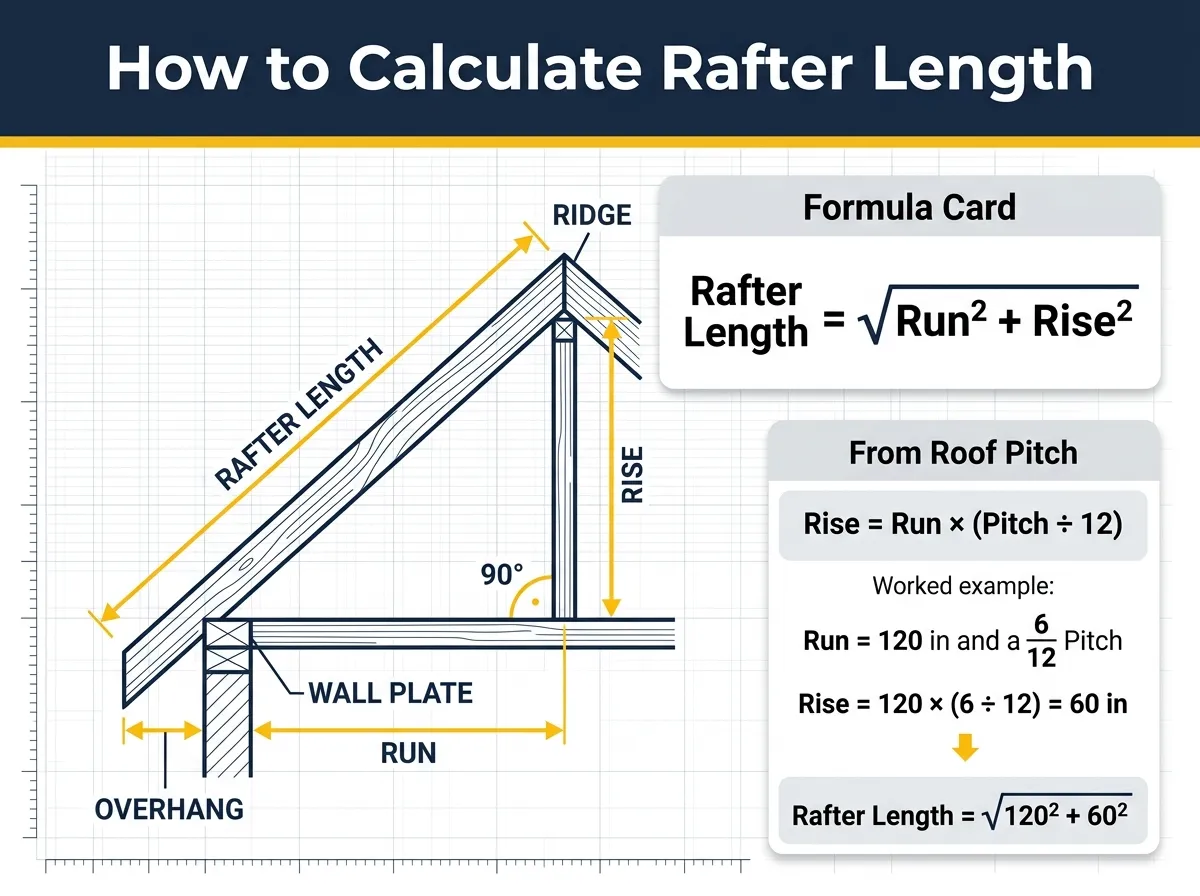
To calculate roof rafter length mathematically, you are essentially solving for the hypotenuse of a right-angled triangle. The horizontal distance across the building is the run, the vertical height the roof gains is the rise, and the sloped diagonal connecting them is the geometric rafter length.
Rafter Length Formula
To figure out rafter length directly from your horizontal and vertical measurements, apply the Pythagorean theorem:
Rafter Length = √(Run² + Rise²)
Rafter Calculator From Roof Pitch
If you only know the horizontal run and the target roof pitch ratio (e.g., 6/12), calculate the vertical rise first, then apply the formula above:
Rise = Run × (Pitch ÷ 12)
How to Calculate Rafter Rise
Roof rise is the total vertical height measured from the top of the wall plate straight up to the peak (top of the ridge). The rafter calculator easily determines this if you provide the pitch.
Because roof pitch is typically defined as inches of vertical rise per 12 inches of horizontal run, the formula scales that ratio to your specific building size.
Formula: Rise = Run × (Pitch ÷ 12)
Example: For a 120-inch run and a 6/12 pitch, the rise is 120 × (6 ÷ 12) = 60 inches.
Rafter Run Calculator
Rafter run is the horizontal distance the rafter covers. It forms the base of the structural triangle. If you need to find the run based on a known height restriction and pitch, use the calculation mode: Find Rafter Run.
Run = Rise ÷ (Pitch ÷ 12)
Rafter Pitch Calculator
Roof pitch dictates steepness. If you measure an existing roof's run and vertical rise, you can easily calculate the pitch using the Find Pitch and Angle mode to determine exactly what the standard "X/12" ratio is.
Pitch = (Rise ÷ Run) × 12
Rafter Dimensions Calculator
When processing a calculation, this tool serves as a comprehensive rafter dimensions calculator, outputting the entire geometric profile of the roof. Here is what each calculation represents:
Rafter Length:
The diagonal geometric hypotenuse connecting the ridge and wall plate.
Run:
The flat, horizontal base distance of the rafter triangle.
Rise:
The total vertical height gained over the run.
Pitch:
The steepness ratio, expressed as vertical inches per 12 horizontal inches.
Angle:
The physical angle of the roof slope relative to the horizontal floor.
Slope Percentage:
The steepness expressed as a percentage (Rise ÷ Run × 100).
Common Rafter Calculator vs. Roof Contexts
Because structural layouts vary, calculating rafter length requires the tool to know what kind of roof you are framing. The primary difference is how the horizontal run is determined from the building span.
Common Rafter Calculator
A standard gable roof uses common rafters that meet at a central ridge board. This means a single common rafter only spans roughly half the width of the building. The tool calculates this automatically by taking your total span, subtracting the ridge thickness, and dividing by two.
Common Run = (Span − Ridge) ÷ 2
Rafter Calculator for Shed Roofs
A shed roof (single-slope roof) leans entirely in one direction with no central ridge dividing the layout. Therefore, the shed rafter length calculator uses the full horizontal roof distance as the structural run to calculate the final geometric hypotenuse.
Shed Run = Full Horizontal Roof Distance
Roof Rafter Calculator With Overhang
Most roof rafters do not end flush at the exterior wall—they extend outward to create eaves. Our calculator accounts for this by processing the overhang geometry simultaneously.
When you enter the Eave Overhang Run (the horizontal distance the roof projects past the wall), the tool uses the same roof pitch to determine the overhang rise and the overhang hypotenuse length. The overhang calculation assumes the same roof pitch continues beyond the wall. It then adds this to the main length to give you the total rafter length.
How to Measure for Rafter Length
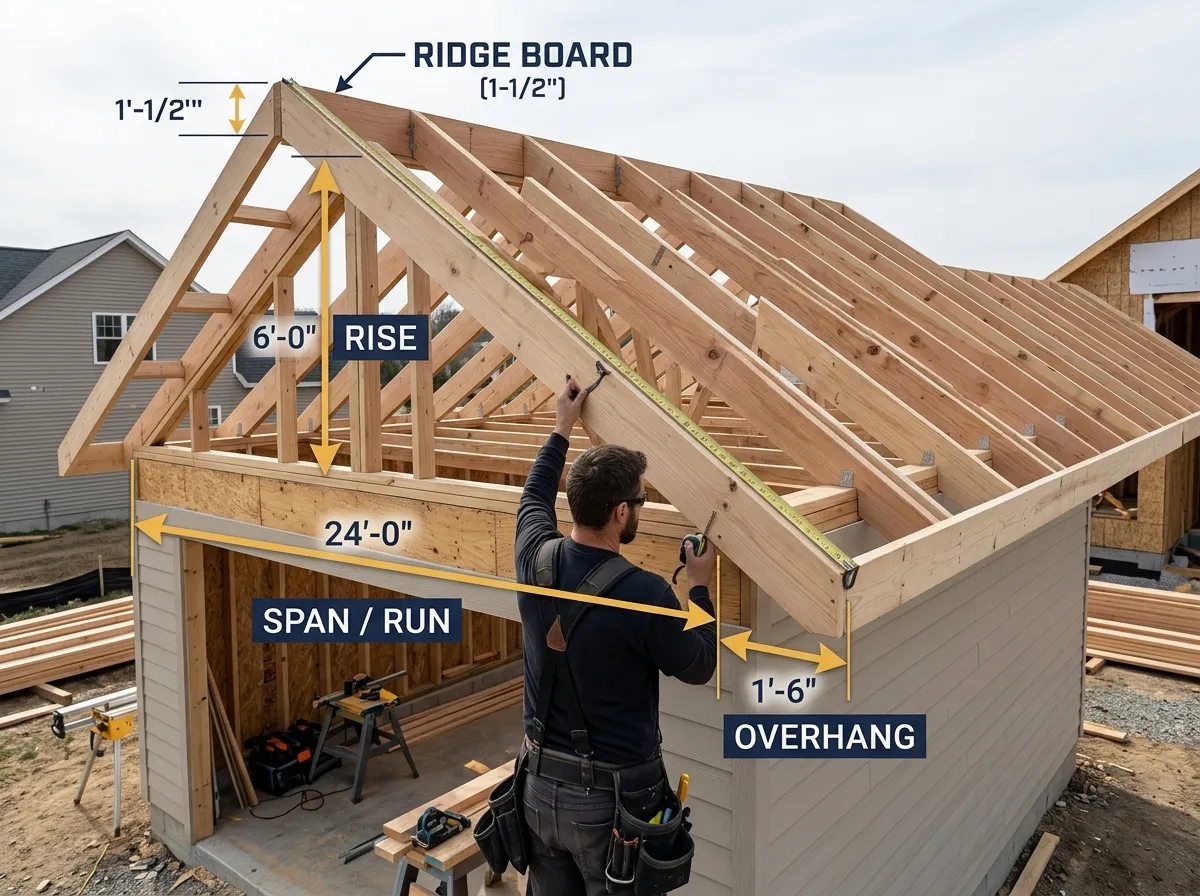
Using the tool is straightforward once you have the correct measurements from your project or architectural plans.
- Determine the Span or Run: Measure the total outside-to-outside width of the building plates (for gable roofs) or the total horizontal run (for shed roofs).
- Determine the Pitch or Rise: Decide on the steepness of the roof (e.g., a 4/12 pitch) or measure the maximum allowable vertical height.
- Account for the Ridge: If framing a common roof, measure the actual thickness of the central ridge board (typically 1.5 inches for "2x" lumber).
- Plan the Overhang: Decide how far horizontally the eave should project outward past the siding.
- Enter the Data: Select consistent measurement units and input your layout data into the calculator to generate the geometric framing measurements.
Rafter Cut Length vs Geometric Rafter Length
It is crucial to understand that this tool acts as a rafter dimensions calculator generating mathematically perfect geometric rafter lengths (the direct diagonal distance forming the triangle).
Actual physical framing cut lengths will differ. A real-world piece of lumber requires structural cuts that change its physical end-to-end length, including plumb cuts at the ridge, birdsmouth cuts (seat and heel cuts) where it rests on the plate, and specific fascia/eave tail details.
Disclaimer: This calculator provides geometric estimates for reference layout. It does not replace approved construction plans, structural engineering, lumber sizing codes, or project-specific framing requirements.
Rafter Length Examples
Example 1: Using Rise and Run
- Run: 120 inches
- Rise: 40 inches
Length = √(120² + 40²)
Length = √(14400 + 1600)
Length = √(16000)
Length ≈ 126.49 inches
Length = √(14400 + 1600)
Length = √(16000)
Length ≈ 126.49 inches
Example 2: Using Run and Pitch
- Run: 120 inches
- Pitch: 4/12
Rise = 120 × (4 ÷ 12) = 40 inches
Length = √(120² + 40²)
Length ≈ 126.49 inches
Length = √(120² + 40²)
Length ≈ 126.49 inches
Rafter Length Reference Table
This chart shows the standard roof pitch ratios and their corresponding mathematical slope percentages for quick reference during rafter calculations.
| Roof Pitch Ratio | Slope Percentage (%) |
|---|---|
| 2/12 | 16.67% |
| 3/12 | 25.00% |
| 4/12 | 33.33% |
| 5/12 | 41.67% |
| 6/12 | 50.00% |
| 8/12 | 66.67% |
| 10/12 | 83.33% |
| 12/12 | 100.00% |
Rafter Calculator by Measurement Unit
This online free rafter calculator supports inches, feet, centimeters, or meters. Because trigonometric math relies on proportional ratios, you can use any measurement system. Just ensure you use the exact same unit for the span, rise, and overhang inputs.
Rafter Calculator PDF
Once your inputs are configured, you can generate a downloadable PDF report. The document instantly captures your roof type, calculation mode, selected unit, and all geometric outputs (rafter length, run, rise, pitch, angle, slope, and overhang) for easy project reference and printing.
What Users Value About This Calculator
DR
Dave Runner
"This rafter calculator saved me time on manual geometry. Being able to quickly process span and pitch into exact rafter run and total length helps considerably with setting up framing cuts."
MT
Mark Turner
"The PDF export feature is perfect. I use it to attach exact rafter length calculations and overhang dimensions to my material supply files and architectural references."
SH
Sarah Harris
"Very easy to use for calculating shed dimensions. The shed roof rafter calculator option handles the full run geometry without me having to manually bypass the center ridge logic."
JL
Jason Lewis
"The reverse calculations are incredibly helpful. When I know my pitch and run, the calculator figures out the exact rise in seconds without needing to pull out a construction calculator app."
AC
Alex Carter
"Great for finding the rafter length based on the span and pitch. It calculates the baseline hypotenuse and the overhang length simultaneously, making estimating far more accurate."
MP
Michael Parker
"I appreciate that this calculator lets me input ridge board thickness. That little deduction ensures the rafter run is structurally correct before it outputs the rafter dimensions."
TC
Tom Collins
"Having the different calculation modes in one tool is a time saver. I can switch from calculating rafter length to finding the roof pitch angle instantly using the same interface."
RB
Robert Blake
"I use the rafter run calculator mode constantly. Being able to plug in my maximum allowable rise and match it against the pitch to see my run constraints prevents layout errors."
EM
Eric Munson
"The layout makes sense. Entering the overhang as a separate variable and seeing the total rafter length vs main rafter length is exactly how we plan material lists on the job site."
KW
Kevin Ward
"Best free rafter length calculator I've used. I simply set it to feet or inches, enter the building span, and the geometry is solved. Highly recommend for quick framing checks."
Frequently Asked Questions
Have a Question or Feedback?
Found an issue, have a suggestion, or have a question about this calculator? Contact us and let us know.
Contact Us →
Message here