
Free construction calculators for quick, accurate estimates, measurements, and project planning
Rip Rap Calculator
Calculate material volume and tonnage with professional accuracy based on standard volumetric and material bulk density formulas.
Calculation Logic
Tonnage is computed using bulk material density coefficients (tons per cubic yard) including a customizable waste and displacement settling factor.
Project Estimate
Calculated Summary
Required Tonnage
0.00
Tons
Total Volume
0.00
yd³
Est. Cost
$
0.00
Truck Loads
0
(Based on 15 tons/truck)
Surface Area
0
ft²
How Much Rip Rap Do I Need?
Determining the exact quantity of rip rap required for slope protection, shoreline revetments, or drainage channels depends on total surface area, layer depth, and bulk material density. A layer thickness equal to 1.5 to 2.0 times the median stone size ($D_{50}$) is standard to ensure proper structural interlocking.
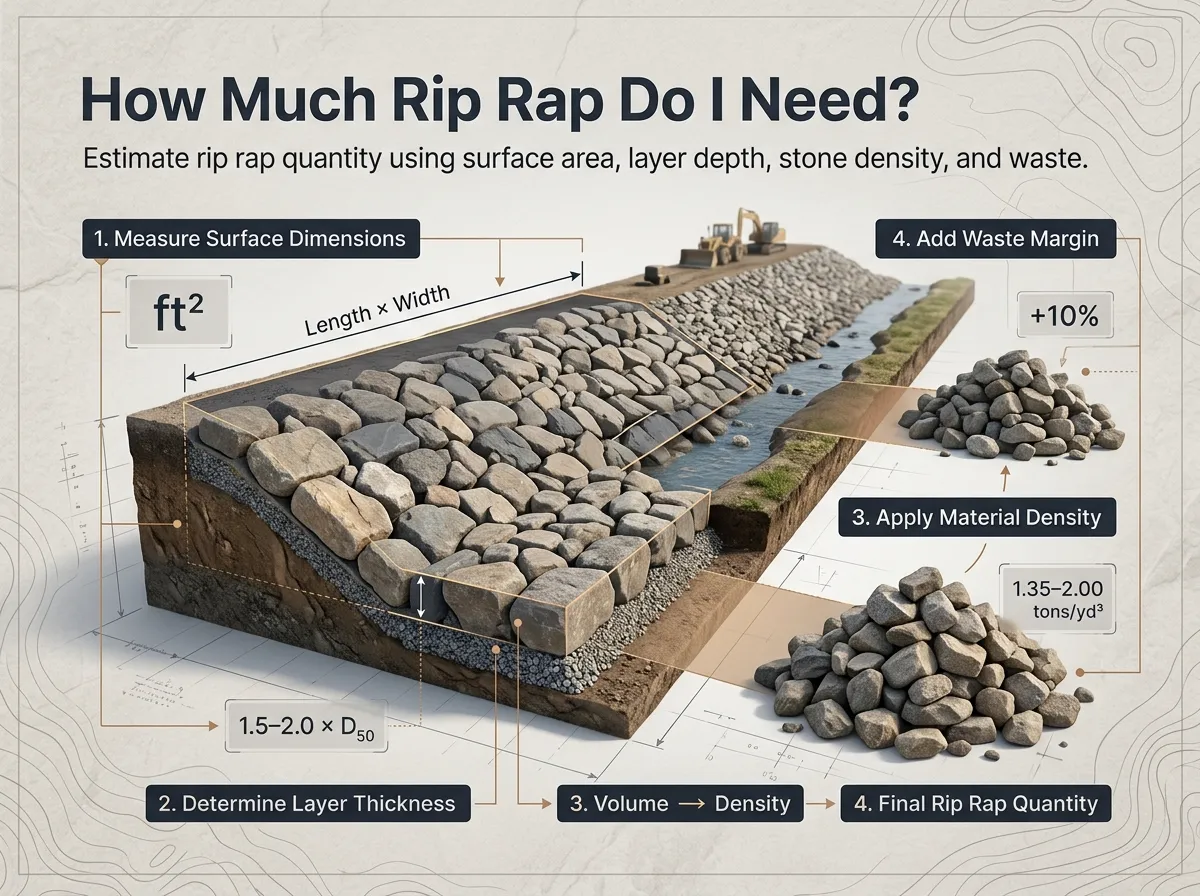
1. Measure Surface Dimensions
Measure the total length and width of the bank slope or channel area in feet to find total surface area ($ft^2$).
2. Determine Layer Thickness
Set layer depth in inches based on stone class ($2 \times D_{50}$). Convert inches to feet ($Depth \div 12$).
3. Apply Material Density
Multiply volume ($yd^3$) by stone bulk density (1.35 to 2.00 $tons/yd^3$) plus a 10% waste margin.
How to Calculate Rip Rap Tonnage
Tonnage calculations convert physical volume into weight so quarries can fulfill delivery orders. The standard volumetric formula multiplies Length $\times$ Width $\times$ Depth to compute cubic feet, converts to cubic yards ($yd^3 = ft^3 \div 27$), and multiplies by material bulk density.
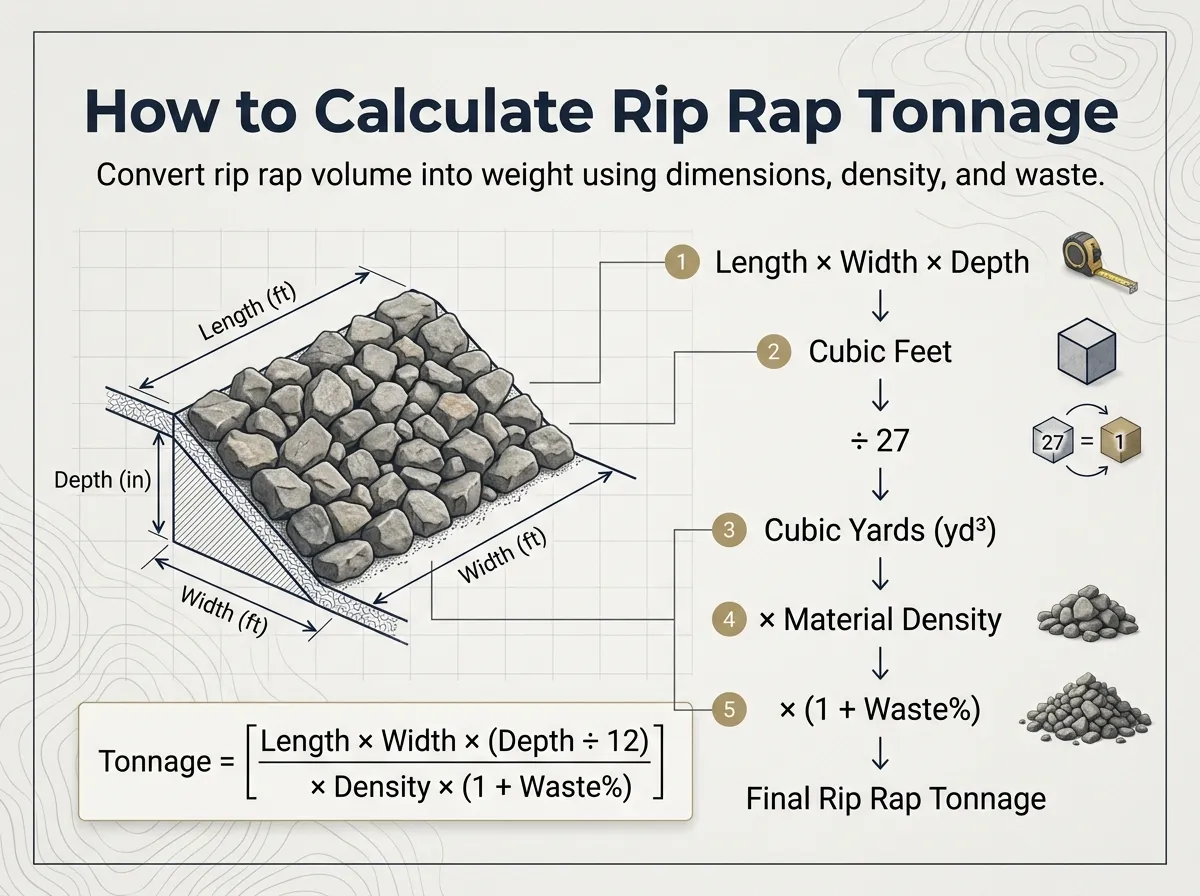
Mathematical Formula:
Tonnage = [ (Length(ft) × Width(ft) × (Depth(in) ÷ 12)) ÷ 27 ] × Density (t/cy) × (1 + Waste%)
Technical Resource Hub
Engineering Standards for Slope Stabilization
Verified guidelines for Erosion Control, Channel Armoring, and Shoreline Protection based on ASTM D6092.
Rip Rap Size and Stone Gradation Guide
Selecting the right stone gradation ensures the revetment resists water velocities without dislodging. Rip rap is graded by $D_{50}$ (the median stone diameter where 50% of the mixture by weight is smaller). Well-graded mixtures fill voids and interlock efficiently.
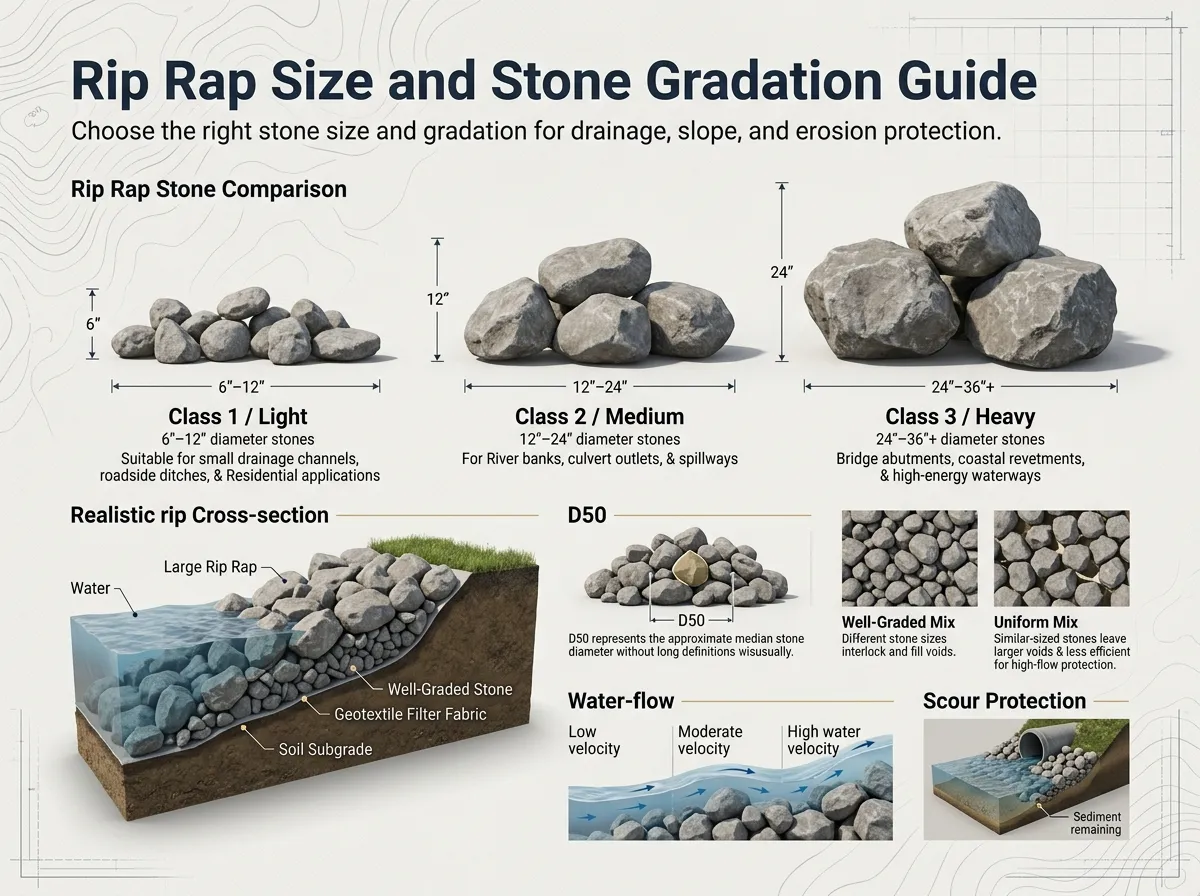
Class 1 / Light
6" - 12" DiaBest for: Roadside ditch lining, small drainage swales, and residential weed suppression. Low velocity (< 6 ft/s).
Class 2 / Medium
12" - 24" DiaBest for: River bank stabilization, culvert outlets, and spillways. Moderate velocity protection.
Class 3 / Heavy
24" - 36"+ DiaBest for: Bridge abutments, coastal revetments, and high-energy jetties. Critical infrastructure.
Scour Protection
Critical for preventing sediment transport. Stone weight must exceed the tractive force of water velocity to prevent scour at culvert outlets and bridge abutments.
D50 & Gradation
Proper sizing relies on the D50 value (median diameter). A "well-graded" mix locks stones together, unlike "uniform" sizing which is prone to failure in high-flow channels.
Geotextile Separation
Mandatory installation of non-woven filter fabric prevents soil piping. Without this layer, hydrostatic pressure will suck the subgrade through the voids of the armor layer.
Standard DOT Rip Rap Classes
Class 1 / Light
6" - 12" DiaBest for: Roadside ditch lining, small drainage swales, and residential weed suppression. Low velocity (< 6 ft/s).
Class 2 / Medium
12" - 24" DiaBest for: River bank stabilization, culvert outlets, and spillways. Moderate velocity protection.
Class 3 / Heavy
24" - 36"+ DiaBest for: Bridge abutments, coastal revetments, and high-energy jetties. Critical infrastructure.
Step-by-Step Rip Rap Installation Guide
Standard Slope Cross-Section
Water Level
Armor Layer (2x D50)
Interlocked Stones
Toe Trench
Keyed into bed
1
Preparing the Subgrade & Toe Trench
Excavate the slope to the required depth. Dig a "toe trench" at the base (min 2ft deep) to anchor the rock and prevent sliding failure.
2
Why Geotextile Fabric is Non-Negotiable
Lay non-woven filter fabric directly on the soil. This prevents hydrostatic pressure from "piping" soil through the rock voids, which is the #1 cause of bank failure.
3
Mechanical vs. Hand Placement
For Class 2 and 3 stone, use an excavator with a thumb attachment. Place stones starting from the bottom up. Avoid "end dumping" to prevent segregation.
Choosing the Right Rock Density
Understanding ASTM D6092 Compliance and Material Durability
Limestone
SG: 2.30 - 2.60
Softer sedimentary rock, prone to abrasion. Best for low-velocity residential drainage where aesthetics matter more than sheer durability.
Recommended
Granite
SG: 2.65 - 2.75
The industry gold standard. Igneous rock with excellent freeze-thaw resistance. Standard for DOT highway projects.
Basalt / Trap Rock
SG: 2.80 - 3.00+
Extremely dense volcanic rock. Required for high-energy coastal zones or dam spillways where water velocity exceeds 15 ft/s.
Rock Specific Gravity
Ref: ASTM C127
Basalt / Trap Rock
2.80 - 3.00 SG
Highest density. Ideal for high-velocity coastal zones.
Granite (Standard)
2.65 - 2.75 SG
Most common spec. Excellent freeze-thaw durability.
Limestone / Sandstone
2.30 - 2.60 SG
Lower density. Use for low-flow swales only.
Bank Armoring Protocol
-
1Key-In the Toe Excavate a trench at the bottom of the slope (the toe) to at least 2x the stone diameter. This anchors the entire revetment against sliding.
-
2Filter Layer Placement Install geotextile fabric or a gravel aggregate layer. Overlap fabric seams by 12 inches minimum (upstream over downstream).
-
3Mechanical Placement Place stones from the toe moving upward. Do not end-dump from the top of the slope to avoid segregation and fabric damage.
Rip Rap Cost Factors & Delivery Logistics
Truck Access
Standard tri-axle dumps carry ~15-18 tons. Ensure you have 10ft wide access and stable ground for dumping.
Quarry Proximity
Freight is often 50% of the cost. Prices jump significantly if the haul is >30 miles from the quarry.
Bulk vs. Pallet
Bulk loose rock is ~$45/ton. Palletized wire baskets for hand-unloading can cost $250+/ton.
Standby Time
Drivers typically allow 15 mins for unloading. Complex sites causing delays incur standby fees (~$100/hr).
Critical Maintenance Protocols
While rip rap is designed as a permanent solution, "set it and forget it" often leads to failure after major storm events. Regular inspection cycles are required to maintain structural integrity.
The "After-Storm" Checklist
Inspections should occur annually and immediately following any discharge event exceeding the 10-year storm recurrence interval. Look for stone displacement, exposure of the geotextile fabric, or scouring at the toe.
Repairing Slump Failures
"Slumping" occurs when the underlying soil moves. Do not simply pile more rock on top. You must remove the displaced stone, repair the subgrade and fabric, and re-key the toe trench before replacing the armor layer.
Vegetation Management
Woody vegetation (trees) can dislodge stones with their roots and should be removed. However, shallow-rooted grasses (Joint Planting) can actually increase bank stability by binding the soil beneath the fabric.
Environmental Permitting
Installing rip rap often constitutes "fill" in waters of the U.S., triggering federal and state regulations. Failure to permit can result in fines up to $37,500 per day.
USACE Section 404 Permit
CriticalRequired by the Army Corps of Engineers for any discharge of dredged or fill material into wetlands or waterways. For minor projects (< 500 linear feet), a Nationwide Permit (NWP 13) for Bank Stabilization is often applicable.
SWPPP Requirements
EPAIf your disturbance area exceeds 1 acre, you must file a Stormwater Pollution Prevention Plan. Rip rap stockpiles must be surrounded by silt fencing to prevent sediment runoff during construction.
Wildlife Friendly Design
Best PracticeLarge rip rap can create barriers for amphibians and turtles. Consider mixing "chinking" stone (smaller aggregate) into voids to create a traversable surface for local wildlife.
Engineering Estimation Note
"The calculations provided by this tool utilize standard bulk material density factors for loose, quarried stone. For critical civil infrastructure or water flow rates exceeding 10 ft/s, always consult a licensed civil or hydraulic engineer for site-specific shear stress and hydraulic analysis."
— Construction Estimation Guide
Rip Rap Calculator Examples
Examine typical civil engineering and landscaping estimation scenarios below to see how project dimensions, rock density selection, and waste margins convert to actual tonnage and truckload requirements.
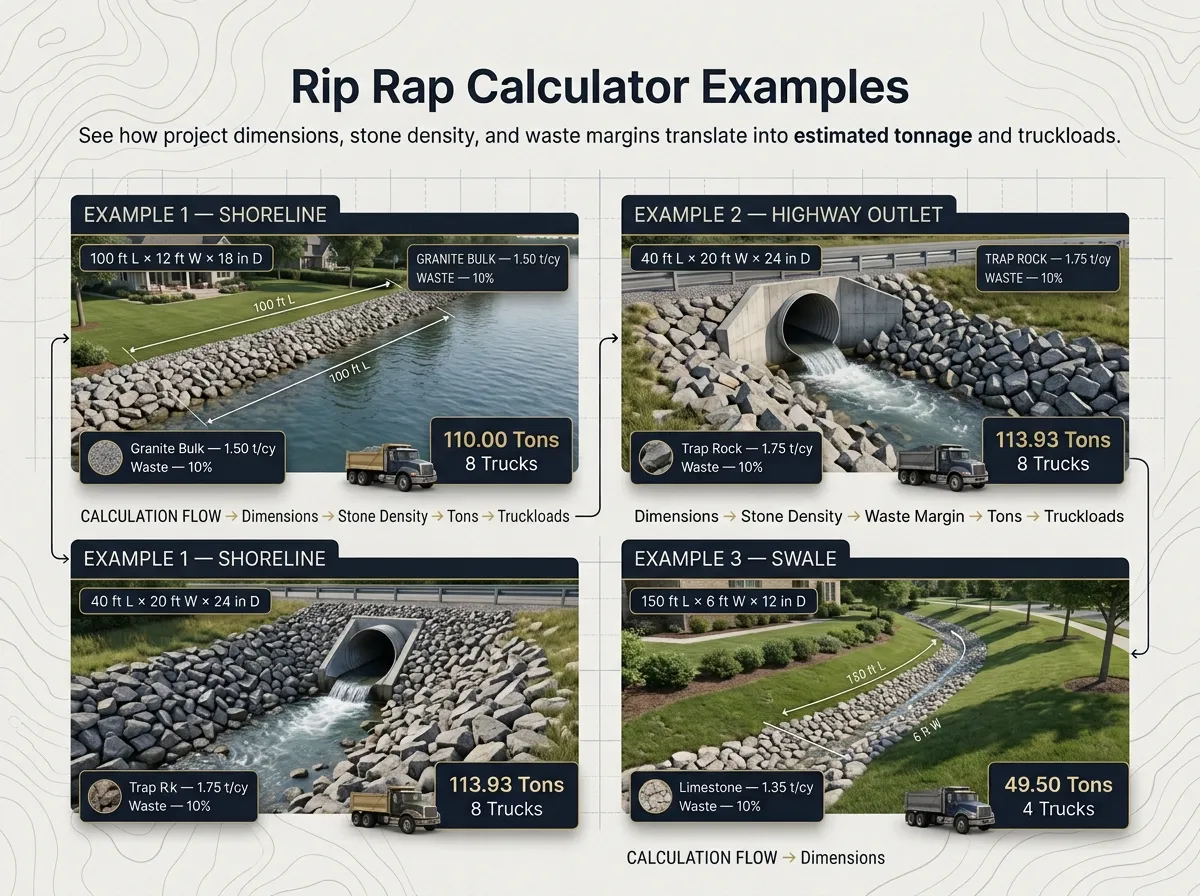
Example 1: Shoreline
Residential Lake Shoreline
- Dimensions: 100 ft L × 12 ft W × 18 in D
- Stone: Granite Bulk (1.50 t/cy)
- Waste Margin: 10%
Est. Material:
110.00 Tons (8 Trucks)
Example 2: Culvert
Highway Culvert Outlet
- Dimensions: 40 ft L × 20 ft W × 24 in D
- Stone: Trap Rock (1.75 t/cy)
- Waste Margin: 10%
Est. Material:
113.93 Tons (8 Trucks)
Example 3: Swale
Drainage Swale Lining
- Dimensions: 150 ft L × 6 ft W × 12 in D
- Stone: Limestone (1.35 t/cy)
- Waste Margin: 10%
Est. Material:
49.50 Tons (4 Trucks)
Project Success Stories
JS
John Stevens
Site Superintendent
"This tonnage calculator is incredibly accurate. We used it to bid a 2,000 ft shoreline project and were within 2% of our actual material delivery."
SJ
Sarah Jenkins
Landscape Architect
"Excellent for quick estimations during client meetings. I deducted one star because I'd love a dark mode option, but the math is solid."
RM
Robert Miller
Homeowner
"Saved me from over-ordering stones for my ditch lining. Simple to use and the density options made a huge difference."
DC
David Chen
Civil Engineer
"Calculations are accurate to standard. However, the default waste factor of 10% feels high for precision paving projects. Good for rough estimates."
GE
GreenEarth Co.
Contractor
"Our crews use this on every site. The ability to switch between Limestone and Granite density saves us hours of manual math."
MR
Mike Ross
DIY Enthusiast
"Great free tool. I wish there was a way to save my results as a PDF directly, but the print button works well enough."
Frequently Asked Questions
Granite is the most common standard (1.50 t/cy). Use Limestone (1.35 t/cy) for lighter weight requirements and Trap Rock or Basalt for heavy-duty coastal armoring.
Rip rap is irregular in shape. The waste factor accounts for voids, settling into the subgrade, and material overlap during installation.
The general engineering rule is 2.0 times the D50 (average stone size). For example, if you are using 12-inch stones, your layer depth should be at least 24 inches to ensure no light passes through to the fabric.
Material prices typically range from $35 to $65 per ton delivered, depending on quarry proximity. Installation adds labor costs, bringing the total to $85-$150 per ton.
Rip rap is generally stable on slopes up to a 2:1 ratio (2 feet horizontal for every 1 foot vertical). Slopes steeper than 1.5:1 typically require grouting or a retaining wall system.
A standard cubic yard of granite rip rap weighs approximately 1.5 tons (3,000 lbs). This calculator automatically converts your volume to tonnage based on the specific density selected.
Help Us Improve
We regularly update our density algorithms based on field data. If you encounter discrepancies or have a feature request for Version 2.5, please let our engineering team know.