
Free construction calculators for quick, accurate estimates, measurements, and project planning
Sand Calculator
Estimate sand volume for your project and convert quantities into cubic yards, cubic feet, or cubic meters.
Calculate Using:
Optional Estimates
Estimated Requirements
Required Sand Volume
-
yd³
Or - cubic feet (ft³)
Or - cubic meters (m³)
Estimated Weight:
-
-
Estimated Bags:
-
Estimated Material Cost:
-
Sand Estimator: Calculate Sand Needed for Your Project
Using our sand estimator is the most reliable way to calculate sand needed for your specific job. Whether you are filling a sandbox, leveling a patio base, or preparing a construction site, this tool helps you accurately estimate the required sand volume based on your measurements, saving you time and money on materials.
How to Use the Sand Calculator
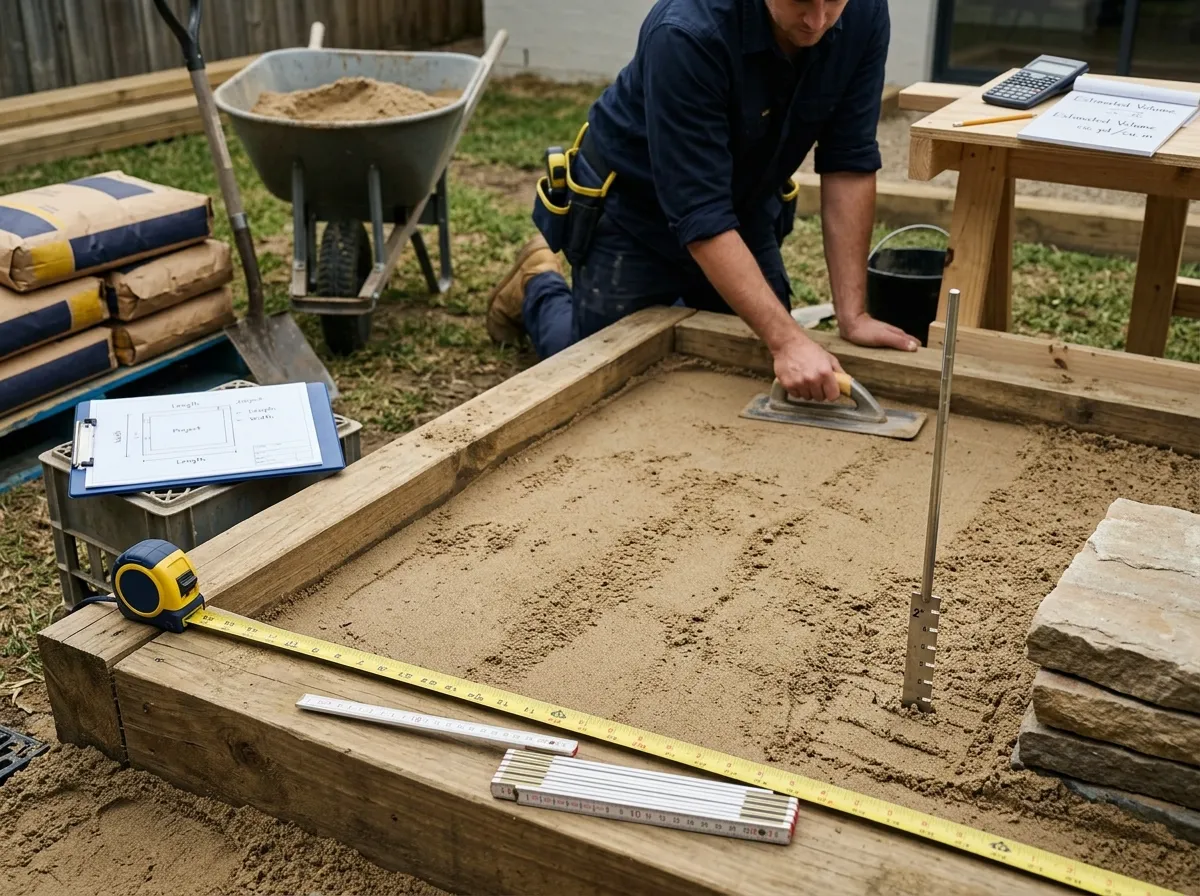
1 Enter Project Dimensions
Measure the length and width of the area you intend to fill. If you already know the square footage, switch to "Area and Depth" mode.
2 Set Measurement Units
Use the dropdowns to select feet, meters, inches, etc. You can safely mix units; the calculator converts everything automatically.
3 Input Required Depth
Determine how deep the sand layer needs to be. For paver bases, this is often 1 to 2 inches. For sandbox fills, it might be 6+ inches.
4 Review the Results
The tool instantly provides your required volume in standard units like cubic yards (yd³), cubic feet (ft³), and cubic meters (m³).
How to Calculate Sand Volume
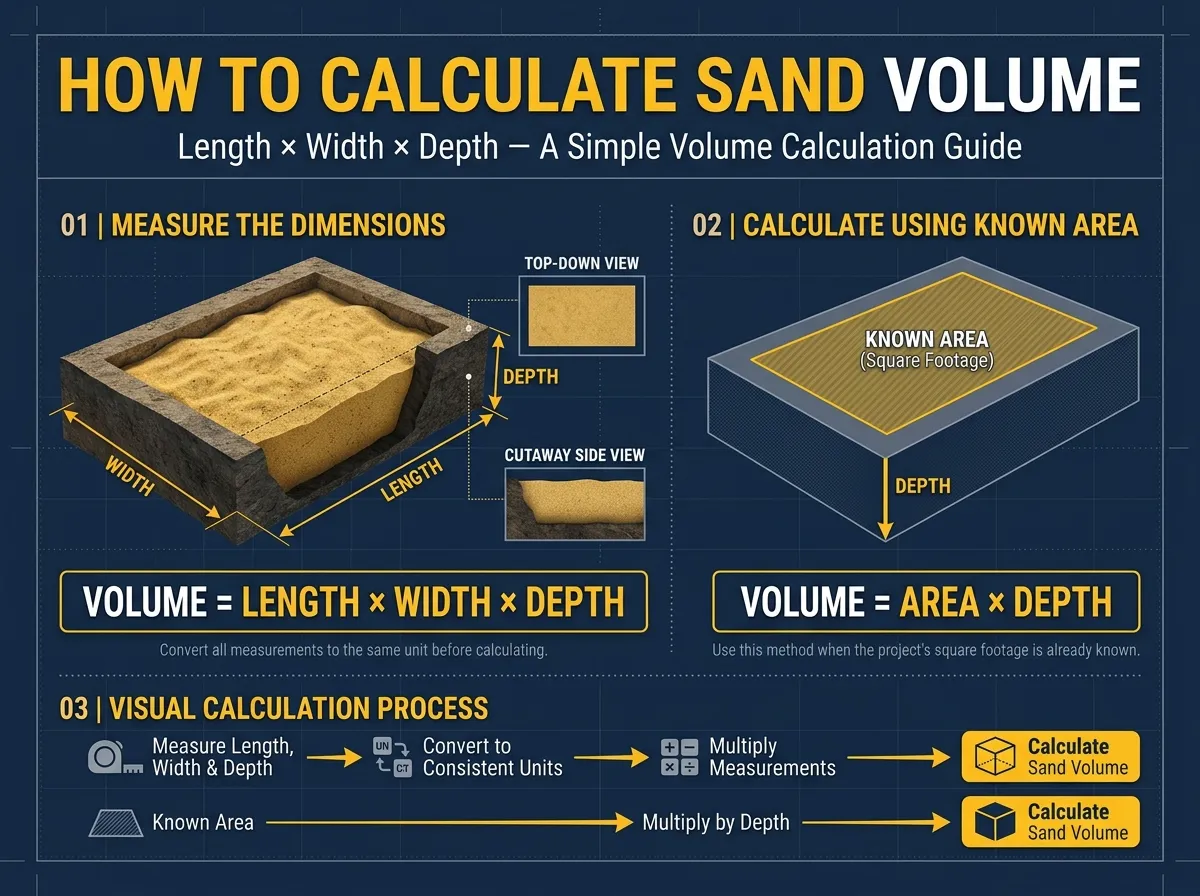
To find the volume of a rectangular space, you must convert all measurements into the same unit base (e.g., feet) and multiply them together:
Volume = Length × Width × Depth
If you already know the square footage (Area) of your project, the formula simplifies to:
Volume = Area × Depth
Sand Calculation Example
Imagine you are laying a paver patio. The area is 12 feet long and 10 feet wide. You need a 2-inch depth of sand for the leveling base.
- Convert the depth to feet so units match: 2 inches ÷ 12 = 0.1667 feet
- Multiply Length × Width × Depth: 12 ft × 10 ft × 0.1667 ft = 20 cubic feet
- Convert to Cubic Yards: 20 ÷ 27 ≈ 0.74 cubic yards
Result: You need approximately 0.74 cubic yards of sand.
Understanding Sand Volume Measurements
| Measurement Unit | Common Usage & Definition |
|---|---|
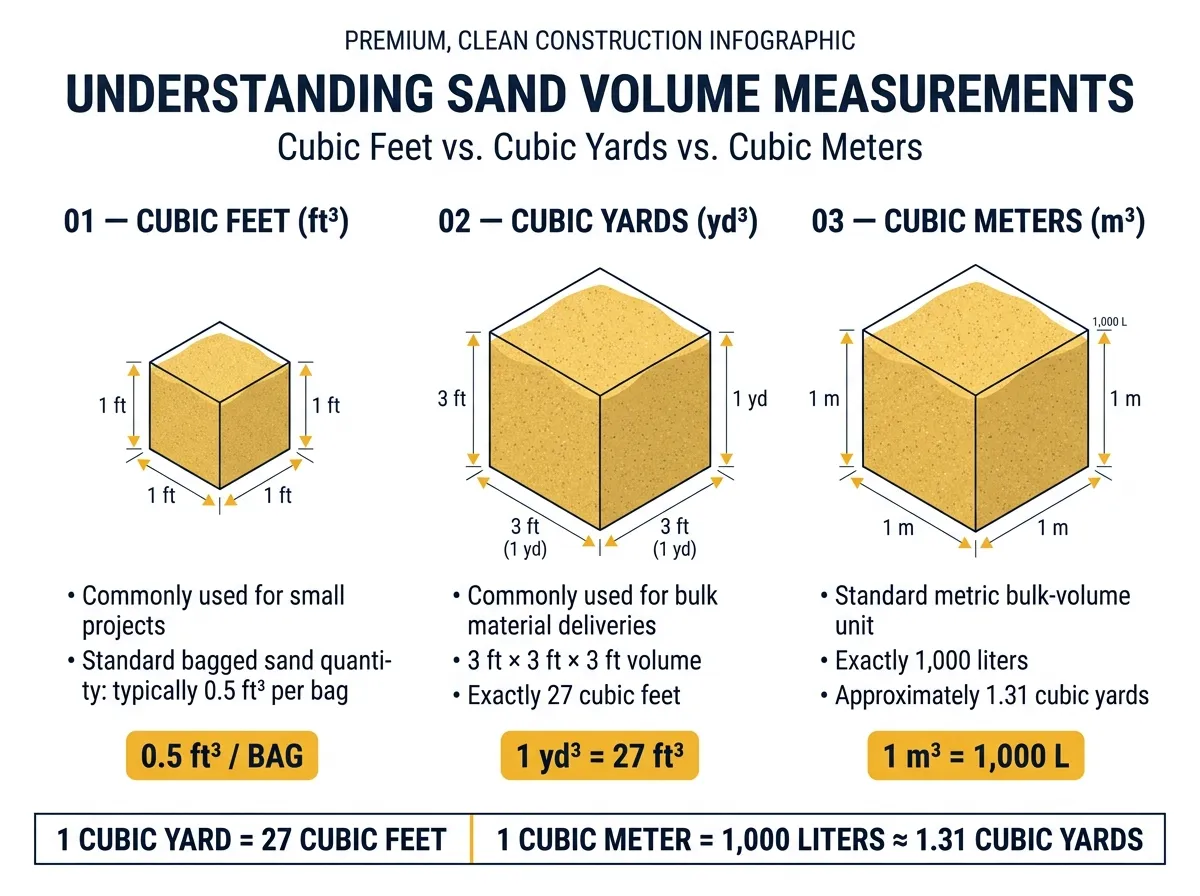
| Cubic Feet (ft³) | Often used for small projects. It is the standard unit for bagged sand at home centers (typically 0.5 ft³ per bag). |
| Cubic Yards (yd³) | Standard for bulk material deliveries. Equal to a 3ft × 3ft × 3ft cube, or exactly 27 cubic feet. Using a reliable sand yardage calculator is essential for planning these large truckloads accurately. |
| Cubic Meters (m³) | Standard metric bulk volume. Equals exactly 1,000 liters, or approximately 1.31 cubic yards. |
How Much Sand Do I Need?
Figuring out exactly how much sand you need depends entirely on the length, width, and depth of your project space. By taking these three measurements and multiplying them together (ensuring all units match), you determine the total volume required. Acting as a practical sand coverage calculator, this tool instantly processes those dimensions so you know exactly how much material will cover your specified area at the required depth.
Factors That Can Affect Sand Quantity
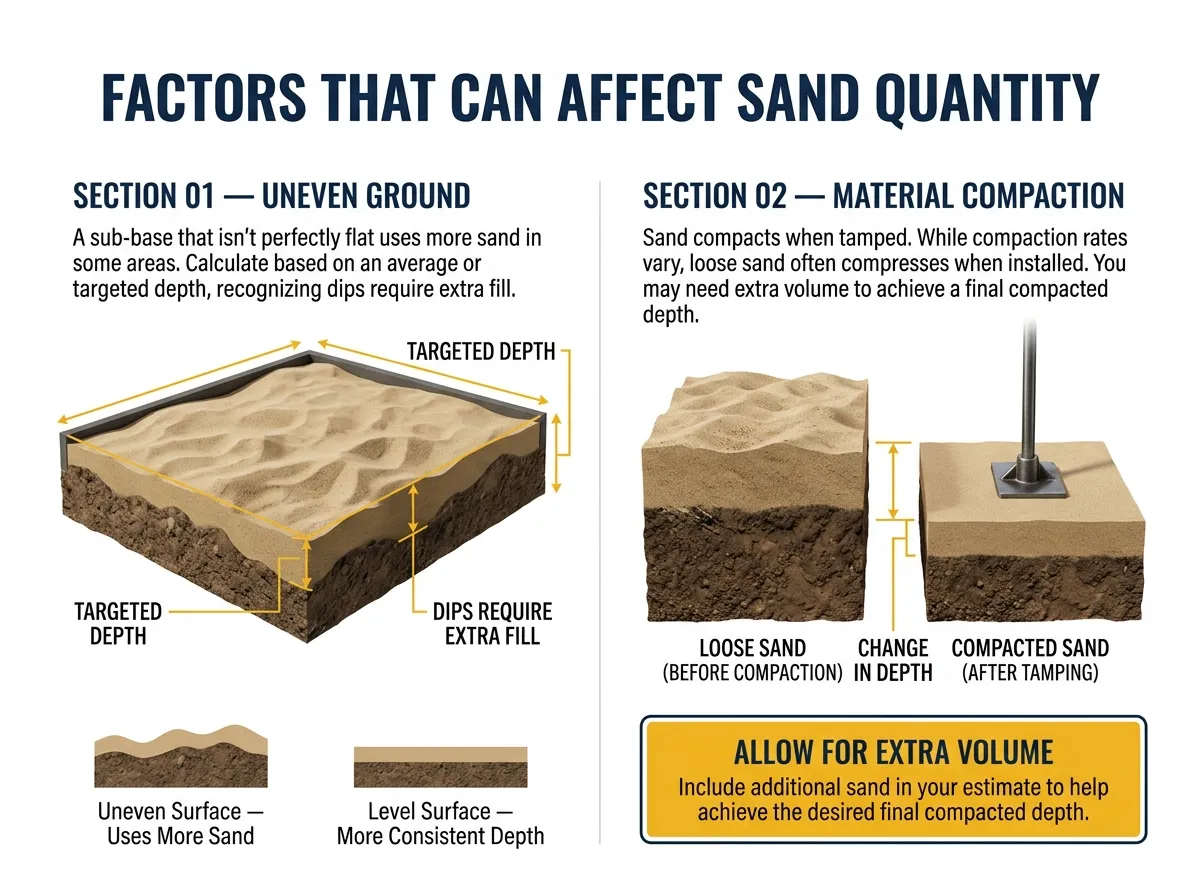
Uneven Ground
A sub-base that isn't perfectly flat uses more sand in some areas. Calculate based on an average or targeted depth, recognizing dips require extra fill.
Material Compaction
Sand compacts when tamped. While compaction rates vary, loose sand often compresses when installed. You may need extra volume to achieve a final compacted depth.
How Much Sand Does Your Project Need?
Sand for a Rectangular Area
Standard calculations utilize exact boundary lines. Volume is determined by multiplying Length × Width × Depth. Always ensure all three dimensions are converted to the same unit (like feet) before multiplying.
Volume = Length × Width × Depth
Sand for Landscaping and Ground Leveling
Leveling requires filling dips while skimming high spots. Uneven ground affects the total quantity required. Take depth measurements from multiple points to calculate a realistic average depth, rather than relying solely on the deepest spot.
Sand for Filling Low Areas
When filling deep holes, estimate the surface area and the average depth. Keep in mind that deep fills experience significant settlement and compaction over time, which may require you to top off the area later.
Common Sand Calculation Mistakes
| Common Mistake | Why It Matters | How to Avoid It |
|---|---|---|
| Mixing incompatible measurement units. | Formulas fail unless all inputs share the exact same base unit before multiplying. | Convert everything to the same unit (e.g., all feet) before calculating, or use the calculator dropdowns. |
| Entering the wrong depth unit. | Accidentally entering a 2-inch depth as "2 feet" drastically multiplies your estimated volume. | Double-check the unit dropdown for depth specifically. |
| Using an unsuitable sand-density value. | Wet sand is much heavier than dry sand. The default 100 lb/ft³ is an illustrative estimate. | Check with your local supplier for the exact material density of the sand you are purchasing. |
| Ignoring uneven ground or compaction. | You may run short if the ground dips heavily or the sand compacts more than expected. | Take multiple depth measurements for an average, and recognize compaction settling. |
| Ordering material without checking requirements. | Ordering incorrect quantities delays projects or creates unnecessary waste and removal fees. | Measure the site twice, and calculate carefully before scheduling a bulk delivery. |
| Misunderstanding volume, weight, and cost. | A price per ton versus a price per cubic yard requires entirely different mathematical calculations. | Use the correct pricing unit in the calculator based exactly on how the supplier bills. |
What Users Say
PJ
Patrick Joseph
"The cubic yard calculations are incredibly fast and accurate for paving projects. Saved me from ordering too much material."
SJ
Sarah Jenkins
"The automatic unit conversions saved me from manual math errors. It's perfectly straightforward to use."
MT
Marcus Torres
"A perfect tool for estimating sandbox fills. I knew exactly how many 50 lb bags to pick up from the hardware store."
EC
Emily Chen
"The calculator's cubic yard and bag quantity conversions are incredibly helpful for bulk material ordering."
DS
David Smith
"Very clean, straightforward, and easy to use on my phone while out on the landscaping job site."
RG
Rachel Green
"Being able to mix measurements like feet for length and inches for depth without doing the math myself is brilliant."
Frequently Asked Questions
Measure the length and width of your project area, then determine the required depth of the sand layer. Multiply these three dimensions together (ensuring they are all in the same unit of measurement) to find the total cubic volume.
The fundamental formula is: Volume = Length × Width × Depth. If you are calculating in feet, the result will be in cubic feet.
First calculate the total volume in cubic feet. Then, divide that number by 27. There are exactly 27 cubic feet in one cubic yard.
Depth varies by project. Paver bases typically require 1 to 2 inches of bedding sand. Play sand in sandboxes often ranges from 4 to 6 inches deep. Always check manufacturer specifications.
Yes. If you know the square footage (area), the formula simplifies to Area × Depth. Our calculator includes an "Area and Depth" mode for this exact scenario.
Yes, as an optional estimate. It uses a user-defined density (defaulting to an illustrative 100 lbs per cubic foot) to convert the calculated volume into an estimated weight in pounds and US short tons.
Yes. By entering your target bag weight, the calculator divides the total estimated weight by the bag weight and rounds up to tell you how many bags to purchase.
Sand weight fluctuates significantly depending on moisture content and the size of the granules. Wet sand can weigh 20% to 30% more than dry sand for the exact same volume.
Need Help With Your Sand Estimate?
Have a question about the calculator or found a calculation issue? Contact ConstructionMaths and share your feedback.
Contact ConstructionMaths