
Free construction calculators for quick, accurate estimates, measurements, and project planning
Square Footage Calculator
Measure any area with precision. Perfect for flooring, painting, and landscaping projects.
feet
in
feet
in
$
Standard recommendation is 10-15% for cuts, mistakes, and future repairs.
%
Did this calculator solve your problem?
Total Area
-
Square Feet (ft²)
Total Estimated Cost
-
How to Calculate Square Footage
Follow these simple steps to measure and calculate the area of any space.
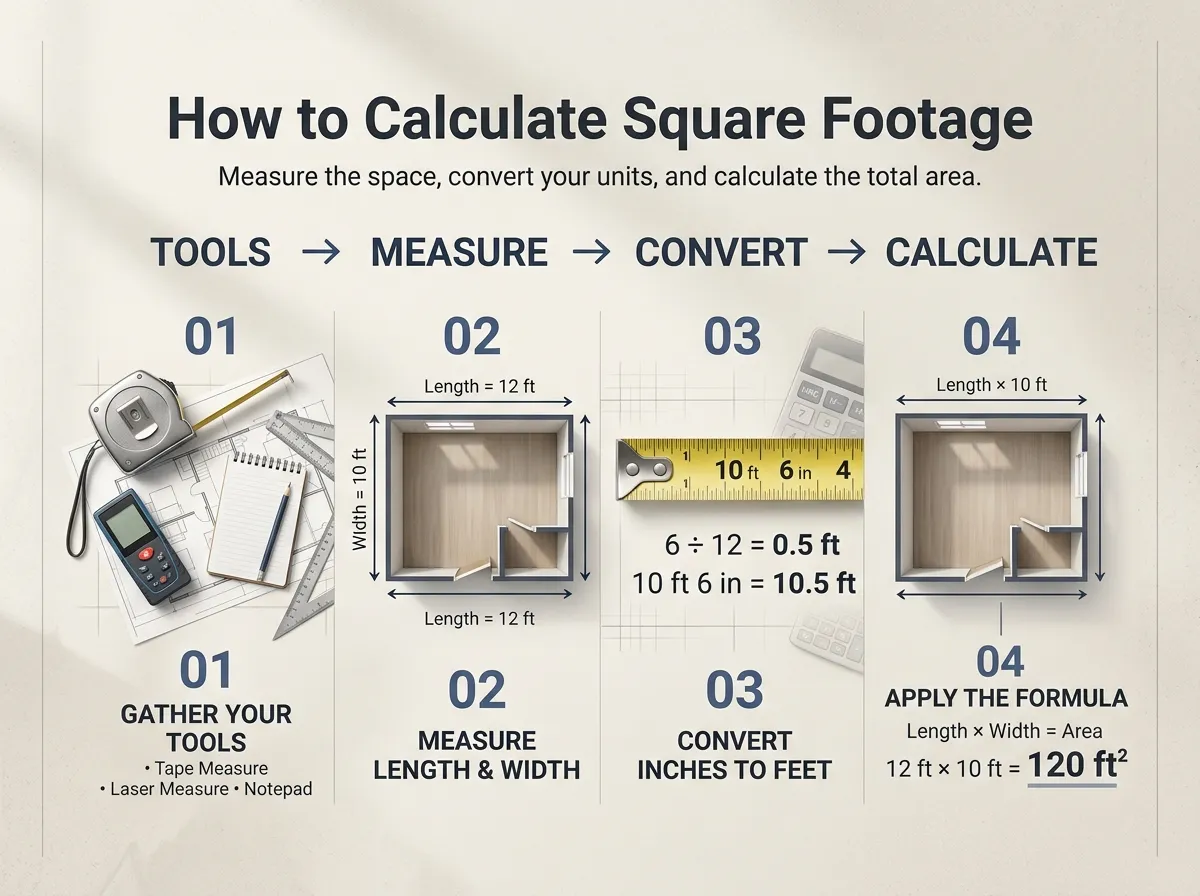
1 Gather Your Tools
You'll need a reliable tape measure (a rigid metal one is best), a notepad, and a pen or pencil to record your measurements. Alternatively, you can use a laser measure for quicker results over larger distances.
2 Measure the Length and Width
Identify the longest wall of the room and measure it from corner to corner. This is your Length. Next, measure the adjacent wall (perpendicular to the first one) to find your Width.
Pro Tip: Measure at the floor level, ignoring baseboards, to get the true wall-to-wall distance.
3 Convert Inches to Decimal Feet (If Necessary)
If your measurements include inches (e.g., 10 feet 6 inches), you must convert the inches to a decimal part of a foot before calculating. Divide the inches by 12.
Example: 6 inches ÷ 12 = 0.5 feet. So, 10 feet 6 inches becomes 10.5 feet.
4 Apply the Basic Formula
For a standard rectangular or square room, the formula is straightforward:
Length × Width = Square Footage (Area)
Example: If your room is 12 feet long and 10 feet wide, calculate 12 × 10 = 120 square feet.
Square Footage Formulas for Different Shapes
Not all spaces are perfect rectangles. Here are the math formulas used by our calculator for various shapes.
Rectangle
Area = Length × Width
The most common shape for rooms. Multiply the longest side by the shorter side.
Square
Area = Side × Side (or Side²)
Since all sides are equal, simply multiply the length of one side by itself.
Circle
Area = π × Radius²
Measure from the center to the edge to find the radius. π (pi) is approximately 3.14159.
Triangle
Area = ½ × Base × Height
Measure the flat base and the straight vertical height from the base to the tallest point.
Trapezoid
Area = ½ × (Base 1 + Base 2) × Height
Often found in rooms with bay windows or sloped ceilings. Add the parallel bases, multiply by height, then divide by 2.
How to Calculate L-Shaped & Irregular Rooms
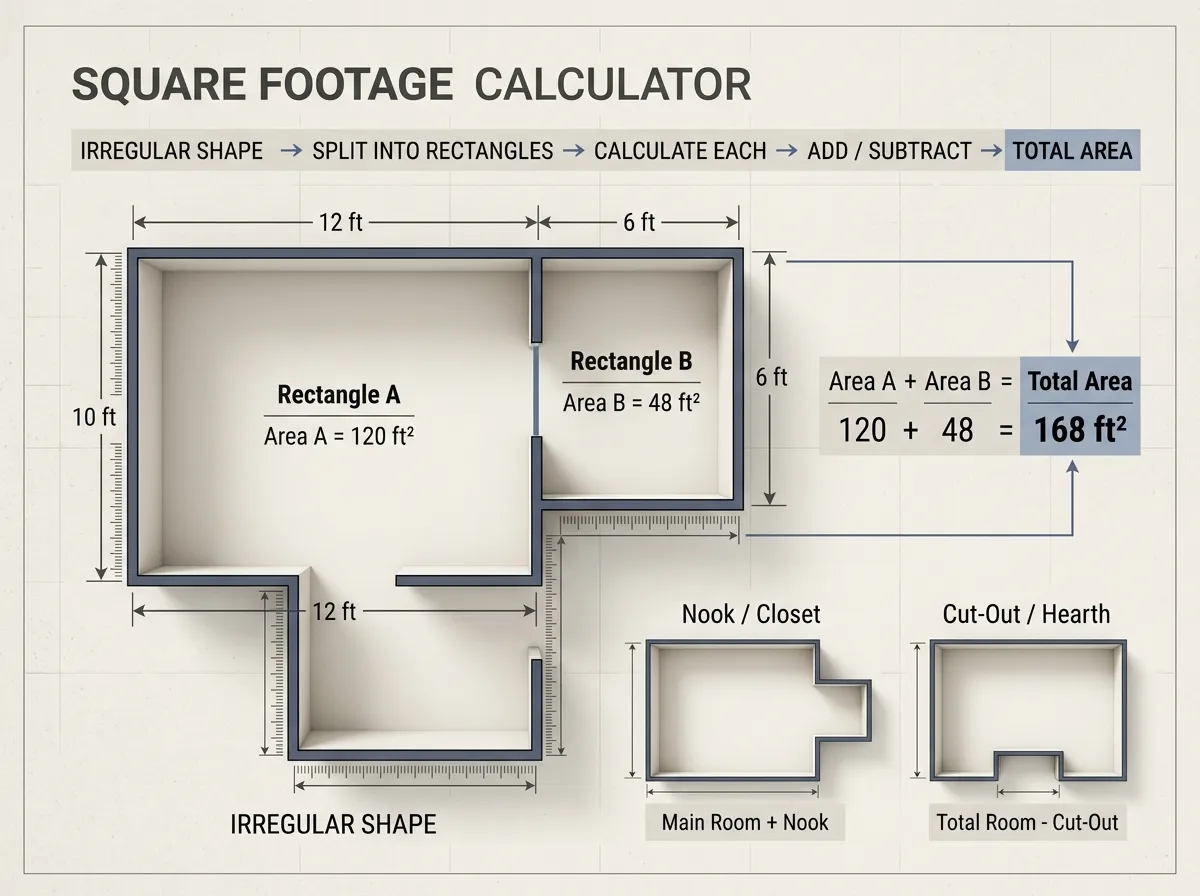
Most houses aren't perfectly square. If you have an L-shaped room, an alcove, or a complex layout, don't panic. The easiest method is to divide the space into simpler shapes.
- Split it up: Draw a line on your floor plan to separate the room into two distinct rectangles.
- Calculate individually: Measure the length and width of Rectangle A and calculate its square footage. Do the same for Rectangle B.
- Add them together: Sum the two areas (Area A + Area B = Total Area).
For a room with a closet or nook sticking out, calculate the main room, calculate the nook, and add them. For a piece taken out of a room (like a fireplace hearth), calculate the total room as if it were whole, calculate the hearth area, and subtract it.
Square Feet Conversion Chart
Quickly convert square feet to other common units of area measurement.
| To Convert Square Feet To... | Use This Formula |
|---|---|
| Square Inches (sq in) | Multiply by 144 |
| Square Yards (sq yd) | Divide by 9 |
| Square Meters (m²) | Multiply by 0.0929 (or divide by 10.764) |
| Acres | Divide by 43,560 |
| Roofing Squares | Divide by 100 |
How This Tool Calculates Square Footage
Our calculator simplifies complex geometry into a few easy steps. Here’s the process it follows to give you an accurate result.
Shape Selection
First, you select the shape that best matches your area. The tool then loads the specific mathematical formula required for that shape.
Unit Conversion
The calculator automatically converts any inch measurements you enter into feet by dividing them by 12, ensuring all units are consistent before calculation.
Applying the Formula
It applies the standard area formula for the selected shape (e.g., Length × Width for rectangles or πr² for circles) to your measurements.
Initial Area Calculation
The core calculation is performed, resulting in the precise square footage for a single unit of the area you measured.
Quantity Multiplication
If you enter a quantity greater than one (e.g., for multiple identical rooms), the tool multiplies the single-unit area by that quantity.
Cost Estimation
Finally, if you provide a cost per square foot, it multiplies this rate by the total area to give you an accurate project cost estimate.
Practical Project Planning
Square footage is a critical measurement for many common home improvement projects.
Flooring
Calculate how much tile, carpet, vinyl, or hardwood you need. Don't forget to add 10-15% for waste!
Painting
Measure the area of your walls to determine the exact amount of paint required for one or more coats.
Landscaping
Plan your garden or lawn by calculating the square footage for sod, seeds, or fertilizer.
Tiling
Perfect for estimating the number of tiles needed for a kitchen backsplash, bathroom floor, or shower wall.
HVAC Sizing
Determine the square footage of a room or house to help choose the correctly sized air conditioner or heater.
Real Estate
Quickly verify or measure the living area of a property, a key metric in home listings.
Understanding Common Area Units
Get to know the standard units used for measuring area to make your project planning seamless.
Square Inch (in²)
The area of a square with one-inch sides. Used for very small, detailed projects.
Square Foot (ft²)
The most common unit for rooms and houses. Equal to 144 square inches.
Square Yard (yd²)
Often used for carpeting and fabric. Equal to 9 square feet.
Acre
A large unit for land, equal to 43,560 square feet. Common in real estate.
Pro Tips for Accurate Measurements
Avoid common mistakes and ensure your project starts on the right foot with these expert tips.
Measure Twice, Calculate Once
Double-checking your length and width measurements before calculating can save you from costly errors and material shortages.
Use a Quality Tape Measure
A sturdy, straight metal tape measure is more reliable than a fabric one, which can stretch and give inaccurate readings.
Measure the Fullest Extent
Always measure from wall to wall, not from the edge of the baseboards, to capture the true dimensions of the room.
Note Down Irregularities
For rooms with closets, alcoves, or fireplaces, measure these areas separately and add or subtract them from your main calculation.
Frequently Asked Questions
First, convert the inches to feet by dividing the number of inches by 12. Then, add this decimal value to the total number of feet. For example, a measurement of 10 feet 6 inches becomes 10.5 feet (since 6 / 12 = 0.5). Our calculator handles this conversion for you automatically.
The easiest way is to break the 'L' shape into two separate rectangles. Measure the length and width of each rectangle, calculate their individual square footage using our calculator, and then simply add the two results together to get the total area of the room.
It's a professional standard to add a "waste factor" to your order. For projects like flooring or tiling, it is recommended to purchase 10-15% more material than your calculated square footage. This accounts for cuts, mistakes, and potential future repairs.
The formula for the area of a circle is Area = πr², where 'π' (pi) is approximately 3.14159, and 'r' is the radius of the circle (the distance from the center to the edge). You can find the radius by measuring the diameter (the widest part of the circle) and dividing it by two.
A 12 foot by 12 foot room is 144 square feet. You can find this by multiplying the length (12 ft) by the width (12 ft), which equals 144 ft².
Linear feet measure length in one dimension (e.g., the length of a fence), while square feet measure area in two dimensions (length and width). You use square footage to cover a surface, like a floor, but you use linear feet to measure its perimeter or a straight line.
To find a wall's square footage, measure its length and height in feet and multiply them (Length × Height). For a precise paint estimate, calculate the area of any windows and doors on the wall and subtract their combined area from the wall's total.
Yes, fundamentally. "Area" is the general mathematical term for the space inside a two-dimensional shape. "Square footage" is simply the most common unit used to express that area in countries that use the imperial system, like the United States.
Trusted by Professionals and DIYers
See what our users are saying about this tool.
SC
Sarah Chen
Interior Designer
"This tool is indispensable for my work. It gives me quick, accurate area calculations for flooring estimates. The cost estimator is a fantastic bonus."
MR
Michael Rodriguez
DIY Homeowner
"Used this for a major painting project. It was super simple to figure out wall areas. My only wish is for a feature to subtract window/door areas automatically."
EC
Emily Carter
Real Estate Agent
"I recommend this calculator to all my clients. It's perfect for verifying listing information. Very user-friendly on mobile devices."
DL
David Lee
Landscaper
"Great for planning out garden beds or new lawn installations. The different shape options are very useful. It handles most of my needs."
TJ
Tom Johnson
Flooring Installer
"The basic calculations are solid. It struggles a bit with very complex, irregular rooms. Still, it's a good starting point for most jobs."
JW
Jessica Williams
General Contractor
"A lifesaver on site. Fast, reliable, helps me create quotes for clients instantly. The clean interface is a huge plus."
BA
Ben Adams
Art Teacher
"I use this with my students for large-scale art projects. It helps them plan canvas sizes or mural spaces. They find it very intuitive."
OG
Olivia Garcia
Property Manager
"Managing multiple properties means constant small projects. This calculator is my go-to for everything from carpet replacement to ordering tiling. Highly recommend."
KH
Kevin Harris
Carpenter
"Helpful for estimating materials for custom decks or built-ins. I double-check with my own math, but it's always spot on. A reliable tool."
CM
Chloe Martinez
Event Planner
"Fantastic for mapping out venue layouts. Calculating floor space for seating or dance floors is now so much faster. The share feature is great for team collaboration."
Share Your Ideas
We are constantly working to improve our free tools. If you have a suggestion for a new feature or have noticed an issue, we would love to hear from you.