
Free construction calculators for quick, accurate estimates, measurements, and project planning

How to Create a Construction Budget That Actually Holds Up (USA)
A construction project rarely fails because of one big expense. It usually fails because dozens of smaller costs were never accounted for in the first place. Learning how to create a construction budget properly, before the first material is ordered or the first crew is hired, is what keeps a project financially realistic from start to finish.
Here’s the full process: what a construction budget actually includes, how to build one step by step, how to break it into categories, and how to keep it on track once work begins. Whichever type of project you’re planning, a residential addition, a full custom build, or a small renovation, the same core process applies.
What Is a Construction Budget and Why It Matters?
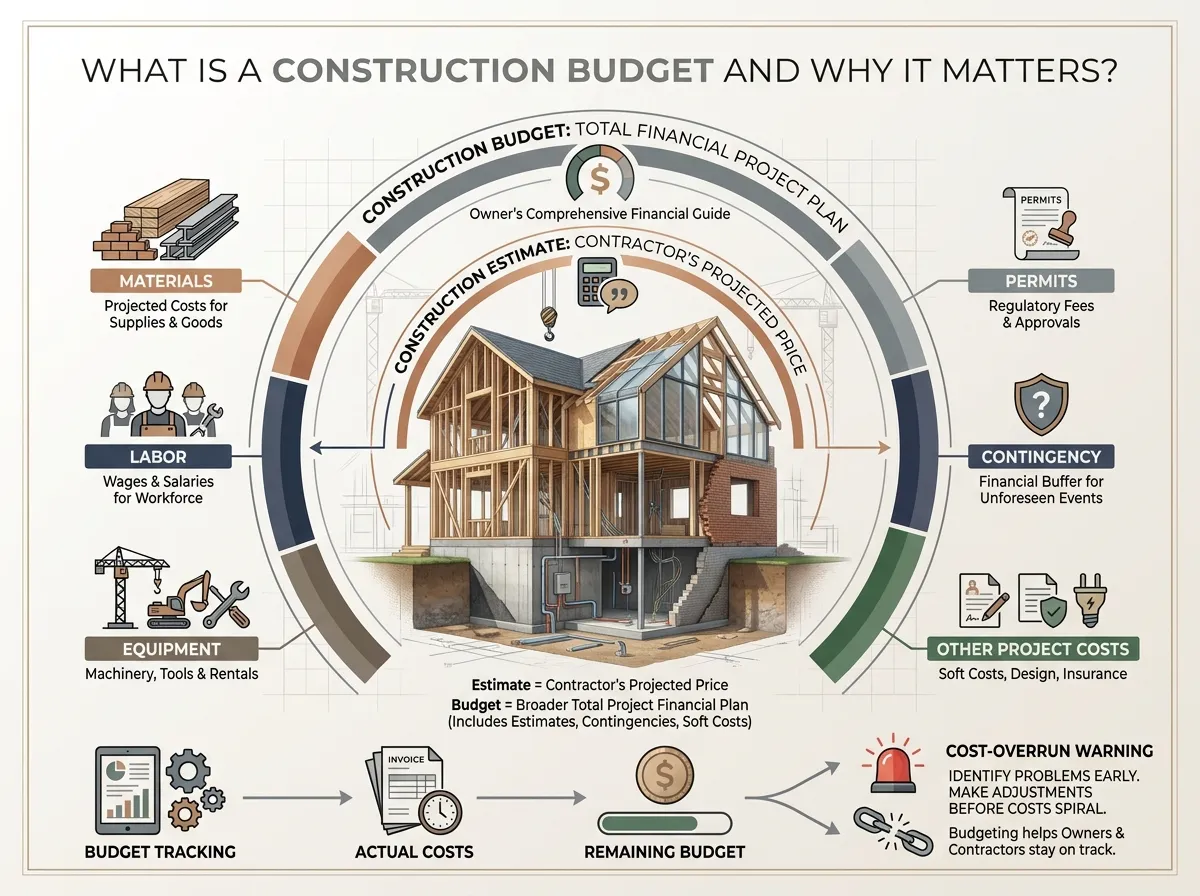
A construction budget is a detailed plan of how much a project is expected to cost, broken down by category, before work begins. It covers materials, labor, equipment, permits, and every other expense involved in getting a project from drawings to completion.
This is different from a construction estimate, which is usually a single contractor’s projected price for doing the work. A budget is broader: it’s the full financial plan for the project, often built from one or more estimates plus other costs like permits, contingency, and owner-side expenses.
People sometimes ask what a construction site budget is, or what a budget in construction is more generally. Whatever construction budget definition you go by, it comes down to the same idea: a complete financial picture that can be tracked, compared, and adjusted as work progresses.
That’s also where the importance of budgeting in construction comes from. A budget for construction work gives the owner, the contractor, and any lender a shared reference point for decisions, and it makes cost overruns visible early, while there’s still time to adjust, instead of only at the end when the money is already spent.
How to Create a Construction Budget Step by Step
Building a construction budget is a matter of working through the same categories of cost, in a consistent order, until every major expense has been accounted for. People phrase this a few different ways: how to construct a budget from scratch, how to budget a construction project, or how to prepare cost budget documents for the work ahead.
At the project level, this same process is often called construction project budgeting, or simply budgeting for construction projects. A building project budget covers the same ground for a single addition or a full new build alike, and budgeting for building construction projects at any scale means accounting for scope, phases, materials, labor, equipment, subcontractors, permits, delivery, site work, overhead, and contingency together, rather than pricing any one of them in isolation.
Here’s how that process typically works:
1. Define the Project Scope
Start by describing exactly what’s being built: size, design, finish level, and any site-specific requirements. A vague scope makes every later step in the budgeting process less accurate, since materials and labor can’t be priced without knowing what’s actually being constructed.
Construction Maths provides a range of the Best Free Construction calculators online built around exactly this kind of measurement and quantity work.
2. Break the Project into Phases and Categories
Rather than treating the project as one lump cost, divide it into phases (site work, foundation, framing, mechanical systems, finishes) and categories within each phase. This is the foundation of construction budget planning, since it’s much easier to price and track a project broken into manageable pieces.
3. Estimate Material Quantities and Costs
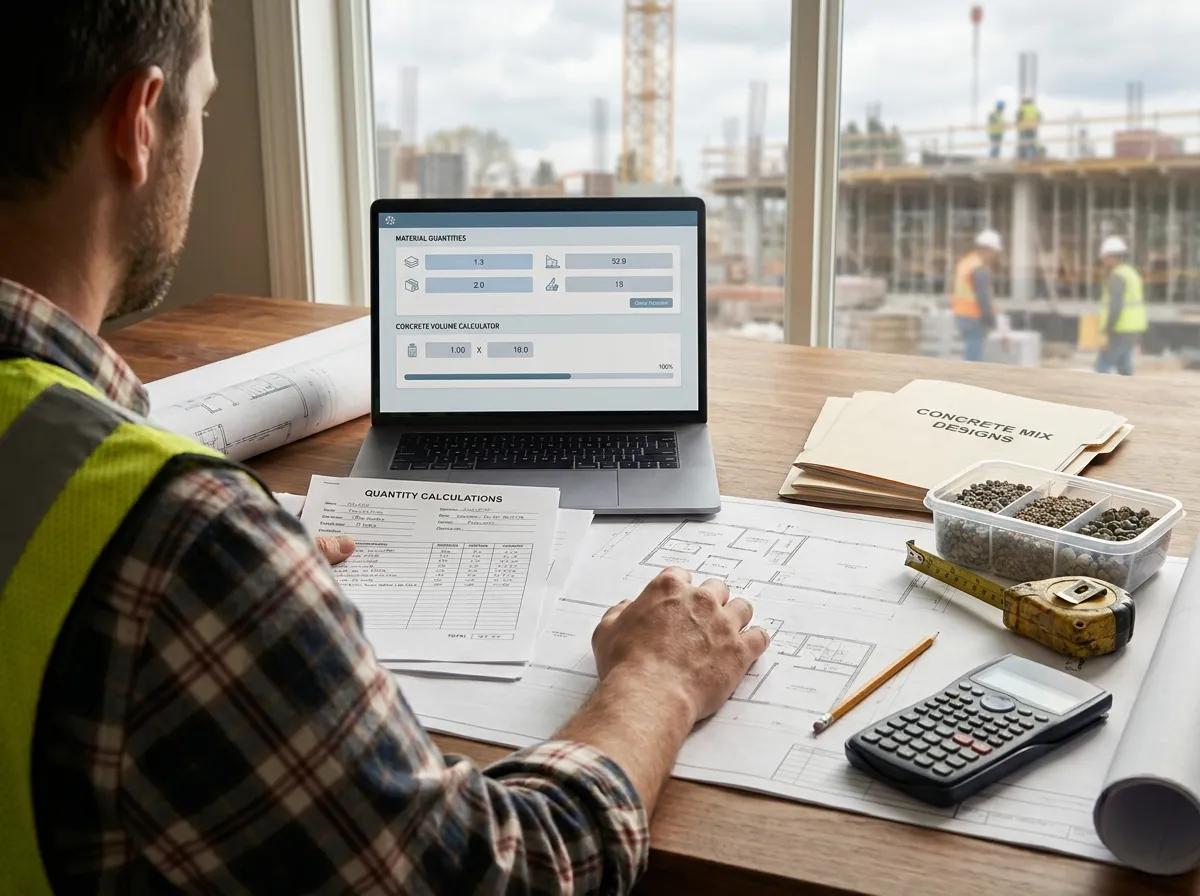
Work out the quantities needed for each material and apply current supplier prices to each one. Accurate budgeting usually starts here, with accurate quantities and measurements, since a material quantity that’s off by even a small margin can throw off the entire category’s cost.
4. Estimate Labor Costs
Labor costs come from multiplying expected hours for each trade by that trade’s local rate. Each trade is usually priced separately, since rates and productivity vary between them:
- Framing and structural labor
- Electrical
- Plumbing
- HVAC and mechanical
- Finishing trades (drywall, paint, flooring, trim)
5. Add Equipment and Subcontractor Costs
Next, add any equipment that needs to be rented or mobilized, along with pricing from subcontractors handling specialized work. Subcontractor quotes are often the most accurate source available for that portion of the budget, since they come from the trade actually pricing the work.
6. Include Permits, Delivery, and Site Work
Permit fees, delivery charges, and site preparation costs are easy to overlook when budgeting from the building plans alone. These costs vary significantly by site and local jurisdiction, so they need their own line items rather than being folded into a general allowance.
In the U.S., permit fees and requirements are typically set at the city or county level, so it’s worth checking with the local building department rather than assuming a flat rate:
- Building and trade-specific permit fees
- Material delivery and transport charges
- Grading and excavation
- Utility connections
7. Add Overhead and Contingency
Overhead covers general business costs allocated to the project, and contingency is a reserve set aside for unexpected costs or scope changes. Both should be sized to match the project’s actual complexity, not treated as a token line item.
8. Finalize the Total Planned Budget
Once every category has been priced, add everything together to get the total planned budget. Before treating that number as final, it’s worth double-checking a few things:
- Every category from scope to contingency has actually been priced, not estimated in your head
- Quantities were confirmed with a takeoff or calculator, not just a guess
- Pricing reflects current supplier and subcontractor quotes, not older figures
At this point, the building budget plan is complete and ready to guide purchasing and scheduling decisions, and it becomes the reference point that actual spending gets measured against for the rest of the project.
What Should Be Included in a Construction Budget?
Construction budget categories vary somewhat depending on the size and type of project, but most residential and small commercial budgets share a similar core structure. Breaking the total budget into these categories makes it far easier to track spending and spot problems early.
Table 1: Construction Budget Categories
| Category | What It Includes | Why It Matters |
|---|---|---|
| Site preparation | Clearing, grading, excavation, utility connections | Site conditions can vary widely and affect cost significantly |
| Design and planning | Architectural and engineering fees, drawings | Sets the foundation for every other cost in the budget |
| Permits | Local permit and inspection fees | Required before work can legally begin |
| Materials | Concrete, framing, roofing, flooring, finishes | Usually the largest share of a residential budget |
| Labor | Wages for every trade involved | Varies by trade, region, and project complexity |
| Equipment | Rented or owned machinery | Often overlooked when budgeting from plans alone |
| Subcontractors | Electrical, plumbing, HVAC, and other specialized trades | Frequently priced separately from general labor |
| Delivery | Transport of materials to the site | Can add meaningfully to cost on larger or remote projects |
| Utilities | Temporary power, water, and connections during construction | Needed for the work itself, separate from finished utilities |
| Overhead | General business costs allocated to the project | Covers administrative and indirect costs |
| Contingency | Reserve for unexpected costs | Protects the budget from being derailed by surprises |
Not every project needs every category listed here, and a large commercial project will often need more detailed subcategories than this. The goal isn’t to match every category exactly; it’s to make sure nothing significant gets left out of the total.
How Construction Budgeting and Scheduling Work Together
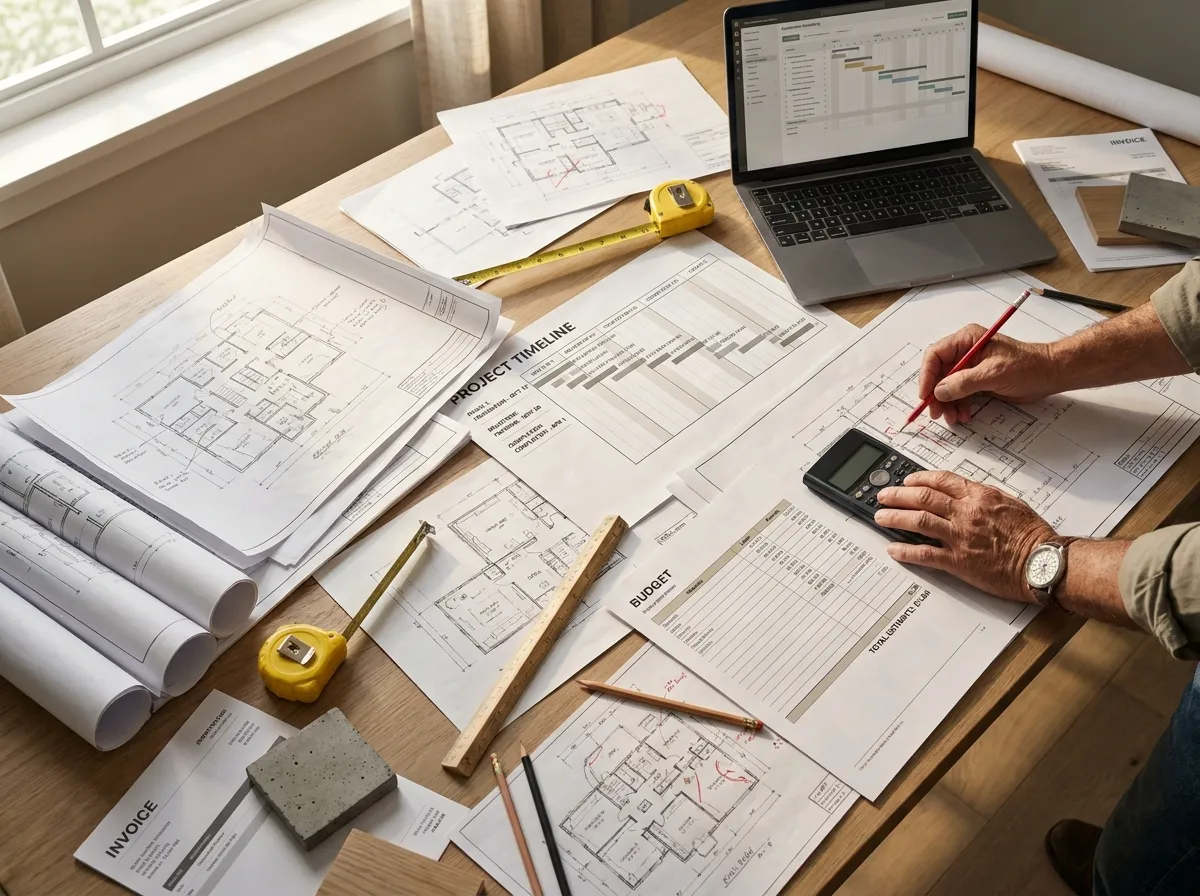
A construction budget shouldn’t be built separately from the project schedule, since the two directly affect each other throughout the project. Budgeting and scheduling construction work together to determine both how much a project will cost and when those costs will actually occur.
Delayed work often increases labor and equipment costs, since crews and rented machinery may need to stay on site longer than planned. A late material delivery can push back the schedule for several trades at once, and a change in project scope almost always affects both the timeline and the budget together, not just one or the other.
Because of this connection, a schedule is a useful tool for predicting when costs will actually hit the budget, not just how long the project will take. Reviewing the budget and schedule together, rather than as two separate documents, makes it easier to catch a cost problem caused by a schedule delay before it grows.
Construction Budgeting Techniques
Budgeting in construction isn’t a one-size-fits-all exercise. Different budgeting techniques for construction projects fit different stages, and no single method works well for every situation. Choosing the right one usually depends on how much design and pricing detail is available.
- Preliminary budgeting: a rough, early number based on very limited design information, useful for initial feasibility decisions
- Unit-cost based budgeting: applying a known cost per unit (per square foot, per fixture) to quickly estimate a category
- Detailed quantity-based budgeting: pricing exact quantities measured from finalized drawings, the most accurate approach once plans are complete
- Historical project comparison: using data from similar, recently completed projects as a starting point
- Supplier and subcontractor quote-based budgeting: building the budget directly from actual quotes rather than estimated rates
- Phase-based budgeting: allocating and tracking costs separately for each phase of the project, useful for larger or longer projects
Most real projects end up blending several of these techniques as part of one overall construction budgeting process, moving from an early concept toward a finalized, detailed budget.
Types of Construction Budgets
A construction budget also changes in purpose and detail depending on the stage of the project. Understanding these types helps set the right expectations for how precise a number should be at any given point.
A preliminary or conceptual budget is a rough figure used early on, before detailed design work exists, mainly to check if a project idea is financially realistic. A detailed project budget comes later, once drawings and specifications are complete enough to price accurately.
A construction phase budget breaks the total down by phase (site work, structure, finishes) so spending can be tracked as the project physically progresses. A procurement budget focuses specifically on materials and equipment purchasing, while a closeout budget accounts for final costs, punch-list items, and any remaining payments once the project wraps up.
Construction Budget Example
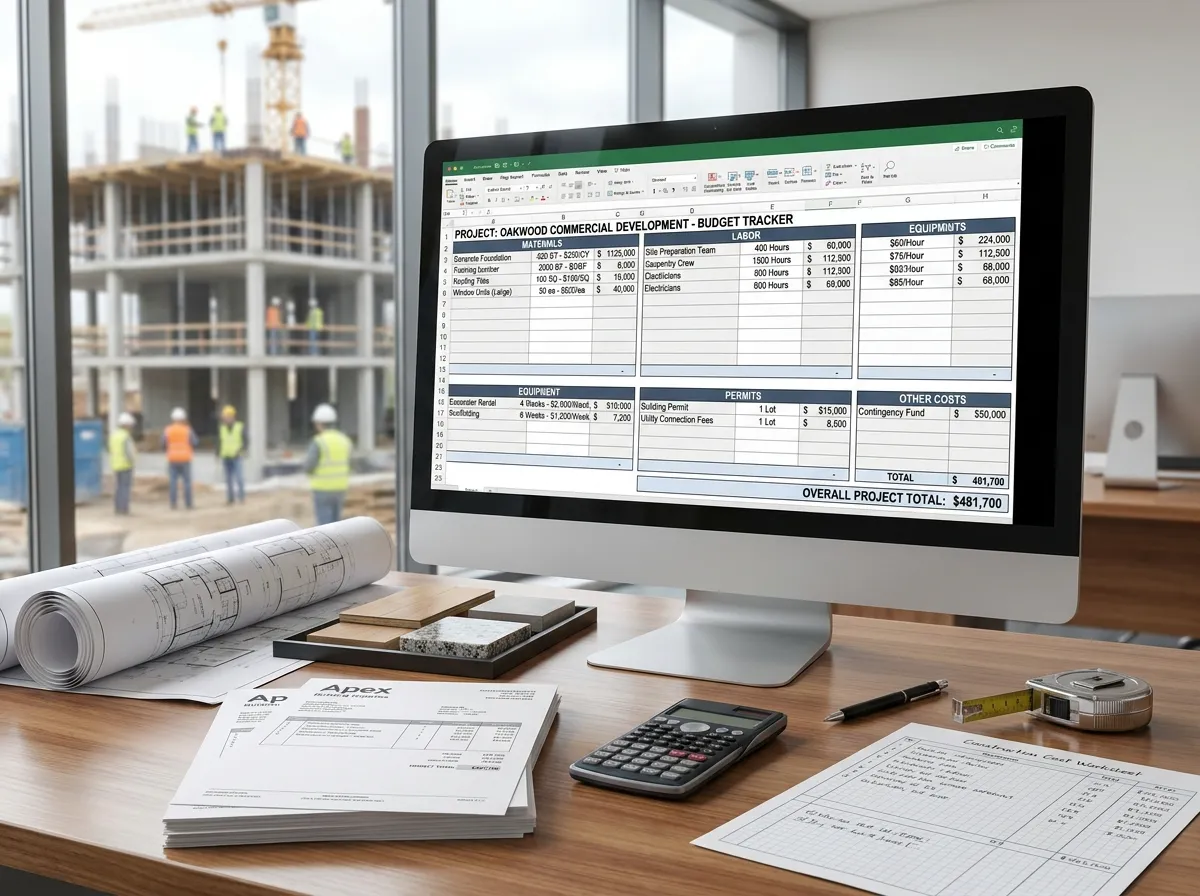
The table below shows a construction budget example for a hypothetical 400 sq. ft. residential addition. All figures are illustrative only; actual costs vary based on location, supplier pricing, labor rates, project size, site conditions, material selection, project complexity, and current market conditions.
Table 2: Example Construction Budget Breakdown
| Category | Notes | Example Amount |
|---|---|---|
| Project scope | 400 sq. ft. single-story addition | Reference only |
| Materials | Framing, roofing, siding, drywall, flooring | $48,000 |
| Labor | All trades combined | $36,000 |
| Equipment | Rental equipment for the project duration | $3,500 |
| Permits | Local building permit and inspections | $2,000 |
| Delivery | Material transport to the site | $1,200 |
| Waste allowance | Approximately 8% applied to materials | $3,800 |
| Overhead | Allocated business costs | $5,000 |
| Contingency | Approximately 10% of subtotal | $9,950 |
| Total planned budget | $109,450 |
Our Area Calculator can help confirm the square footage used to size several of these categories before committing to final numbers. Once real quotes come in for materials and labor, this kind of table becomes a working budget rather than an example.
Tracking, Reviewing, and Analyzing Your Construction Budget
A budget only stays useful if it’s compared against what’s actually being spent as the project moves forward. This involves three related activities: tracking, reviewing, and analyzing the numbers as work progresses.
Comparing Budgeted Cost vs. Actual Cost
Construction budget analysis usually comes down to a simple comparison: what was planned versus what was actually spent, category by category. If the budget for materials was $10,000 and actual spending reaches $11,500, the project is $1,500 over the original material budget.
Table 3: Budgeted Cost vs. Actual Cost Example
| Category | Budgeted Cost | Actual Cost | Difference |
|---|---|---|---|
| Materials | $10,000 | $11,500 | +$1,500 over |
| Labor | $8,000 | $7,600 | $400 under |
| Equipment | $1,200 | $1,200 | On budget |
When a category runs over, it’s worth investigating why before assuming it’s simply a one-time cost. A material overrun might come from a price increase, a quantity that was underestimated, or added waste, and each of those causes points to a different fix.
When to Review Your Construction Budget
A construction budget review shouldn’t wait until the project is nearly finished. Reviewing it at several defined points catches problems while there’s still room to adjust.
- Before construction begins, to confirm the initial numbers are realistic
- Before ordering major materials, once current pricing is available
- After receiving major quotes from suppliers or subcontractors
- During each major construction phase, as actual costs come in
- When project scope changes for any reason
- When unexpected costs appear on site
- Before completion, to reconcile the full project
Ongoing Budget Management
Managing a construction budget day-to-day means keeping planned and actual costs updated in the same place, so they can be compared at any point rather than only at the end.
This kind of construction budget management, sometimes called budgeting in construction management or construction budgeting management, focuses on tracking planned costs, tracking actual costs, and keeping the forecast current rather than fixed.
In practice, this means tracking what’s been spent, updating the forecast for remaining categories, and keeping a running total of what’s left in the budget. Reviewing changes as they happen, rather than after several have accumulated, keeps the forecast accurate and makes it much easier to spot a developing overrun early.
What Causes a Construction Budget to Go Over?
Most construction budget overruns come from a small, repeatable set of causes rather than one dramatic failure. Recognizing them ahead of time is the easiest way to prevent them.
Table 4: Common Causes of Budget Overruns and How to Prevent Them
| Cause | How to Prevent It |
|---|---|
| Inaccurate initial quantities | Use measured takeoffs and calculators rather than rough guesses |
| Outdated material or labor prices | Get current quotes close to the time of ordering |
| Scope changes without budget review | Price every change before approving it |
| Unexpected site conditions | Complete a site assessment before finalizing the budget |
| No contingency, or one that’s too small | Size contingency to the project’s actual complexity |
| Poor cost tracking during construction | Compare actual spending against the budget regularly |
| Material waste not accounted for | Include a realistic waste allowance in each material category |
| Delays that increase labor and equipment time | Track schedule and budget together, not separately |
How to Keep a Construction Project on Budget
Learning how to keep construction projects on budget comes down to consistent habits more than any single trick. Effective construction cost control, or simply learning how to control construction costs day to day, relies on a few practices that make a real difference across almost any project.
Start with a realistic initial budget built from accurate quantities, not rough guesses, and confirm supplier prices before finalizing material costs. Plan labor carefully by trade, and size the contingency to match the project’s actual risk rather than a token percentage.
- Review changes before approving them, including their full cost impact
- Hold regular budget reviews rather than waiting for a scheduled milestone
- Track actual spending against the budget as the project progresses
- Avoid unnecessary scope changes once construction has started
- Monitor material waste and adjust future orders accordingly
- Review subcontractor quotes carefully rather than assuming they are accurate
What to Do When Actual Costs Exceed the Budget
Once a category is confirmed to be over budget, the first step is identifying exactly why, not just how much. A price increase, an underestimated quantity, added waste, and a scope change all call for different responses.
If the overrun is isolated to one category, check if savings elsewhere in the budget can offset it before assuming the total budget needs to increase. If it can’t be offset, update the total budget and communicate the change clearly to everyone involved, rather than letting it surface only at final reconciliation.
How Construction Budgets Differ by Project Type
Building budgets look different depending on what’s actually being built, from a single-family home to a commercial build-out to a small renovation. Residential construction tends to involve more finish-level variation (flooring, fixtures, cabinetry), which gives material selection an outsized effect on the total.
Renovation and addition budgets usually carry a larger contingency than new construction, since existing conditions aren’t always fully known until work begins. A few commercial construction budgeting tips are worth calling out separately, since commercial projects tend to involve a larger project scope, more subcontractor coordination, and more complex procurement and permitting.
Cost tracking on commercial projects is often organized by phase, since these projects tend to run longer and involve more moving parts than a typical residential job.
Budgeting for construction firms managing several projects at once generally means applying the same core budgeting process described above to each project individually, then tracking them together at a portfolio level. The fundamentals accurate quantities, clear categories, and regular reviews, stay the same regardless of project size.
Frequently Asked Questions About Construction Budgets
What is a construction budget?
A construction budget is a detailed financial plan that estimates every major cost involved in a construction project, organized into categories like materials, labor, equipment, and permits.
How do you create a construction budget?
You create a construction budget by defining the project scope, breaking it into categories, estimating quantities and costs for materials and labor, adding equipment, subcontractor, and site costs, then including overhead and contingency.
What is included in a construction budget?
A construction budget typically includes site preparation, design and permits, materials, labor, equipment, subcontractors, delivery, utilities, overhead, and contingency, though categories vary by project.
What are the main construction budget categories?
The main categories usually include materials, labor, equipment, subcontractors, permits, site work, delivery, overhead, and contingency.
How do you keep a construction project on budget?
Keeping a project on budget comes down to accurate initial quantities, current pricing, a realistic contingency, regular budget reviews, and reviewing every change before it’s approved.
What causes construction budgets to increase?
Common causes include inaccurate initial quantities, outdated pricing, unapproved scope changes, unexpected site conditions, insufficient contingency, and poor cost tracking during the project.
How often should a construction budget be reviewed?
A construction budget should be reviewed before construction starts, before major material orders, after receiving major quotes, during each construction phase, and whenever scope or costs change unexpectedly.
What is the difference between a construction budget and an estimate?
An estimate is typically a single contractor’s projected price for the work, while a budget is the broader financial plan for the entire project, often built from one or more estimates plus other owner-side costs.
Why is budgeting important in construction?
Budgeting supports financial control, better decision-making, and early detection of cost overruns, keeping a project realistic and manageable from start to finish.
How do you prepare a construction cost budget?
Preparing a construction cost budget means gathering current material and labor prices, applying them to measured quantities and estimated hours, then adding fixed costs like permits and a contingency reserve on top.