
Free construction calculators for quick, accurate estimates, measurements, and project planning
Cement Calculator Report
Detailed cement quantity, bag estimation, volume breakdown, and mix ratio specification report.
Cement Calculator
Calculate cement quantity, cement volume, and the estimated number of cement bags needed for your project using mix ratios and project dimensions.
Project Measurements & Volume
Direct geometric wet volume required for your project.
Direct volume bypasses length, width, and thickness geometry.
Cement Mix Ratio
2 sand + 4 aggregate = 6 total
Cement Bag Weight & Allowance
lb
Optional allowance for handling loss, spillage, and measurement variation.
Rounded Bags to Buy
8 bags
Estimated Bags Required:
7.37 bags
Base Bags:
7.02 bags
Cement Weight (with Allowance)
693 lbs
Cement Weight (Metric):
314 kg
Wastage Allowance:
+33.0 lbs (5%)
Base Cement Volume
7.33 cu ft
Cement Volume with Allowance:
7.70 cu ft (0.22 m³)
Wet Project Volume:
33.33 cu ft (1.23 yd³)
Dry Mix Volume:
51.33 cu ft
Estimating Assumptions Note: This calculator uses an assumed 1.54 dry-volume factor for concrete mixes and 1.33 for the included sand-cement mortar presets. Actual material yield can vary depending on materials, moisture, aggregate condition, batching method, and project conditions. Cement weight is estimated using an assumed bulk density of approximately 90 lb/ft³ (about 1,440 kg/m³). Actual bulk density can vary by product and material condition.
More Related Tools
Explore related calculators for your construction and masonry projects.
Concrete Calculator
Calculate total concrete volume, ready-mix yards, and slab dimensions for large pours.
Brick Calculator
Calculate total brick units, mortar quantities, and material estimates for your masonry project.
Concrete Footing Calculator
Calculate concrete volume, depth, and material requirements for trench footings and piers.
Square Footage Calculator
Calculate the square footage of complex rooms, walls, and flooring layouts with ease.
Brick Course Height Calculator
Calculate brick course height, masonry course gauge, courses per foot, and target wall coursing.
Retaining Wall Calculator
Calculate materials, backfill, block counts, and dimensions for retaining wall builds.
How to Use the Cement Calculator
Follow these steps to determine cement volume, calculate the required cement quantity, and estimate commercial bags accurately.
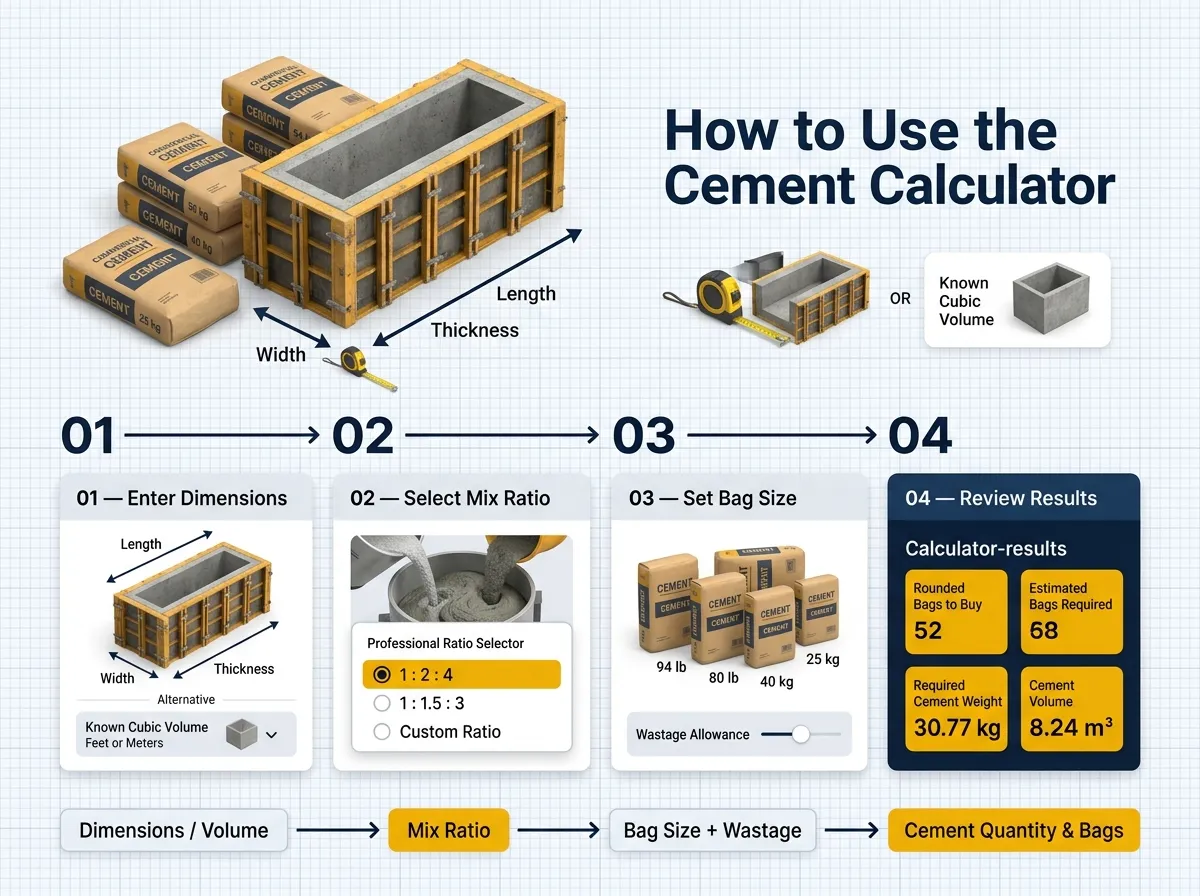
1. Enter Dimensions
Input the length, width, and thickness of your formwork or enter a known cubic volume directly in feet or meters.
2. Select Mix Ratio
Choose an established mix ratio preset such as 1:2:4, richer 1:1.5:3, or enter custom proportional parts.
3. Set Bag Size
Choose your commercial bag size (94 lb, 80 lb, 50 kg, 40 kg, 25 kg) and specify an optional wastage allowance.
4. Review Results
Examine rounded bags to buy, estimated bags required, required cement weight, and volume figures.
Cement Calculator for Construction Projects
Overview: This cement calculator estimates the pure cement quantity and the required commercial bags needed for on-site mixing, whether you are pouring footings, bedding brickwork, or laying small concrete pads.
In building and civil works, knowing the gross volume of a pour is only half the battle. When mixing concrete or mortar on site rather than ordering pre-mixed transit trucks, builders must determine the required quantity of cement for batching and material procurement. An accurate calculator for cement helps ensure you purchase an appropriate number of bags for continuous work while minimizing unexpected site delays.
How Much Cement Do You Need for Your Project?
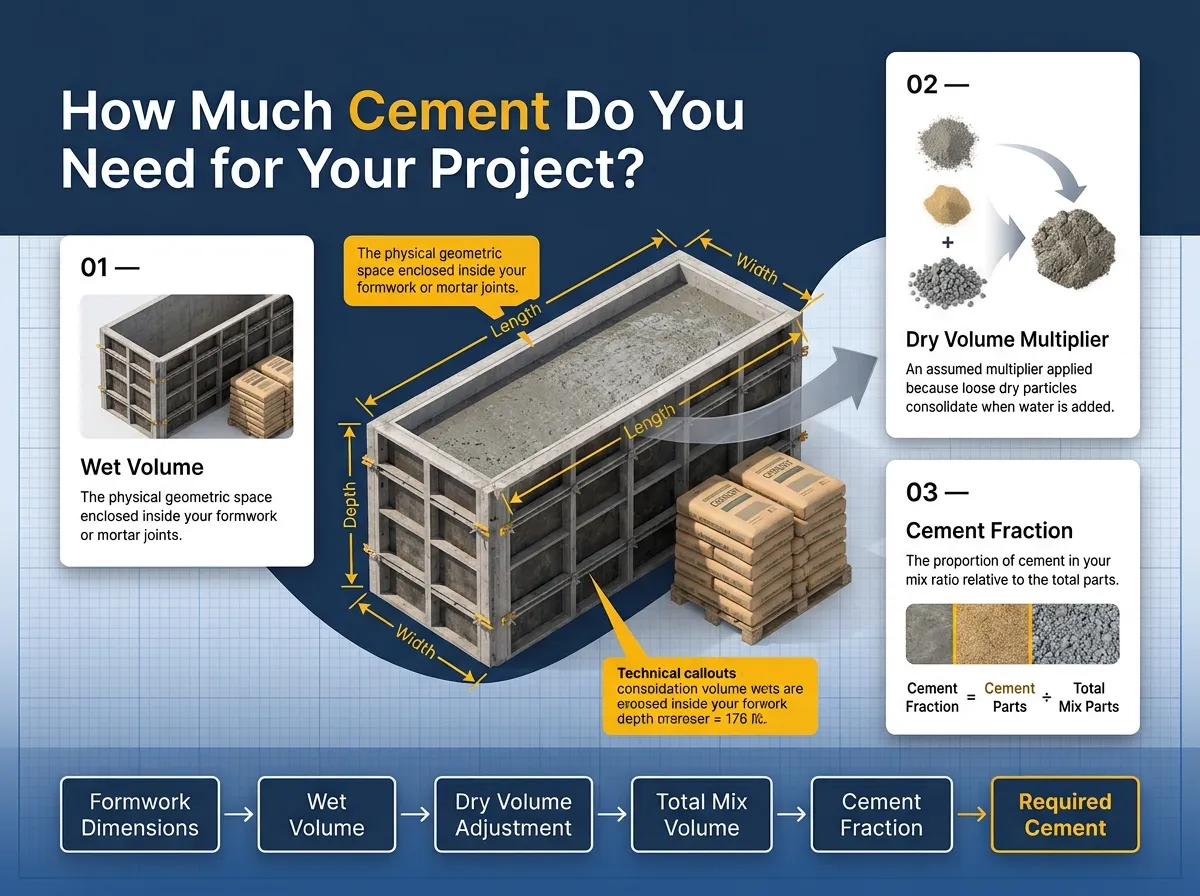
When estimating how much cement you need, two fundamental physical principles must be addressed: the geometric wet volume of the structural member and the volumetric reduction that occurs when dry cement and sand are mixed with water.
Wet Volume
The physical geometric space enclosed inside your formwork or mortar joints.
Dry Volume Multiplier
An assumed multiplier applied because loose dry particles consolidate when water is added.
Cement Fraction
The proportion of cement in your mix ratio relative to the total parts.
How to Calculate the Amount of Cement Required
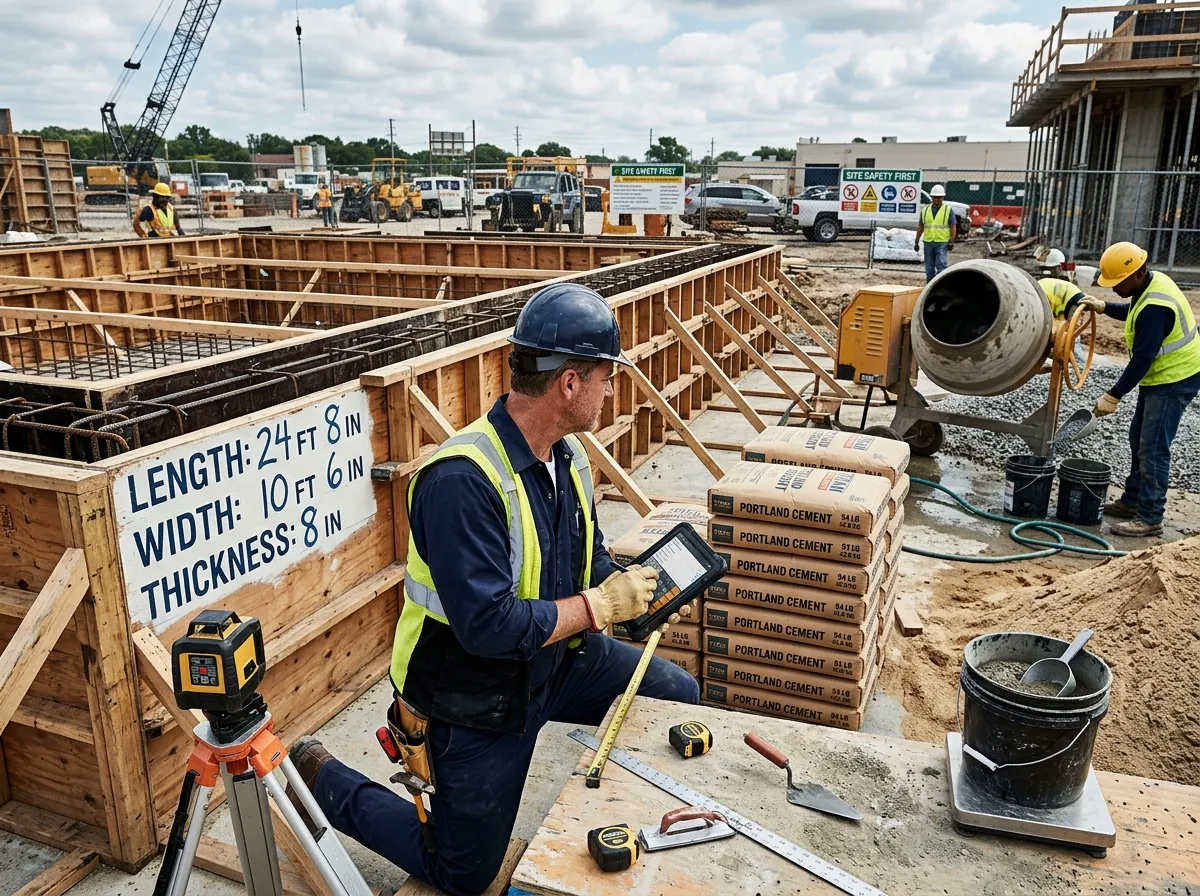
To calculate cement needed from jobsite measurements, follow this sequential estimating procedure:
| No. | Calculation Step | What to Do |
|---|---|---|
| 1 | Determine Project Volume | Calculate length × width × thickness or enter a known volume. |
| 2 | Convert Units | Convert measurements into cubic feet or cubic meters. |
| 3 | Apply Dry-Volume Factor | Use the calculator's estimating factor for the selected mix type (1.54 for concrete or 1.33 for mortar). |
| 4 | Apply Mix Ratio | Divide the dry volume according to the selected cement mix proportions. |
| 5 | Calculate Cement Volume | Multiply dry volume by the cement fraction: (Cement Parts ÷ Total Parts) × Dry Volume. |
| 6 | Calculate Cement Weight | Multiply cement volume by the assumed cement bulk density (~90 lb/ft³ or 1,440 kg/m³). |
| 7 | Add Wastage Allowance | Apply the optional percentage for handling and material losses. |
| 8 | Calculate Bags | Divide the final cement weight by the selected bag weight. |
| 9 | Round Up | Round the estimated bags upward to determine whole bags to buy. |
Calculating Cement Quantity From Project Dimensions
Physical project dimensions rarely match uniform units on the jobsite. Lengths and widths are typically specified in feet, while slab thickness or footing depth is measured in inches. Our cement volume calculator converts all dimensions into unified cubic measurements:
Imperial Measurement
Length (ft) × Width (ft) × [Thickness (in) ÷ 12] = Cubic Feet (ft³).
Divide by 27 to obtain Cubic Yards (yd³).
Metric Measurement
Length (m) × Width (m) × Thickness (m) = Cubic Meters (m³).
1 m³ equals approximately 35.3147 ft³.
Using a Cement Mix Ratio for Quantity Calculations
The cement mix ratio defines the volumetric relationship between cement, fine aggregate (sand), and coarse aggregate (gravel or stone). Selecting an appropriate ratio guides how much binder is needed relative to aggregates:
| Mix Description | Ratio (C : S : A) | Total Parts | Cement Share | Estimating Context |
|---|---|---|---|---|
| Standard Nominal Concrete Mix | 1 : 2 : 4 | 7 | 14.29% | General flatwork reference |
| Richer Concrete Mix | 1 : 1.5 : 3 | 5.5 | 18.18% | Richer volumetric reference |
| Rich Nominal Mix | 1 : 1 : 2 | 4 | 25.00% | Higher-cement volumetric reference |
| Lean Concrete Mix | 1 : 3 : 6 | 10 | 10.00% | Sub-base leveling and trench blinding reference |
| General Masonry Mortar | 1 : 4 (Sand only) | 5 | 20.00% | Brick and block jointing reference |
Note: These volumetric ratios serve as general estimating references only. Actual mix design and proportions should follow certified project specifications, engineering drawings, and applicable regional building codes.
Cement Calculation Formula
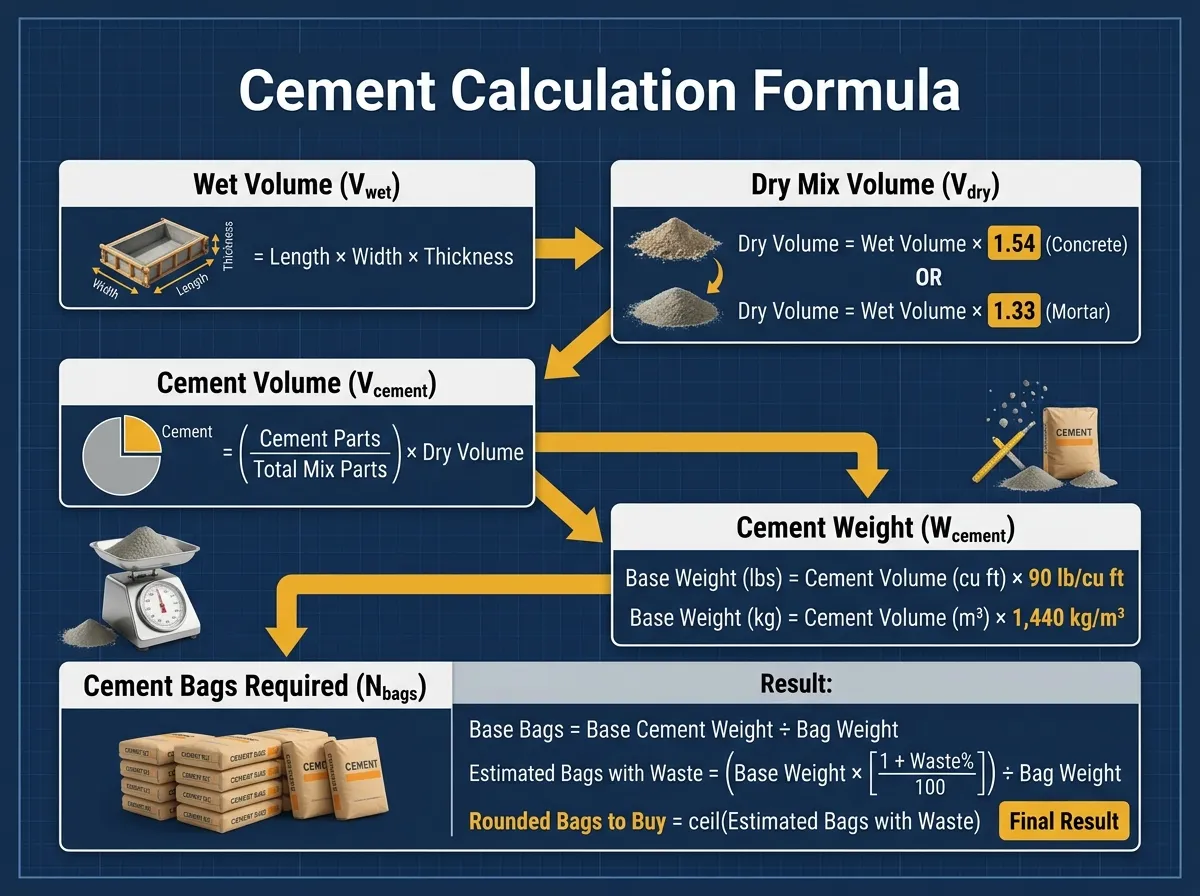
Civil estimation uses standard geometric and bulk density relationships to translate structural volume into bag counts:
Wet Volume ($V_{wet}$)
Wet Volume = Length × Width × Thickness
Dry Mix Volume ($V_{dry}$)
Dry Volume = Wet Volume × 1.54 (Concrete) OR Wet Volume × 1.33 (Mortar)
Cement Volume ($V_{cement}$)
Cement Volume = (Cement Parts ÷ Total Mix Parts) × Dry Volume
Cement Weight ($W_{cement}$)
Base Weight (lbs) = Cement Volume (cu ft) × 90 lb/cu ft
Base Weight (kg) = Cement Volume (m³) × 1,440 kg/m³
Base Weight (kg) = Cement Volume (m³) × 1,440 kg/m³
Cement Bags Required ($N_{bags}$)
Base Bags = Base Cement Weight ÷ Bag Weight
Estimated Bags with Waste = (Base Weight × [1 + Waste% / 100]) ÷ Bag Weight
Rounded Bags to Buy = ceil(Estimated Bags with Waste)
Estimated Bags with Waste = (Base Weight × [1 + Waste% / 100]) ÷ Bag Weight
Rounded Bags to Buy = ceil(Estimated Bags with Waste)
| Parameter | Formula / Definition | Example / Value |
|---|---|---|
| Project Volume | Length × Width × Thickness | 33.33 cu ft (1.23 yd³) |
| Dry-Volume Factor | 1.54 (Concrete) / 1.33 (Mortar) | 1.54 multiplier |
| Dry Volume | Wet Volume × Dry Factor | 51.33 cu ft |
| Cement Ratio & Parts | Cement : Sand : Stone | 1 : 2 : 4 (7 total parts) |
| Cement Fraction | Cement Parts ÷ Total Parts | 1 / 7 = 14.29% |
| Base Cement Volume | Dry Volume × Cement Fraction | 7.33 cu ft (0.21 m³) |
| Estimated Weight | Cement Volume × Assumed Bulk Density | 660 lbs (299 kg) |
| Optional Wastage | Base Weight × Allowance % | +33 lbs (5%) |
| Estimated Bags | Total Weight ÷ Unit Bag Weight | 7.37 bags (Buy 8 bags) |
Cement Calculator Example
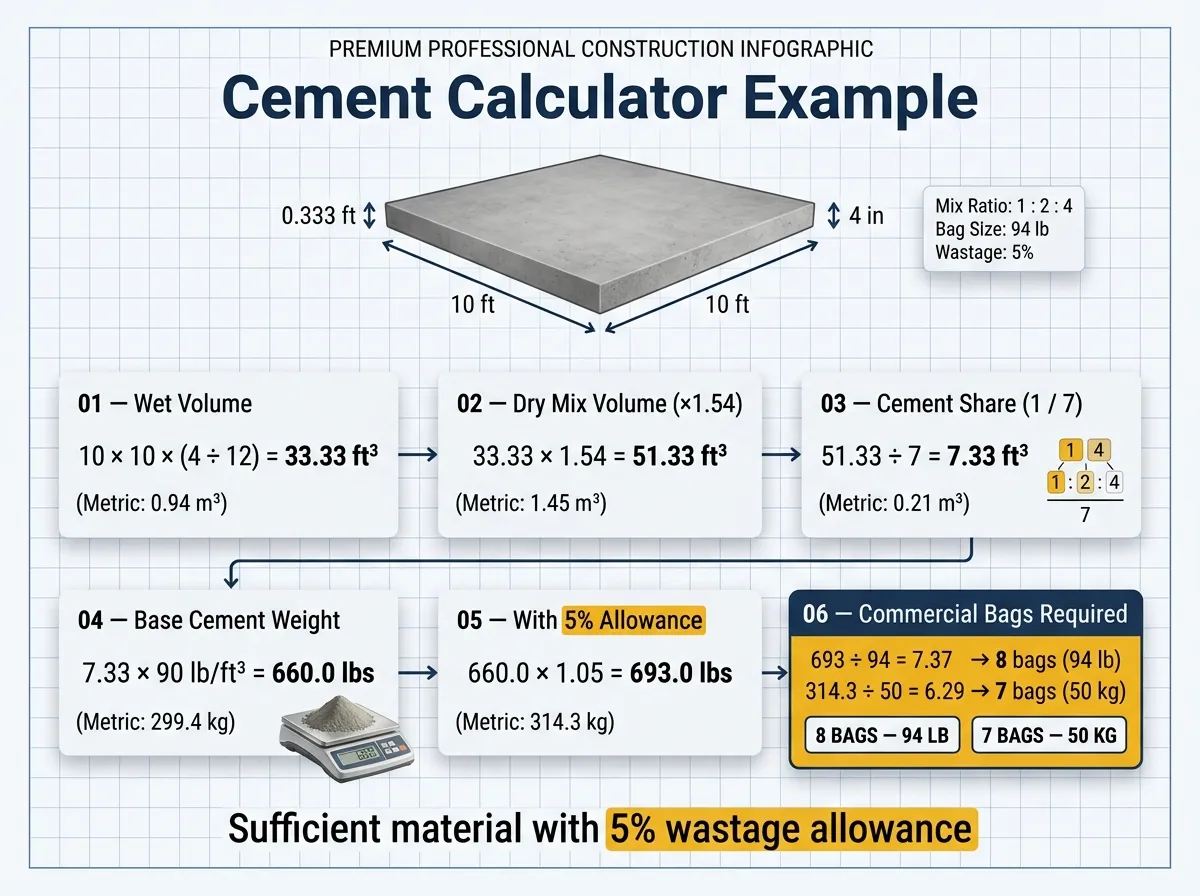
Assume you are casting a 10 ft × 10 ft patio pad that is 4 inches deep (0.333 ft) using a standard 1 : 2 : 4 concrete mix and 94-pound cement bags with 5% wastage:
| Calculation Stage | Imperial Values | Metric Equivalent |
|---|---|---|
| 1. Wet Volume | 10 × 10 × (4 ÷ 12) = 33.33 ft³ | 0.94 m³ |
| 2. Dry Mix Volume (×1.54) | 33.33 × 1.54 = 51.33 ft³ | 1.45 m³ |
| 3. Cement Share (1 / 7) | 51.33 ÷ 7 = 7.33 ft³ | 0.21 m³ |
| 4. Base Cement Weight | 7.33 × 90 lb/ft³ = 660.0 lbs | 299.4 kg |
| 5. With 5% Allowance | 660.0 × 1.05 = 693.0 lbs | 314.3 kg |
| 6. Commercial Bags Required | 693 ÷ 94 = 7.37 → 8 bags (94 lb) | 314.3 ÷ 50 = 6.29 → 7 bags (50 kg) |
Based on the selected 5% allowance, the estimate rounds to 8 bags of 94-lb cement (or 7 bags of 50-kg cement).
Cement Bag Size and Quantity Guide
Commercial cement is packaged in standardized bag weights. Bag weights vary depending on packaging regulations and supplier specifications:
| Bag Size | Nominal Weight |
|---|---|
| 94 lb Bag | 94.0 lb (42.6 kg) |
| 80 lb Bag | 80.0 lb (36.3 kg) |
| 50 lb Bag | 50.0 lb (22.7 kg) |
| 50 kg Bag | 50.0 kg (110.2 lb) |
| 40 kg Bag | 40.0 kg (88.2 lb) |
| 25 kg Bag | 25.0 kg (55.1 lb) |
Bag weights vary by supplier and market. Always confirm the bag weight printed on the product.
Cement Calculation Tips for the Jobsite
Account for Dry Volume Reduction:
Mixing 1 ft³ of dry cement, 2 ft³ of sand, and 4 ft³ of gravel does not yield 7 ft³ of concrete. Because sand and cement fill the void spaces between gravel stones, the resulting wet volume is roughly 30–35% lower than the loose dry sum. Estimating tools apply an assumed factor like 1.54 to account for this shrinkage.
Purchase Whole Commercial Bags:
Cement is typically purchased in whole bags. If the calculation indicates 7.37 bags, the purchasing estimate rounds up to 8 bags.
Keep Cement Dry on Site:
Hydration begins as soon as moisture penetrates the packaging. Store cement bags on raised timber skids or pallets and keep them covered with waterproof tarpaulins until mixing.
Important Calculation Assumptions and Notes
Estimating Purpose: This cement calculator is designed for material quantity estimating, purchasing planning, and volumetric estimation. It is not an engineered structural mix-design software. Structural elements subject to engineering inspection or building code approvals must follow certified engineering drawings, water-cement specifications, and regional standards.
Wastage Considerations: Optional wastage allowance accounts for handling loss, spillage, measurement variation, and other minor material losses. The appropriate allowance depends on project conditions.
What Builders & Masonry Professionals Say
DL
David Lawson
General Contractor
“This tool makes it simple to estimate required 94-lb bags from pad dimensions. It includes the dry volume factor so our preliminary material counts are very reliable.”
MS
Marcus Stewart
Concrete Specialist
“Being able to switch between standard 1:2:4 and richer 1:1.5:3 mix ratios saves me lots of time when estimating footing pours on small job sites.”
EJ
Edward Jenkins
Site Supervisor
“The display showing both estimated exact bags and rounded bags to purchase with optional wastage is very convenient for project planning.”
BL
Brian Lewis
Construction Estimator
“I use this calculator to estimate cement quantities for small pads and footings. It handles metric 50-kg bags as cleanly as US pound specifications.”
GH
Gregory Hall
Masonry Foreman
“Very helpful for checking bag requirements on brick mortar batches. Setting a 1:4 mortar ratio and seeing the required cement bags is quick and straightforward.”
PF
Patrick Foster
Civil Engineering Tech
“The calculation assumptions are clearly explained. The dry volume factor and loose density assumptions line up with standard civil estimating rules of thumb.”
NB
Nathan Bennett
Independent Builder
“The direct volume input option is practical when an engineer specifies cubic yards and I need an estimate of cement bags for on-site batching.”
TR
Tyler Ross
Project Manager
“Clean interface and easy to use on mobile phones right in the lumber yard. The share feature allows sending exact parameters directly to our crew.”
Frequently Asked Questions
A cement calculator is an estimation tool designed to calculate the specific volume, weight, and commercial bags of cement required for on-site mixing based on structural dimensions and proportional mix designs.
Calculate the gross wet volume (Length × Width × Thickness), multiply by an assumed dry-volume factor (1.54 for concrete or 1.33 for mortar), determine the cement fraction from your mix ratio, and divide total weight by your bag size.
Project dimensions are converted into uniform cubic feet or cubic meters to determine wet volume. The calculator then applies a dry conversion multiplier and divides by total proportional parts to find the cement volume and mass.
Multiply estimated cement volume by bulk density (approximately 90 lb/cu ft or 1,440 kg/m³) to determine total cement weight, then divide by the individual bag weight (e.g., 94 lb or 50 kg) and round up to the next full unit.
Dry cement, sand, and gravel contain air voids between loose particles. When water is added and the mixture is consolidated, the volume reduces by approximately 30–35%. Multiplying wet volume by 1.54 compensates for this shrinkage in estimating calculations.
The calculator includes presets for US 94-lb, 80-lb, and 50-lb bags, as well as metric 50-kg, 40-kg, and 25-kg bags. You can also input any custom bag weight to match specific supplier packaging.
Richer mixes contain a higher proportion of cement per unit volume. For instance, a 1:1.5:3 mix requires 1 part cement for every 5.5 total parts (18.18%), whereas a 1:2:4 mix requires 1 part for every 7 total parts (14.29%).
Yes. Each dimension input features an independent unit selector supporting feet, inches, and meters, allowing flexible entries that are converted accurately into cubic volume.
Concrete is the finished composite material made by combining cement, sand, coarse aggregate, water, and other ingredients as specified by the mix. Cement is the binder component, while the required proportion depends on the selected mix ratio.
Optional wastage allowance accounts for handling loss, spillage, measurement variation, and other minor material losses. The appropriate allowance depends on project conditions.
Yes. Select the appropriate mortar preset. The calculator uses the selected mortar dry-volume factor and mix proportions to estimate the cement quantity.
No. This tool provides mathematical volumetric estimates based on assumed standard bulk densities and dry factors. Actual material yield varies based on aggregate moisture content, particle gradations, and compaction methods.
Always confirm the cement type (e.g., Type I/II Portland, masonry cement), specific bag weight, manufacturer-recommended water-to-cement ratios, and standard curing guidelines for your local climate.
Have a Question or Found an Issue?
If you have a question about the Cement Calculator, found an issue, or have a suggestion for improving the tool, contact the ConstructionMaths team.
Contact Us